Graphodatsky Alexander S, Trifonov Vladimir A, Stanyon Roscoe
Institute of Molecular and Cellular Biology SB RAS, Novosibirsk, 630090, Russia.
Mol Cytogenet. 2011 Oct 12;4:22. doi: 10.1186/1755-8166-4-22.
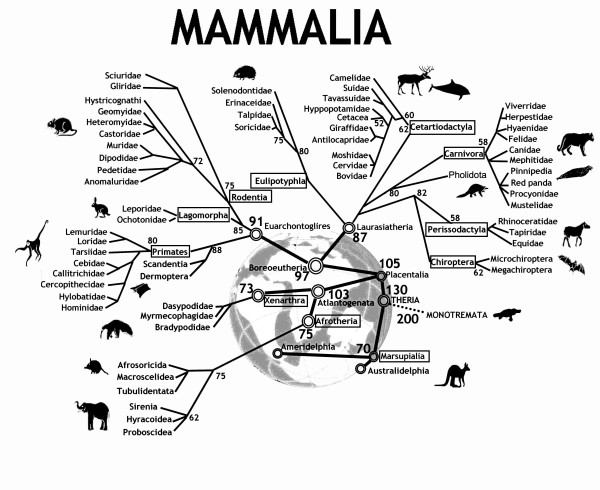
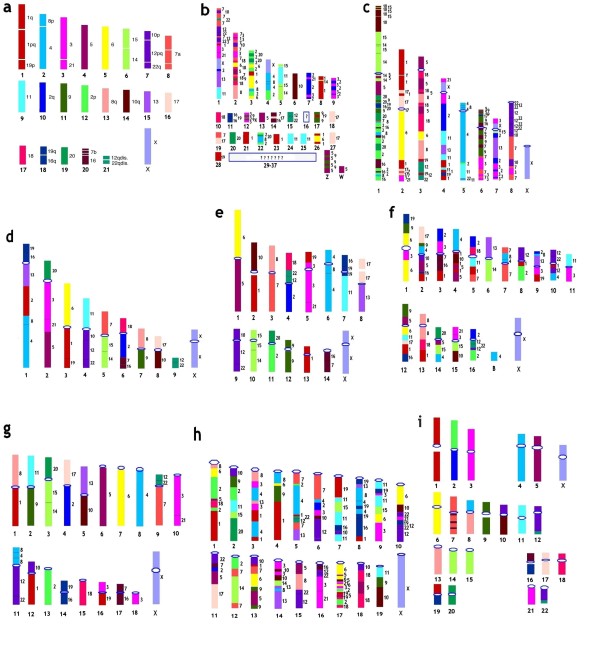
The past decade has witnessed an explosion of genome sequencing and mapping in evolutionary diverse species. While full genome sequencing of mammals is rapidly progressing, the ability to assemble and align orthologous whole chromosome regions from more than a few species is still not possible. The intense focus on building of comparative maps for companion (dog and cat), laboratory (mice and rat) and agricultural (cattle, pig, and horse) animals has traditionally been used as a means to understand the underlying basis of disease-related or economically important phenotypes. However, these maps also provide an unprecedented opportunity to use multispecies analysis as a tool for inferring karyotype evolution. Comparative chromosome painting and related techniques are now considered to be the most powerful approaches in comparative genome studies. Homologies can be identified with high accuracy using molecularly defined DNA probes for fluorescence in situ hybridization (FISH) on chromosomes of different species. Chromosome painting data are now available for members of nearly all mammalian orders. In most orders, there are species with rates of chromosome evolution that can be considered as 'default' rates. The number of rearrangements that have become fixed in evolutionary history seems comparatively low, bearing in mind the 180 million years of the mammalian radiation. Comparative chromosome maps record the history of karyotype changes that have occurred during evolution. The aim of this review is to provide an overview of these recent advances in our endeavor to decipher the karyotype evolution of mammals by integrating the published results together with some of our latest unpublished results.
在过去十年中,进化上多样的物种的基因组测序和图谱绘制出现了爆发式增长。虽然哺乳动物的全基因组测序进展迅速,但仍无法从多个物种中组装和比对直系同源的全染色体区域。传统上,对伴侣动物(狗和猫)、实验动物(小鼠和大鼠)以及家畜(牛、猪和马)构建比较图谱的高度关注一直被用作理解疾病相关或经济上重要表型的潜在基础的一种手段。然而,这些图谱也提供了一个前所未有的机会,可将多物种分析用作推断核型进化的工具。比较染色体涂染及相关技术现在被认为是比较基因组研究中最强大的方法。使用分子定义的DNA探针进行荧光原位杂交(FISH),可以在不同物种的染色体上高精度地鉴定同源性。现在几乎所有哺乳动物目成员的染色体涂染数据都已可得。在大多数目中,都有染色体进化速率可被视为“默认”速率的物种。考虑到哺乳动物辐射演化的1.8亿年历史,在进化史上固定下来的重排数量似乎相对较少。比较染色体图谱记录了进化过程中发生的核型变化历史。本综述的目的是通过整合已发表的结果以及我们一些最新未发表的结果,概述我们在解读哺乳动物核型进化方面的这些最新进展。