Mapi Values, Bollington, Cheshire, UK.
Health Qual Life Outcomes. 2011 Oct 12;9:88. doi: 10.1186/1477-7525-9-88.
Bone metastases are a common painful and debilitating consequence of castration-resistant prostate cancer (CPRC). Bone pain may predict patients' prognosis and there is a need to further explore CRPC patients' experiences of bone pain in the overall context of disease pathology. Due to the subjective nature of pain, assessments of pain severity, onset and progression are reliant on patient assessment. Patient reported outcome (PRO) measures, therefore, are commonly used as key endpoints for evaluating the efficacy of CRPC treatments. Evidence of the content validity of leading PRO measures of pain severity used in CRPC clinical trials is, however, limited.
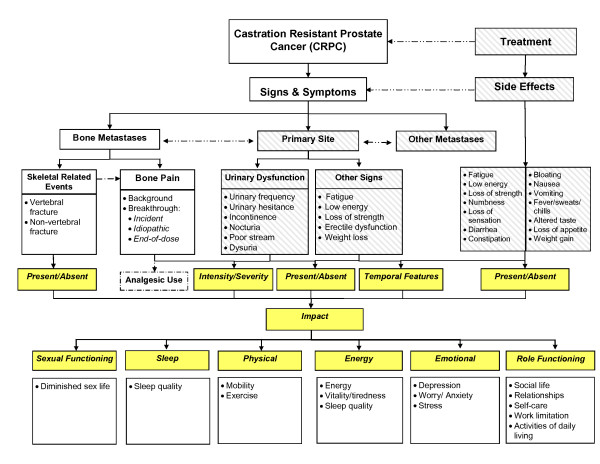
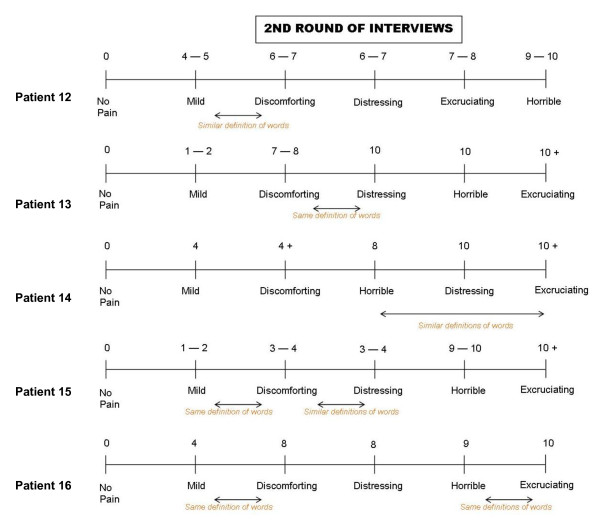
To document patients' experience of CRPC symptoms including pain, and their impact on health-related quality of life (HRQL), semi-structured in-depth qualitative interviews were conducted with 17 patients with CRPC and bone metastases. The content validity of the Present Pain Intensity (PPI) scale from the McGill Pain Questionnaire (MPQ), and the 'Average Pain' and 'Worst Pain' items of the Brief Pain Inventory Short-Form (BPI-SF) was also assessed.
Patients with CRPC and bone metastases present with a constellation of symptoms that can have a profound effect on HRQL. For patients in this study, bone pain was the most prominent and debilitating symptom associated with their condition. Bone pain was chronic and, despite being generally well-managed by analgesic medication, instances of breakthrough cancer pain (BTcP) were common. Cognitive debriefing of the selected PRO measures of pain severity highlighted difficulties among patients in understanding the verbal response scale (VRS) of the MPQ PPI scale. There were also some inconsistencies in the way in which the BPI-SF 'Average Pain' item was interpreted by patients. In contrast, the BPI-SF 'Worst Pain' item was well understood and interpreted consistently among patients.
Study findings support the importance of PRO measures of pain severity as key endpoints for evaluating the efficacy of treatments for CRPC, particularly for patients with bone metastases where episodes of BTcP are common. Qualitative evidence from CRPC patients supports the content validity of the BPI-SF ''Worst Pain' item and promotes use of this item for measuring pain severity in this population.
骨转移是去势抵抗性前列腺癌(CPRC)的一种常见的痛苦且使人虚弱的后果。骨痛可能预示着患者的预后,因此需要进一步探讨 CRPC 患者在疾病病理的整体背景下的骨痛体验。由于疼痛具有主观性,因此对疼痛严重程度、发作和进展的评估依赖于患者的评估。因此,患者报告的结果(PRO)测量通常被用作评估 CRPC 治疗效果的关键终点。然而,用于评估 CRPC 临床试验中疼痛严重程度的主要 PRO 测量的内容有效性的证据有限。
为了记录 CRPC 患者的症状(包括疼痛)的体验及其对健康相关生活质量(HRQL)的影响,对 17 名患有 CRPC 和骨转移的患者进行了半结构化深入定性访谈。还评估了 McGill 疼痛问卷(MPQ)中的现有疼痛强度(PPI)量表和简短疼痛量表(BPI-SF)的“平均疼痛”和“最痛”项目的内容有效性。
患有 CRPC 和骨转移的患者表现出一系列症状,这些症状会对 HRQL 产生深远影响。对于本研究中的患者,骨痛是与病情相关的最突出和使人虚弱的症状。骨痛是慢性的,尽管通常通过镇痛药物得到很好的控制,但突破性癌痛(BTcP)的发作很常见。对所选疼痛严重程度的 PRO 测量进行认知性审查突出了患者在理解 MPQ PPI 量表的语言反应量表(VRS)方面的困难。患者对 BPI-SF“平均疼痛”项目的解释也存在一些不一致之处。相比之下,患者对 BPI-SF“最痛”项目的理解和解释是一致的。
研究结果支持疼痛严重程度的 PRO 测量作为评估 CRPC 治疗效果的关键终点的重要性,特别是对于骨转移患者,他们经常出现 BTcP 发作。来自 CRPC 患者的定性证据支持 BPI-SF“最痛”项目的内容有效性,并促进在该人群中使用该项目来衡量疼痛严重程度。