Departments of Pathology and Epidemiology, GROW-School for Oncology and Developmental Biology, Maastricht University Medical Center, Maastricht, the Netherlands.
Clin Cancer Res. 2011 Dec 15;17(24):7723-31. doi: 10.1158/1078-0432.CCR-11-0990. Epub 2011 Oct 12.
Colorectal cancer (CRC) is a common cause of death worldwide. Tumor-node-metastasis-system stage is currently used to guide therapy decisions but lacks precision. Prognostic biomarkers are needed to refine stratification of patients for chemotherapy but validated biomarkers are not yet available. Recently, a SNP in a lethal-7 (let-7) miRNA complementary site (LCS6) in the KRAS 3'untranslated region was suggested to affect survival in metastatic CRC. Effects in early-stage CRC are however unknown. We studied KRAS-LCS6 genotype, hypothesizing that it might identify early-stage cases with a poor prognosis, and could potentially be used in therapy decision-making.
We studied 409 early stage, 182 stage III, and 69 stage IV cases, and 1,886 subcohort members from the Netherlands Cohort Study. KRAS-LCS6 genotype was assessed with TaqMan PCR. Kaplan-Meier analyses or Cox regression were used to assess associations between genotype and CRC risk or cause-specific survival.
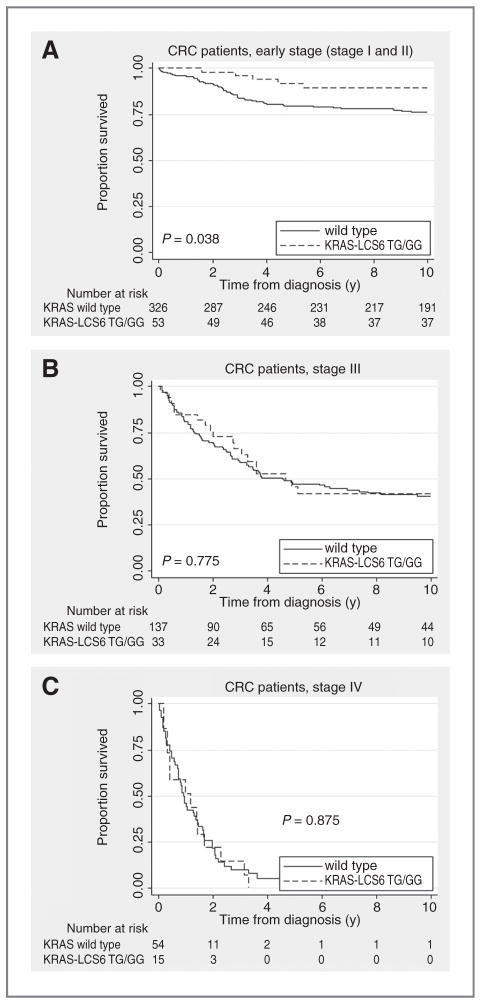
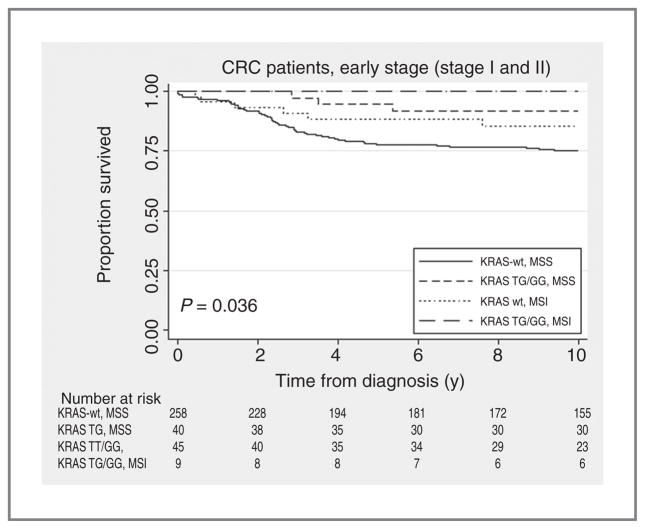
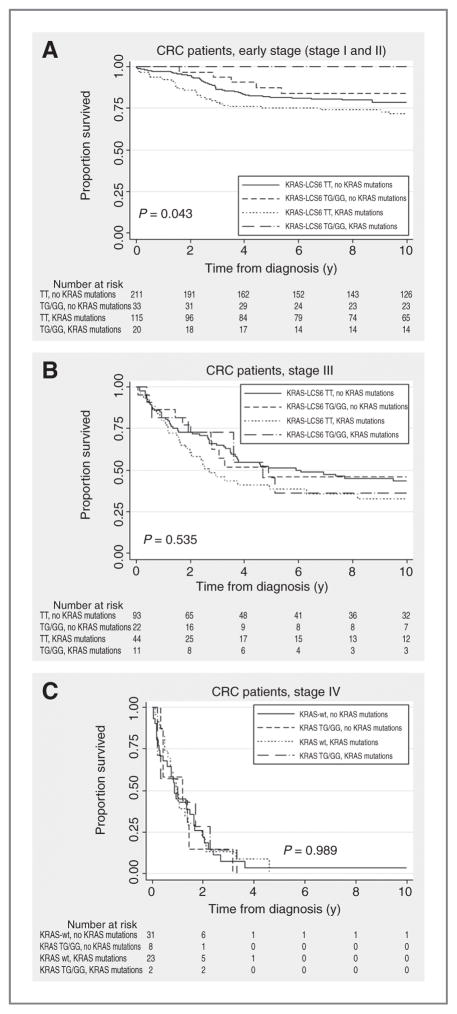
Early-stage cases with the KRAS-LCS6 variant had a lower CRC risk (incidence-rate ratio 0.68; 95% CI: 0.49-0.94) and a better survival (log-rank P = 0.038; HR 0.46; 95% CI: 0.18-1.14). In patients with KRAS-mutated CRC carrying the KRAS-LCS6 variant, the better outcome was enhanced as no patients died of CRC (log-rank P = 0.017). In advanced patients, no clear association between genotype and CRC risk or survival was observed.
Our results indicate that early-stage CRC cases with the KRAS-LCS6 variant have a better outcome. In advanced disease, the better outcome no longer exists. For early-stage patients, KRAS-LCS6 genotype combined with KRAS mutations merits validation as a prognostic biomarker and consideration in therapy decision-making.
结直肠癌(CRC)是全球常见的死亡原因。目前使用肿瘤-淋巴结-转移系统分期来指导治疗决策,但缺乏准确性。需要预后生物标志物来细化化疗患者的分层,但尚未有验证的生物标志物。最近,KRAS 3'非翻译区中一个致命-7(let-7)miRNA 互补位点(LCS6)的 SNP 被认为会影响转移性 CRC 的生存。然而,其在早期 CRC 中的作用尚不清楚。我们研究了 KRAS-LCS6 基因型,假设它可能识别出预后不良的早期病例,并有可能用于治疗决策。
我们研究了 409 例早期病例、182 例 III 期病例和 69 例 IV 期病例,以及来自荷兰队列研究的 1886 名亚组成员。使用 TaqMan PCR 评估 KRAS-LCS6 基因型。使用 Kaplan-Meier 分析或 Cox 回归分析评估基因型与 CRC 风险或特定原因生存之间的关系。
携带 KRAS-LCS6 变体的早期病例 CRC 风险较低(发病率比 0.68;95%CI:0.49-0.94),生存更好(对数秩 P = 0.038;HR 0.46;95%CI:0.18-1.14)。在携带 KRAS-LCS6 变体的 KRAS 突变型 CRC 患者中,由于没有患者死于 CRC,因此更好的结果得到了增强(对数秩 P = 0.017)。在晚期患者中,基因型与 CRC 风险或生存之间没有明显的关联。
我们的结果表明,携带 KRAS-LCS6 变体的早期 CRC 病例有更好的结果。在晚期疾病中,这种更好的结果不再存在。对于早期患者,KRAS-LCS6 基因型结合 KRAS 突变值得作为预后生物标志物进行验证,并考虑在治疗决策中使用。