Kim Sua, Jo Chor Ho, Park Joon-Sung, Han Ho Jae, Kim Gheun-Ho
Department of Internal Medicine, Hanyang University College of Medicine, Seoul, Korea.
Electrolyte Blood Press. 2011 Jun;9(1):7-15. doi: 10.5049/EBP.2011.9.1.7. Epub 2011 Jun 30.
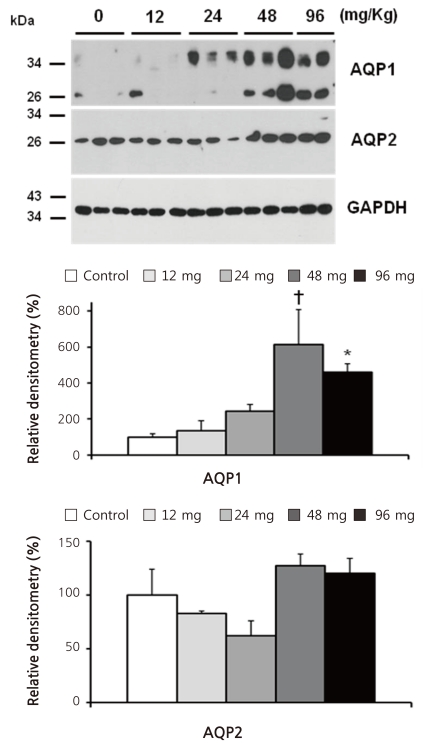
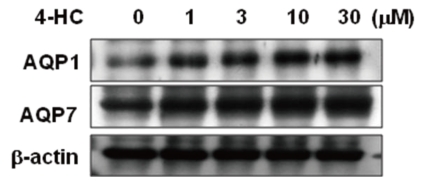
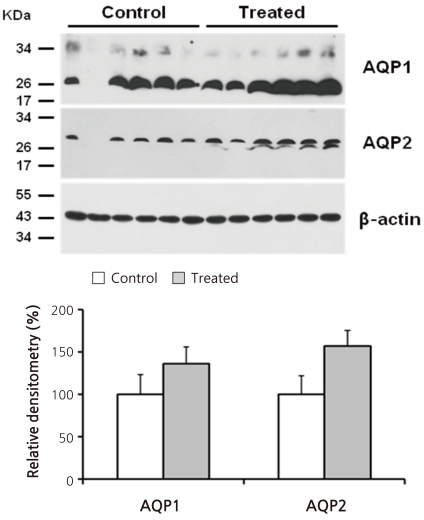
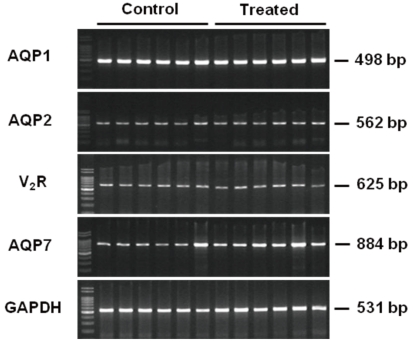
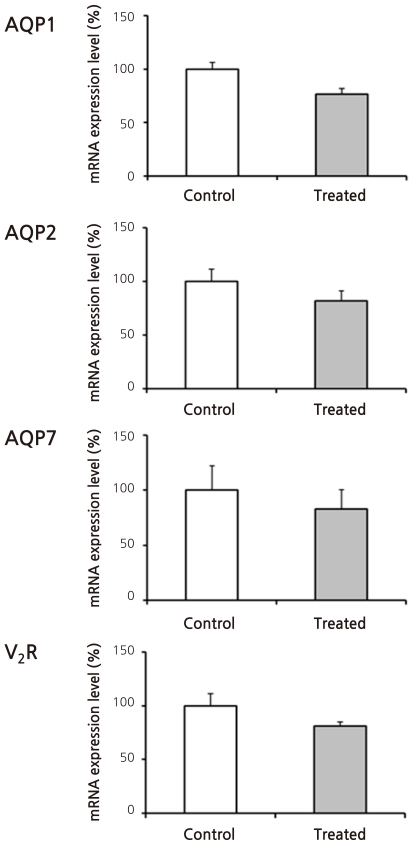
Cyclophosphamide is clinically useful in treating malignancy and rheumatologic disease, but has limitations in that it induces hyponatremia. The mechanisms by which cyclophosphamide induces water retention in the kidney have yet to be identified. This study was undertaken to test the hypothesis that cyclophosphamide may produce water retention via the proximal nephron, where aquaporin-1 (AQP1) and aquaporin-7 (AQP7) water channels participate in water absorption. To test this hypothesis, we gave a single dose of intraperitoneal cyclophosphamide to male Sprague-Dawley rats and treated rabbit proximal tubule cells (PTCs) with 4-hydroperoxycyclophosphamide (4-HC), an active metabolite of cyclophosphamide. In the short-term 3-day rat study, AQP1 protein expression was significantly increased in the whole kidney homogenates by cyclophosphamide administration at 48 (614 ± 194%, P < 0.005), and 96 (460 ± 46%, P < 0.05) mg/kg BW compared with vehicle-treated controls. Plasma sodium concentration was significantly decreased (143 ± 1 vs. 146 ± 1 mEq/L, P < 0.05) by cyclophosphamide 100 mg/kg BW in the long-term 6-day rat study. When primary cultured rabbit PTCs were treated with 4-HC for 24 hours, the protein expressions of AQP1 and AQP7 were increased in a dose-dependent manner. Quantitative polymerase chain reaction revealed no significant changes in the mRNA levels of AQP1 and AQP7 from cyclophosphamide-treated rat renal cortices. From these preliminary data, we conclude that the proximal nephron may be involved in cyclophosphamide-induced water retention via AQP1 and AQP7 water channels. Further studies are required to demonstrate intracellular mechanisms that affect the expression of AQP proteins.
环磷酰胺在临床上可用于治疗恶性肿瘤和风湿性疾病,但存在局限性,即它会诱发低钠血症。环磷酰胺在肾脏中诱导水潴留的机制尚未明确。本研究旨在检验以下假设:环磷酰胺可能通过近端肾单位产生水潴留,水通道蛋白-1(AQP1)和水通道蛋白-7(AQP7)水通道参与近端肾单位的水吸收。为验证这一假设,我们给雄性Sprague-Dawley大鼠腹腔注射单剂量环磷酰胺,并使用环磷酰胺的活性代谢产物4-氢过氧环磷酰胺(4-HC)处理兔近端小管细胞(PTCs)。在为期3天的短期大鼠研究中,与给予赋形剂的对照组相比,给予48(614±194%,P<0.005)和96(460±46%,P<0.05)mg/kg体重的环磷酰胺后,全肾匀浆中AQP1蛋白表达显著增加。在为期6天的长期大鼠研究中,100mg/kg体重的环磷酰胺使血浆钠浓度显著降低(143±1对146±1mEq/L,P<0.05)。当原代培养的兔PTCs用4-HC处理24小时时,AQP1和AQP7的蛋白表达呈剂量依赖性增加。定量聚合酶链反应显示,环磷酰胺处理的大鼠肾皮质中AQP1和AQP7的mRNA水平无显著变化。根据这些初步数据,我们得出结论,近端肾单位可能通过AQP1和AQP7水通道参与环磷酰胺诱导的水潴留。需要进一步研究来证明影响AQP蛋白表达的细胞内机制。