NE Thames Regional Molecular Genetics Laboratories, Great Ormond Street Hospital for Children, London, United Kingdom.
PLoS One. 2011;6(10):e25202. doi: 10.1371/journal.pone.0025202. Epub 2011 Oct 4.
Cell-free fetal DNA is a source of fetal genetic material that can be used for non-invasive prenatal diagnosis. Usually constituting less than 10% of the total cell free DNA in maternal plasma, the majority is maternal in origin. Optimizing conditions for maximizing yield of cell-free fetal DNA will be crucial for effective implementation of testing. We explore factors influencing yield of fetal DNA from maternal blood samples, including assessment of collection tubes containing cell-stabilizing agents, storage temperature, interval to sample processing and DNA extraction method used.
Microfluidic digital PCR was performed to precisely quantify male (fetal) DNA, total DNA and long DNA fragments (indicative of maternal cellular DNA). Real-time qPCR was used to assay for the presence of male SRY signal in samples.
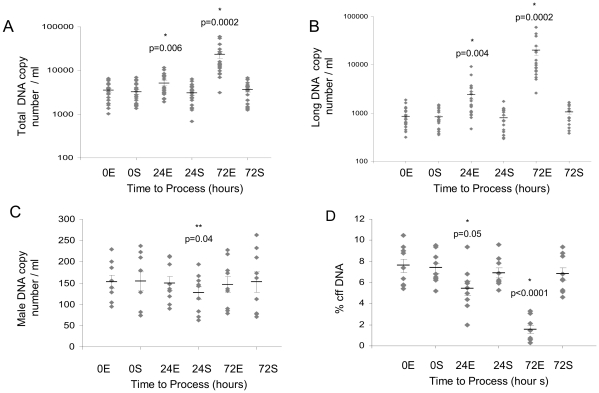
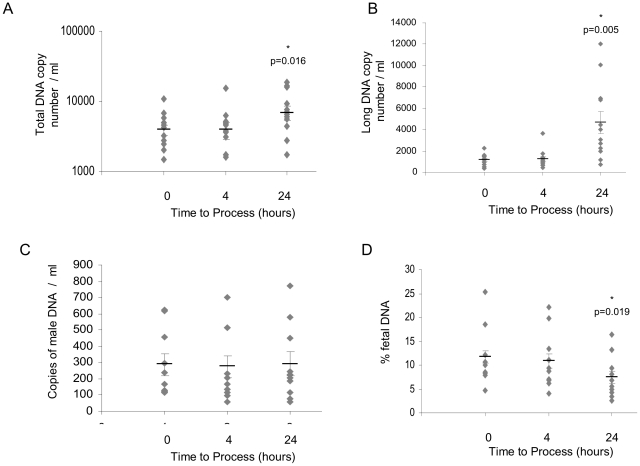
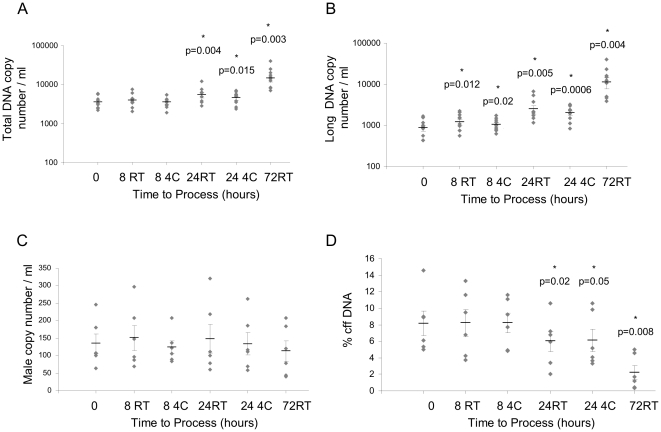
Total cell-free DNA quantity increased significantly with time in samples stored in K(3)EDTA tubes, but only minimally in cell stabilizing tubes. This increase was solely due to the presence of additional long fragment DNA, with no change in quantity of fetal or short DNA, resulting in a significant decrease in proportion of cell-free fetal DNA over time. Storage at 4 °C did not prevent these changes.
When samples can be processed within eight hours of blood draw, K(3)EDTA tubes can be used. Prolonged transfer times in K(3)EDTA tubes should be avoided as the proportion of fetal DNA present decreases significantly; in these situations the use of cell stabilising tubes is preferable. The DNA extraction kit used may influence success rate of diagnostic tests.
游离胎儿 DNA 是一种胎儿遗传物质的来源,可以用于非侵入性产前诊断。通常在母体血浆中游离 DNA 总量中所占比例不到 10%,大多数来自母体。优化条件以最大限度地提高游离胎儿 DNA 的产量对于有效实施检测至关重要。我们探讨了影响从母体血液样本中获得胎儿 DNA 产量的因素,包括评估含有细胞稳定剂的采集管、储存温度、样本处理时间间隔以及使用的 DNA 提取方法。
采用微流控数字 PCR 精确定量雄性(胎儿)DNA、总 DNA 和长 DNA 片段(提示母体细胞 DNA)。采用实时 qPCR 检测样本中男性 SRY 信号的存在。
在 K(3)EDTA 管中储存的样本中,总游离 DNA 数量随时间显著增加,但在细胞稳定管中仅略有增加。这种增加仅仅是由于额外的长片段 DNA 的存在,而胎儿或短 DNA 的数量没有变化,导致游离胎儿 DNA 的比例随时间显著下降。4°C 储存并不能防止这些变化。
当样本可以在采血后八小时内处理时,可以使用 K(3)EDTA 管。应避免 K(3)EDTA 管中转送时间延长,因为存在的胎儿 DNA 比例会显著下降;在这种情况下,使用细胞稳定剂管更为可取。使用的 DNA 提取试剂盒可能会影响诊断测试的成功率。