Bohmova Jana, Lubusky Marek, Holuskova Iva, Studnickova Martina, Kratochvilova Romana, Krejcirikova Eva, Durdova Veronika, Kratochvilova Tereza, Dusek Ladislav, Prochazka Martin, Vodicka Radek
Department of Medical Genetics, University Hospital Olomouc and Faculty of Medicine and Dentistry, Palacky University Olomouc, 775 20 Olomouc, Czech Republic.
Department of Obstetrics and Gynecology, University Hospital Olomouc and Faculty of Medicine and Dentistry, Palacky University Olomouc, 775 20 Olomouc, Czech Republic.
Diagnostics (Basel). 2020 Aug 5;10(8):564. doi: 10.3390/diagnostics10080564.
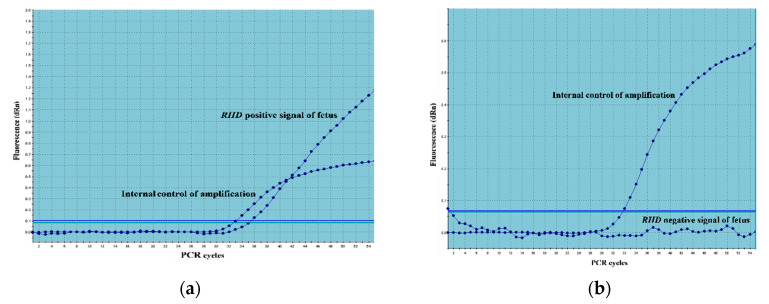
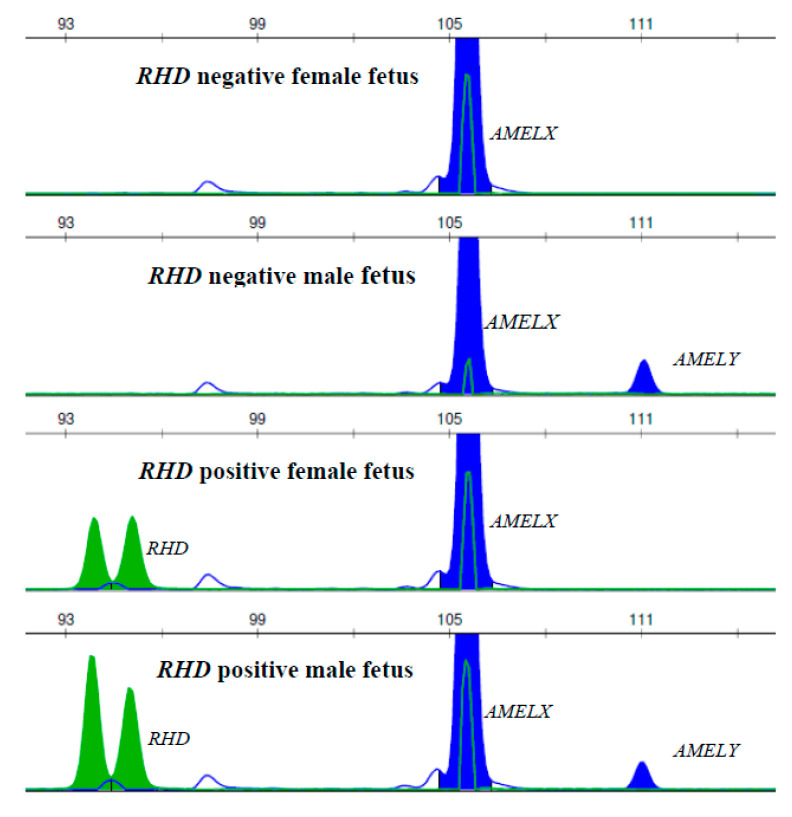
Noninvasive fetal genotyping is an important tool for predicting RhD incompatibility between a pregnant woman and a fetus. This study aimed to assess a methodological approach other than the commonly used one for noninvasive fetal genotyping on a representative set of RhD-negative pregnant women. The methodology must be accurate, reliable, and broadly available for implementation into routine clinical practice. A total of 337 RhD-negative pregnant women from the Czech Republic region were tested in this study. The fetal genotype was assessed using two methods: real-time PCR and endpoint quantitative fluorescent (QF) PCR. We used exon-7-specific primers from the gene, along with internal controls. Plasma samples were analyzed and measured in four/two parallel reactions to determine the accuracy of the genotyping. The genotype was verified using DNA analysis from a newborn buccal swab. Both methods showed an excellent ability to predict the genotype. Real-time PCR achieved its greatest accuracy of 98.6% (97.1% sensitivity and 100% specificity (95% CI)) if all four PCRs were positive/negative. The QF PCR method also achieved its greatest accuracy of 99.4% (100% sensitivity and 98.6% specificity (95% CI)) if all the measurements were positive/negative. Both real-time PCR and QF PCR were reliable methods for precisely assessing the fetal allele from the plasma of RhD-negative pregnant women.
无创胎儿基因分型是预测孕妇与胎儿之间RhD血型不相容性的重要工具。本研究旨在评估一种不同于常用方法的无创胎儿基因分型方法,用于一组具有代表性的RhD阴性孕妇。该方法必须准确、可靠,并且广泛适用于常规临床实践。本研究共检测了来自捷克共和国地区的337名RhD阴性孕妇。使用两种方法评估胎儿基因型:实时荧光定量PCR和终点定量荧光(QF)PCR。我们使用了该基因的外显子7特异性引物以及内部对照。对血浆样本进行四/两个平行反应分析和测量,以确定基因分型的准确性。通过新生儿口腔拭子的DNA分析验证基因型。两种方法都显示出预测基因型的出色能力。如果所有四个PCR均为阳性/阴性,实时荧光定量PCR的最大准确率为98.6%(敏感性为97.1%,特异性为100%(95%CI))。如果所有测量均为阳性/阴性,QF PCR方法的最大准确率也为99.4%(敏感性为100%,特异性为98.6%(95%CI))。实时荧光定量PCR和QF PCR都是从RhD阴性孕妇血浆中精确评估胎儿等位基因的可靠方法。