Institute of Biomedical Engineering, National Taiwan University, Taipei, Taiwan.
PLoS One. 2011;6(10):e25928. doi: 10.1371/journal.pone.0025928. Epub 2011 Oct 5.
Electrotaxis is the movement of adherent living cells in response to a direct current (dc) electric field (EF) of physiological strength. Highly metastatic human lung cancer cells, CL1-5, exhibit directional migration and orientation under dcEFs. To understand the transcriptional response of CL1-5 cells to a dcEF, microarray analysis was performed in this study.
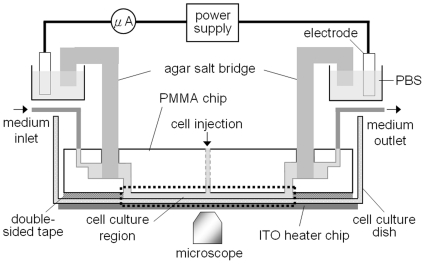
METHODOLOGY/PRINCIPAL FINDINGS: A large electric-field chip (LEFC) was designed, fabricated, and used in this study. CL1-5 cells were treated with the EF strength of 0 mV/mm (the control group) and 300 mV/mm (the EF-treated group) for two hours. Signaling pathways involving the genes that expressed differently between the two groups were revealed. It was shown that the EF-regulated genes highly correlated to adherens junction, telomerase RNA component gene regulation, and tight junction. Some up-regulated genes such as ACVR1B and CTTN, and some down-regulated genes such as PTEN, are known to be positively and negatively correlated to cell migration, respectively. The protein-protein interactions of adherens junction-associated EF-regulated genes suggested that platelet-derived growth factor (PDGF) receptors and ephrin receptors may participate in sensing extracellular electrical stimuli. We further observed a high percentage of significantly regulated genes which encode cell membrane proteins, suggesting that dcEF may directly influence the activity of cell membrane proteins in signal transduction.
CONCLUSIONS/SIGNIFICANCE: In this study, some of the EF-regulated genes have been reported to be essential whereas others are novel for electrotaxis. Our result confirms that the regulation of gene expression is involved in the mechanism of electrotactic response.
电趋性是指贴壁活细胞对生理强度的直流(dc)电场(EF)的运动。高转移性人肺癌细胞 CL1-5 在 dcEF 下表现出定向迁移和定向。为了了解 CL1-5 细胞对 dcEF 的转录反应,本研究进行了微阵列分析。
方法/主要发现:本研究设计、制造和使用了大型电场芯片(LEFC)。CL1-5 细胞用 0 mV/mm(对照组)和 300 mV/mm(EF 处理组)的电场强度处理两小时。揭示了两组间表达不同的基因所涉及的信号通路。结果表明,EF 调节的基因与黏着连接、端粒酶 RNA 成分基因调控和紧密连接高度相关。一些上调基因,如 ACVR1B 和 CTTN,以及一些下调基因,如 PTEN,分别已知与细胞迁移呈正相关和负相关。黏着连接相关 EF 调节基因的蛋白质-蛋白质相互作用表明血小板衍生生长因子(PDGF)受体和 Ephrin 受体可能参与感知细胞外电刺激。我们进一步观察到相当一部分显著调节的基因编码细胞膜蛋白,表明 dcEF 可能直接影响信号转导中细胞膜蛋白的活性。
结论/意义:在这项研究中,一些被报道为电趋性所必需的 EF 调节基因,而另一些则是新的。我们的结果证实,基因表达的调节参与了电趋反应的机制。