National Neurological Institute, C Mondino Foundation, Pavia, Italy.
BMC Neurol. 2011 Oct 14;11:125. doi: 10.1186/1471-2377-11-125.
Conventional magnetic resonance imaging (MRI) has improved the diagnosis and monitoring of multiple sclerosis (MS). In clinical trials, MRI has been found to detect treatment effects with greater sensitivity than clinical measures; however, clinical and MRI outcomes tend to correlate poorly.
In this observational study, patients (n = 550; 18-50 years; relapsing-remitting MS [Expanded Disability Status Scale score ≤4.0]) receiving interferon (IFN) β-1a therapy (44 or 22 µg subcutaneously [sc] three times weekly [tiw]) underwent standardized MRI, neuropsychological and quality-of-life (QoL) assessments over 3 years. In this post hoc analysis, MRI outcomes and correlations between MRI parameters and clinical and functional outcomes were analysed.
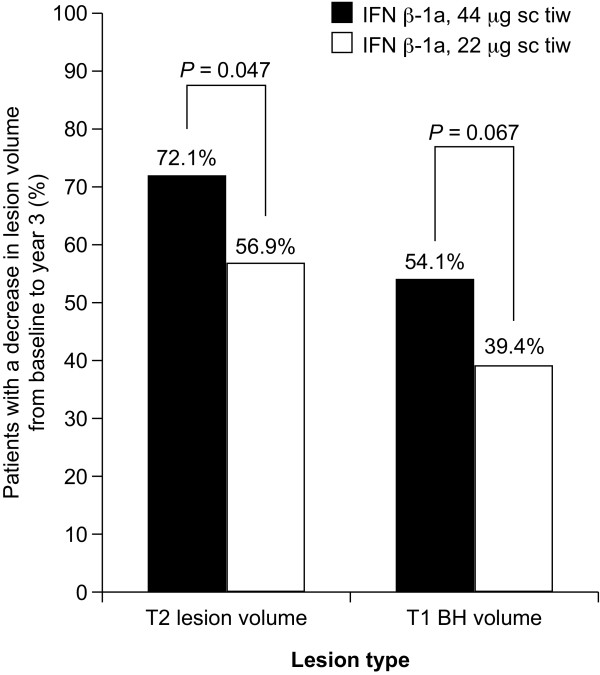
MRI data over 3 years were available for 164 patients. T2 lesion and T1 gadolinium-enhancing (Gd+) lesion volumes, but not black hole (BH) volumes, decreased significantly from baseline to Year 3 (P < 0.0001). Percentage decreases (baseline to Year 3) were greater with the 44 μg dose than with the 22 μg dose for T2 lesion volume (-10.2% vs -4.5%, P = 0.025) and T1 BH volumes (-7.8% vs +10.3%, P = 0.002). A decrease in T2 lesion volume over 3 years predicted stable QoL over the same time period. Treatment with IFN β-1a, 44 μg sc tiw, predicted an absence of cognitive impairment at Year 3.
Subcutaneous IFN β-1a significantly decreased MRI measures of disease, with a significant benefit shown for the 44 µg over the 22 µg dose; higher-dose treatment also predicted better cognitive outcomes over 3 years.
常规磁共振成像(MRI)提高了多发性硬化症(MS)的诊断和监测水平。临床试验发现,MRI 在检测治疗效果方面比临床指标更为敏感;然而,临床和 MRI 结果往往相关性较差。
在这项观察性研究中,接受干扰素(IFN)β-1a 治疗(44 或 22 µg 皮下[sc]每周三次[tiw])的患者(n = 550;18-50 岁;复发缓解型 MS [扩展残疾状况量表评分≤4.0])接受了标准化 MRI、神经心理学和生活质量(QoL)评估,为期 3 年。在这项事后分析中,分析了 MRI 结果以及 MRI 参数与临床和功能结果之间的相关性。
3 年内有 164 名患者可获得 MRI 数据。T2 病变和 T1 钆增强(Gd+)病变体积,而不是黑洞(BH)体积,从基线到第 3 年显著减少(P < 0.0001)。与 22 μg 剂量相比,44 μg 剂量的 T2 病变体积(-10.2%比-4.5%,P = 0.025)和 T1 BH 体积(-7.8%比+10.3%,P = 0.002)的减少百分比更大。3 年内 T2 病变体积的减少可预测同一时间段内 QoL 的稳定。IFN β-1a 治疗,44 μg sc tiw,可预测第 3 年无认知障碍。
皮下 IFN β-1a 可显著降低 MRI 疾病指标,44 µg 剂量的疗效明显优于 22 µg 剂量;高剂量治疗还可预测 3 年内更好的认知结果。