Center for Applied Proteomics and Molecular Medicine, George Mason University, Manassas, Virginia 20110, USA.
J Am Chem Soc. 2011 Nov 30;133(47):19178-88. doi: 10.1021/ja207515j. Epub 2011 Nov 3.
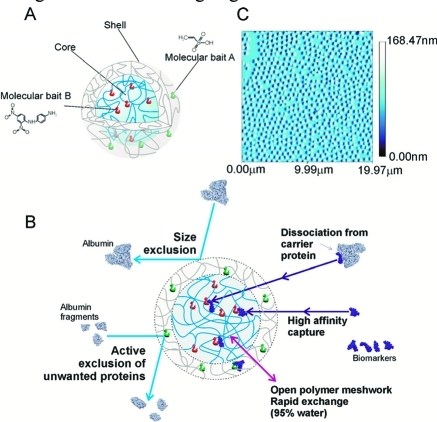
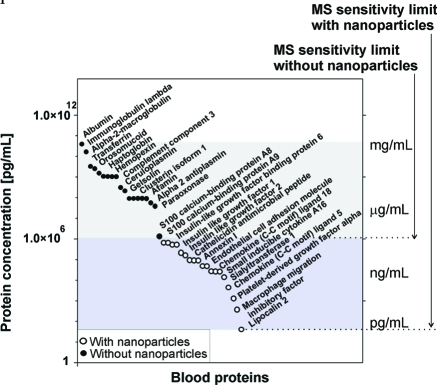
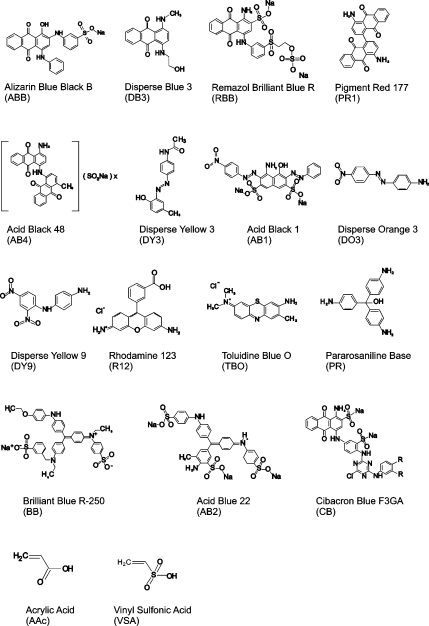
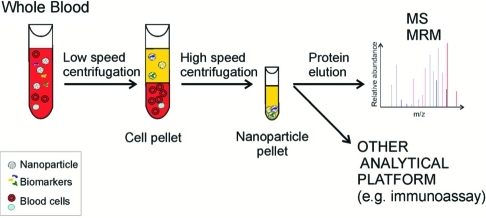
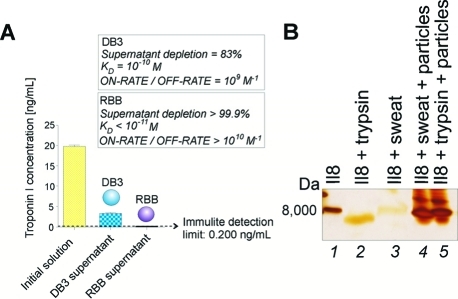
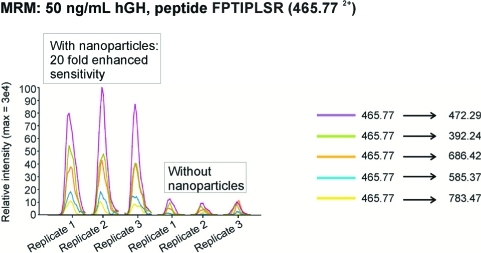
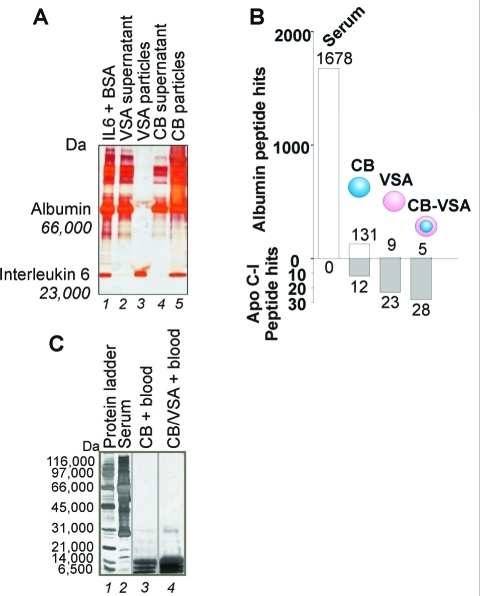
Many low-abundance biomarkers for early detection of cancer and other diseases are invisible to mass spectrometry because they exist in body fluids in very low concentrations, are masked by high-abundance proteins such as albumin and immunoglobulins, and are very labile. To overcome these barriers, we created porous, buoyant, core-shell hydrogel nanoparticles containing novel high affinity reactive chemical baits for protein and peptide harvesting, concentration, and preservation in body fluids. Poly(N-isopropylacrylamide-co-acrylic acid) nanoparticles were functionalized with amino-containing dyes via zero-length cross-linking amidation reactions. Nanoparticles functionalized in the core with 17 different (12 chemically novel) molecular baits showed preferential high affinities (K(D) < 10(-11) M) for specific low-abundance protein analytes. A poly(N-isopropylacrylamide-co-vinylsulfonic acid) shell was added to the core particles. This shell chemistry selectively prevented unwanted entry of all size peptides derived from albumin without hindering the penetration of non-albumin small proteins and peptides. Proteins and peptides entered the core to be captured with high affinity by baits immobilized in the core. Nanoparticles effectively protected interleukin-6 from enzymatic degradation in sweat and increased the effective detection sensitivity of human growth hormone in human urine using multiple reaction monitoring analysis. Used in whole blood as a one-step, in-solution preprocessing step, the nanoparticles greatly enriched the concentration of low-molecular weight proteins and peptides while excluding albumin and other proteins above 30 kDa; this achieved a 10,000-fold effective amplification of the analyte concentration, enabling mass spectrometry (MS) discovery of candidate biomarkers that were previously undetectable.
许多用于癌症和其他疾病早期检测的低丰度生物标志物在质谱分析中是不可见的,因为它们在体液中存在的浓度非常低,被高丰度的蛋白质(如白蛋白和免疫球蛋白)所掩盖,而且非常不稳定。为了克服这些障碍,我们创建了多孔、浮力、核壳水凝胶纳米粒子,其中包含用于蛋白质和肽采集、浓缩和保存的新型高亲和力反应性化学诱饵。聚(N-异丙基丙烯酰胺-co-丙烯酸)纳米粒子通过零长度交联酰胺化反应被含氨基的染料官能化。在核心中用 17 种不同的(12 种化学上新颖的)分子诱饵官能化的纳米粒子显示出对特定低丰度蛋白质分析物的优先高亲和力(K(D) < 10(-11) M)。然后将聚(N-异丙基丙烯酰胺-co-乙烯基磺酸)壳添加到核心颗粒中。这种壳化学选择性地阻止了所有源自白蛋白的肽段的不受欢迎的进入,而不阻碍非白蛋白小蛋白质和肽段的渗透。蛋白质和肽进入核心,被固定在核心中的诱饵以高亲和力捕获。纳米粒子有效地保护白细胞介素-6 免受汗液中的酶降解,并使用多重反应监测分析增加了人尿液中人生长激素的有效检测灵敏度。在全血中作为一步法、溶液预处理步骤使用时,纳米粒子极大地富集了低分子量蛋白质和肽的浓度,同时排除了 30 kDa 以上的白蛋白和其他蛋白质;这实现了分析物浓度的 10,000 倍有效放大,使质谱(MS)能够发现以前无法检测到的候选生物标志物。