CHUQ Research Center and Faculty of Medicine, Laval University, 2705 boul, Laurier, Québec, Québec G1V 4G2, Canada.
BMC Musculoskelet Disord. 2011 Oct 14;12:235. doi: 10.1186/1471-2474-12-235.
Mast cells contribute to tissue repair in fibrous tissues by stimulating proliferation of fibroblasts through the release of tryptase which activates protease-activated receptor-2 (PAR-2). The possibility that a tryptase/PAR-2 signaling pathway exists in skeletal muscle cell has never been investigated. The aim of this study was to evaluate whether tryptase can stimulate myoblast proliferation and determine the downstream cascade.
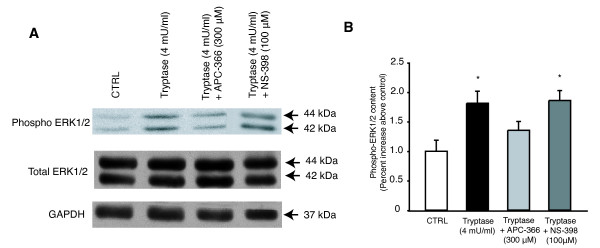
Proliferation of L6 rat skeletal myoblasts stimulated with PAR-2 agonists (tryptase, trypsin and SLIGKV) was assessed. The specificity of the tryptase effect was evaluated with a specific inhibitor, APC-366. Western blot analyses were used to evaluate the expression and functionality of PAR-2 receptor and to assess the expression of COX-2. COX-2 activity was evaluated with a commercial activity assay kit and by measurement of PGF2α production. Proliferation assays were also performed in presence of different prostaglandins (PGs).
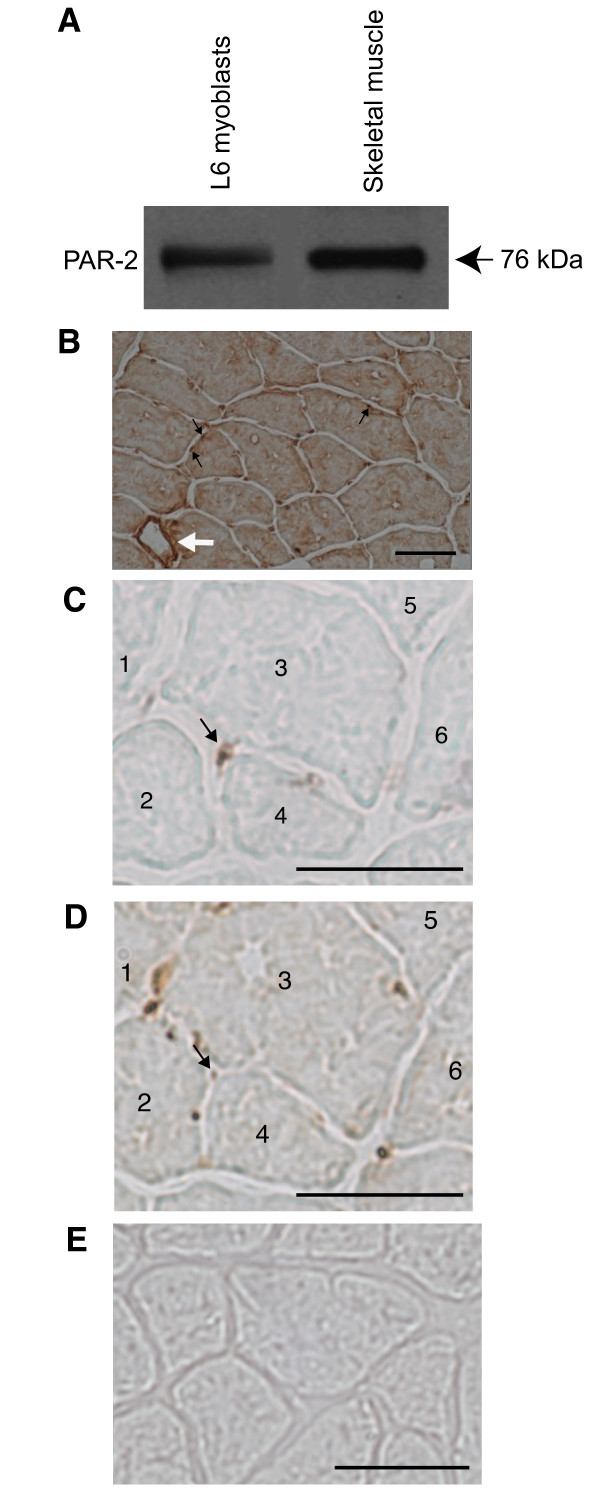
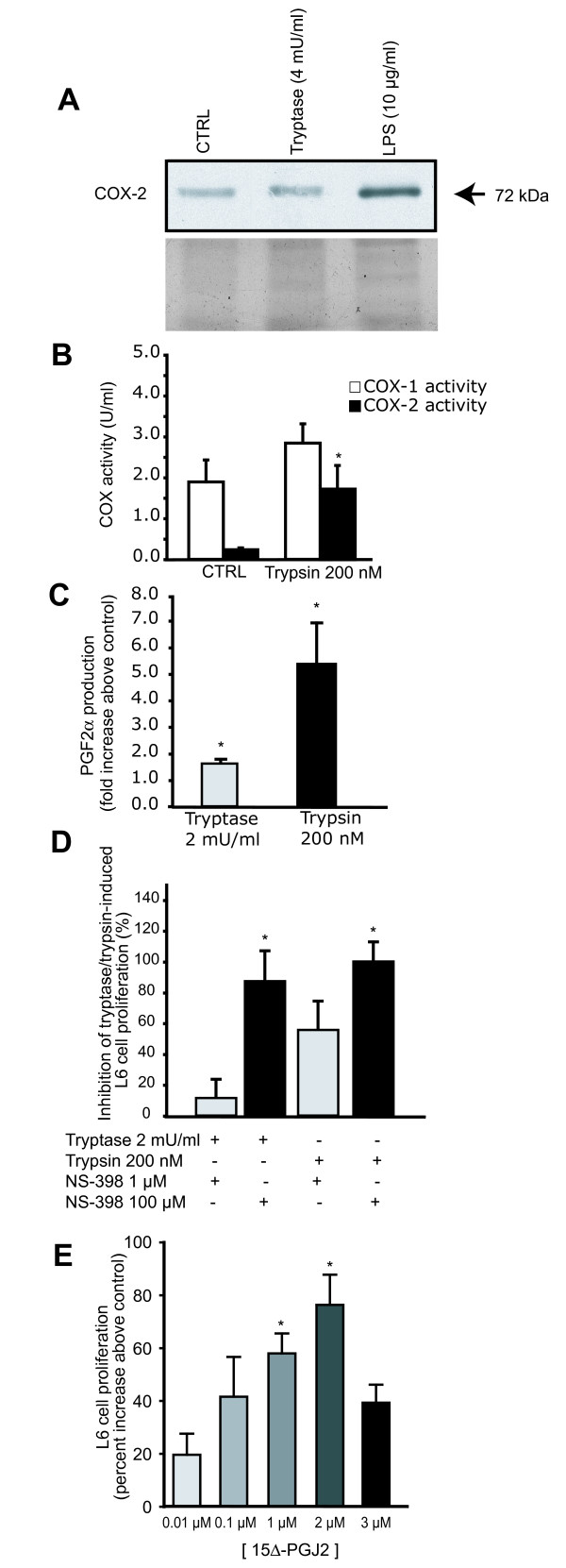
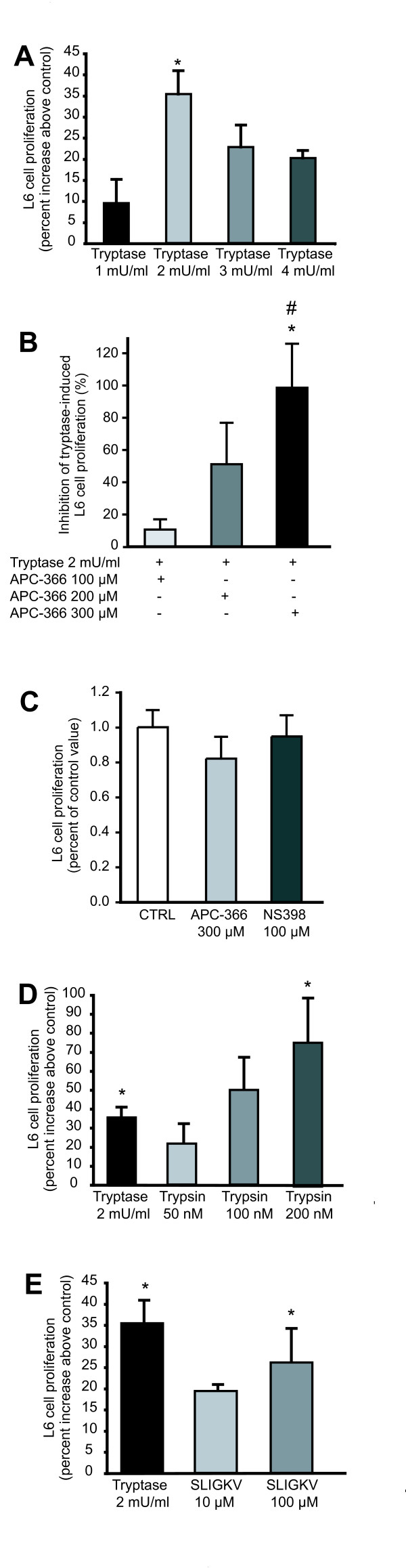
Tryptase increased L6 myoblast proliferation by 35% above control group and this effect was completely inhibited by APC-366. We confirmed the expression of PAR-2 receptor in vivo in skeletal muscle cells and in satellite cells and in vitro in L6 cells, where PAR-2 was found to be functional. Trypsin and SLIGKV increased L6 cells proliferation by 76% and 26% above control, respectively. COX-2 activity was increased following stimulation with PAR-2 agonist but its expression remained unchanged. Inhibition of COX-2 activity by NS-398 abolished the stimulation of cell proliferation induced by tryptase and trypsin. Finally, 15-deoxy-Δ-12,14-prostaglandin J2 (15Δ-PGJ2), a product of COX-2-derived prostaglandin D2, stimulated myoblast proliferation, but not PGE2 and PGF2α.
Taken together, our data show that tryptase can stimulate myoblast proliferation and this effect is part of a signaling cascade dependent on PAR-2 activation and on the downstream activation of COX-2.
肥大细胞通过释放激活蛋白酶激活受体-2(PAR-2)的胰蛋白酶刺激成纤维细胞增殖,从而有助于纤维组织中的组织修复。肥大细胞是否存在于骨骼肌细胞中的胰蛋白酶/PAR-2 信号通路尚未得到研究。本研究旨在评估胰蛋白酶是否可以刺激成肌细胞增殖,并确定下游级联反应。
评估 PAR-2 激动剂(胰蛋白酶、胰蛋白酶和 SLIGKV)刺激 L6 大鼠骨骼肌成肌细胞增殖的情况。使用特异性抑制剂 APC-366 评估胰蛋白酶作用的特异性。使用 Western blot 分析评估 PAR-2 受体的表达和功能,并评估 COX-2 的表达。通过商业活性测定试剂盒和 PGF2α 产生的测量评估 COX-2 活性。还在存在不同前列腺素(PG)的情况下进行了增殖测定。
胰蛋白酶使 L6 成肌细胞增殖比对照组增加 35%,而 APC-366 可完全抑制这种作用。我们在体内骨骼肌细胞和卫星细胞中证实了 PAR-2 受体的表达,在体外 L6 细胞中证实了 PAR-2 受体的功能性。胰蛋白酶和 SLIGKV 使 L6 细胞的增殖比对照组分别增加 76%和 26%。PAR-2 激动剂刺激后 COX-2 活性增加,但表达不变。COX-2 活性抑制通过 NS-398 消除了胰蛋白酶和胰蛋白酶诱导的细胞增殖的刺激。最后,15-去氧-Δ-12,14-前列腺素 J2(15Δ-PGJ2),一种 COX-2 衍生的前列腺素 D2 的产物,刺激成肌细胞增殖,但不刺激 PGE2 和 PGF2α。
综上所述,我们的数据表明,胰蛋白酶可以刺激成肌细胞增殖,这种作用是依赖于 PAR-2 激活和下游 COX-2 激活的信号级联的一部分。