Purokivi Minna, Koskela Heikki, Brannan John D, Kontra Kirsi
Department of Respiratory Medicine, Kuopio University Hospital, P,O, Box 1777, 70211 Kuopio, Finland.
Cough. 2011 Oct 14;7(1):8. doi: 10.1186/1745-9974-7-8.
Mechanisms behind asthmatic cough are largely unknown. It is known that hyperosmolar challenges provoke cough in asthmatic but not in the healthy subjects. It has been postulated that isocapnic hyperpnea of dry air (IHDA) and hypertonic aerosols act via similar mechanisms in asthma to cause bronchoconstriction. We investigated whether there is an association between cough response induced by IHDA and hypertonic saline (HS) challenges.
Thirty-six asthmatic and 14 healthy subjects inhaled HS solutions with increasing osmolalities administered via ultrasonic nebuliser until 15 cumulative coughs were recorded. The IHDA consisted of three three-minute ventilation steps: 30%, 60% and 100% of maximal voluntary ventilation with an end-point of 30 cumulative coughs. The challenges were performed on separate days at least 48 hours between them and within one week. Inhaled salbutamol (400 mcg) was administered before the challenges to prevent bronchoconstriction. The cough response was expressed as the cough-to-dose ratio (CDR) which is the total number of coughs divided by the maximal osmolality inhaled or the maximal ventilation achieved.
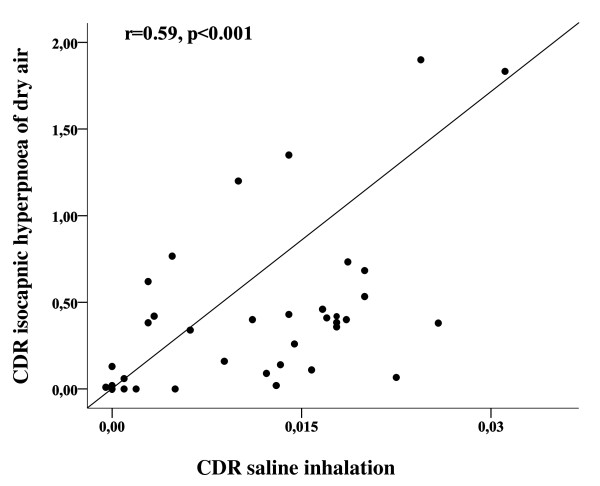
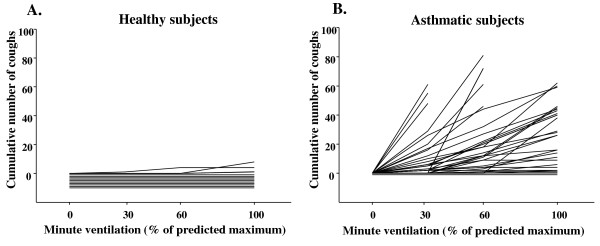
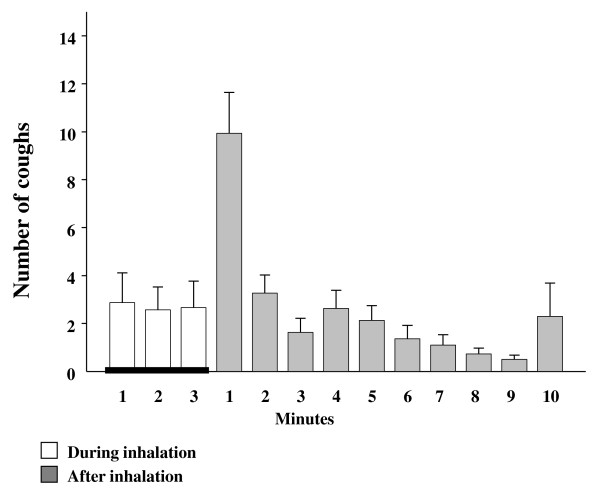
Cough response to IHDA correlated with the HS challenge (Rs = 0.59, p < 0.001). Cough response to IHDA was at its strongest during the first minute after the challenge. IHDA induced more cough among asthmatic than healthy subjects CDR being (mean ± SD) 0.464 ± 0.514 and 0.011 ± 0.024 coughs/MVV%, p < 0.001, respectively. Salbutamol effectively prevented bronchoconstriction to both challenges.
Asthmatic patients are hypersensitive to the cough-provoking effect of hyperpnoea, as they are to hypertonicity. Cough response induced by IHDA and HS correlated well suggesting similar mechanisms behind the responses.
哮喘性咳嗽背后的机制在很大程度上尚不清楚。已知高渗刺激会引发哮喘患者的咳嗽,但健康受试者不会。据推测,干燥空气等碳酸血过度通气(IHDA)和高渗气雾剂在哮喘中通过类似机制导致支气管收缩。我们研究了IHDA诱导的咳嗽反应与高渗盐水(HS)刺激之间是否存在关联。
36名哮喘患者和14名健康受试者通过超声雾化器吸入渗透压不断增加的HS溶液,直至记录到15次累积咳嗽。IHDA包括三个三分钟的通气步骤:最大自主通气量的30%、60%和100%,终点为30次累积咳嗽。两次刺激在不同日期进行,间隔至少48小时且在一周内完成。在刺激前给予吸入沙丁胺醇(400微克)以预防支气管收缩。咳嗽反应以咳嗽与剂量比(CDR)表示,即咳嗽总数除以吸入的最大渗透压或达到的最大通气量。
对IHDA的咳嗽反应与HS刺激相关(Rs = 0.59,p < 0.001)。对IHDA的咳嗽反应在刺激后的第一分钟最强。与健康受试者相比,IHDA在哮喘患者中诱发的咳嗽更多,CDR分别为(平均值±标准差)0.464±0.514和0.011±0.024次咳嗽/最大自主通气量%,p < 0.001。沙丁胺醇有效预防了两种刺激引起的支气管收缩。
哮喘患者对过度通气的致咳作用敏感,就像他们对高渗状态敏感一样。IHDA和HS诱导的咳嗽反应相关性良好,表明反应背后的机制相似。