Department of Medicine II, Klinikum Neumarkt, Neumarkt id OPf, Germany.
J Cell Mol Med. 2012 Aug;16(8):1776-91. doi: 10.1111/j.1582-4934.2011.01473.x.
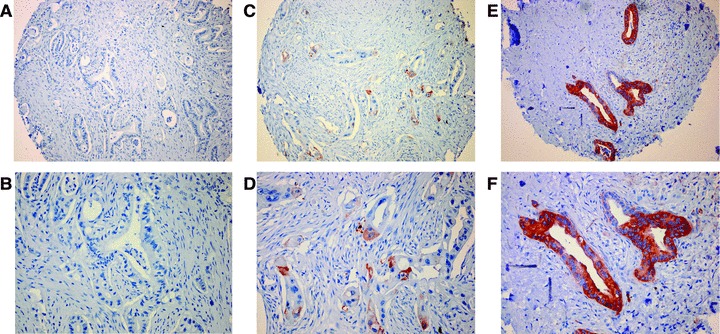
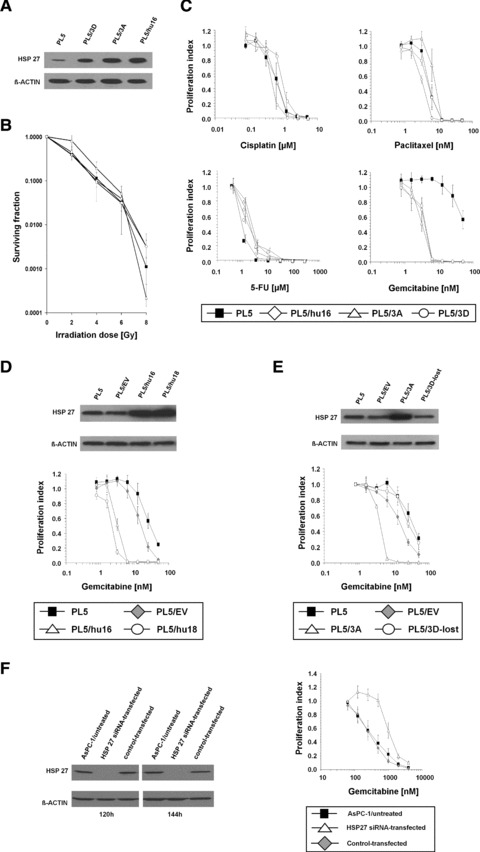
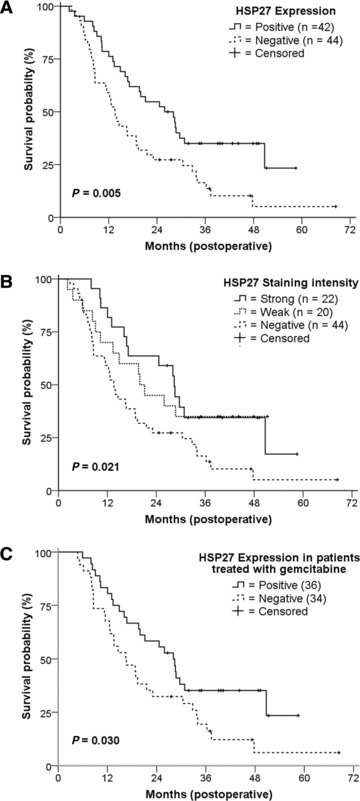
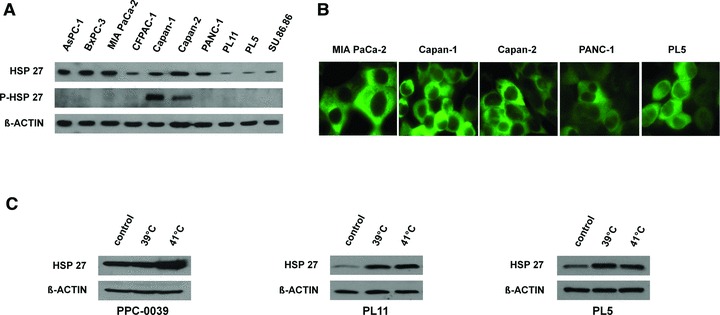
A role of heat shock protein 27 (HSP27) as a potential biomarker has been reported in various tumour entities, but comprehensive studies in pancreatic cancer are lacking. Applying tissue microarray (TMA) analysis, we correlated HSP27 protein expression status with clinicopathologic parameters in pancreatic ductal adenocarcinoma specimens from 86 patients. Complementary, we established HSP27 overexpression and RNA-interference models to assess the impact of HSP27 on chemo- and radiosensitivity directly in pancreatic cancer cells. In the TMA study, HSP27 expression was found in 49% of tumour samples. Applying univariate analyses, a significant correlation was found between HSP27 expression and survival. In the multivariate Cox-regression model, HSP27 expression emerged as an independent prognostic factor. HSP27 expression also correlated inversely with nuclear p53 accumulation, indicating either protein interactions between HSP27 and p53 or TP53 mutation-dependent HSP27-regulation in pancreatic cancer. In the sensitivity studies, HSP27 overexpression rendered HSP27 low-expressing PL5 pancreatic cancer cells more susceptible towards treatment with gemcitabine. Vice versa, HSP27 protein depletion in HSP27 high-expressing AsPC-1 cells caused increased gemcitabine resistance. Importantly, HSP27 expression was inducible in pancreatic cancer cell lines as well as primary cells. Taken together, our study suggests a role for HSP27 as a prognostic and predictive marker in pancreatic cancer. Assessment of HSP27 expression could thus facilitate the identification of specific patient subpopulations that might benefit from individualized treatment options. Additional studies need to clarify whether modulation of HSP27 expression could represent an attractive concept to support the incorporation of hyperthermia in clinical treatment protocols for pancreatic cancer.
热休克蛋白 27(HSP27)作为一种潜在的生物标志物,已在各种肿瘤实体中得到报道,但在胰腺癌中缺乏全面的研究。应用组织微阵列(TMA)分析,我们将 HSP27 蛋白表达状态与 86 例胰腺导管腺癌标本的临床病理参数相关联。此外,我们建立了 HSP27 过表达和 RNA 干扰模型,以直接在胰腺癌细胞中评估 HSP27 对化疗和放疗敏感性的影响。在 TMA 研究中,在 49%的肿瘤样本中发现 HSP27 表达。应用单因素分析,发现 HSP27 表达与生存之间存在显著相关性。在多因素 Cox 回归模型中,HSP27 表达成为独立的预后因素。HSP27 表达也与核 p53 积累呈负相关,表明 HSP27 与 p53 之间存在蛋白相互作用,或 HSP27 在胰腺癌中依赖 TP53 突变进行调节。在敏感性研究中,HSP27 过表达使 HSP27 低表达的 PL5 胰腺癌细胞对吉西他滨更敏感。相反,在 HSP27 高表达的 AsPC-1 细胞中,HSP27 蛋白耗竭导致吉西他滨耐药性增加。重要的是,HSP27 表达在胰腺癌细胞系和原代细胞中均可诱导。总之,我们的研究表明 HSP27 作为一种预后和预测标志物在胰腺癌中具有重要作用。评估 HSP27 表达可以帮助确定可能受益于个体化治疗方案的特定患者亚群。需要进一步的研究来阐明是否调节 HSP27 表达可能是支持将热疗纳入胰腺癌临床治疗方案的一个有吸引力的概念。