Division of Speech and Language Pathology, Department of Clinical Sciences, Umeå University, SE-90185 Umeå, Sweden.
Parkinsons Dis. 2011;2011:605607. doi: 10.4061/2011/605607. Epub 2011 Oct 9.
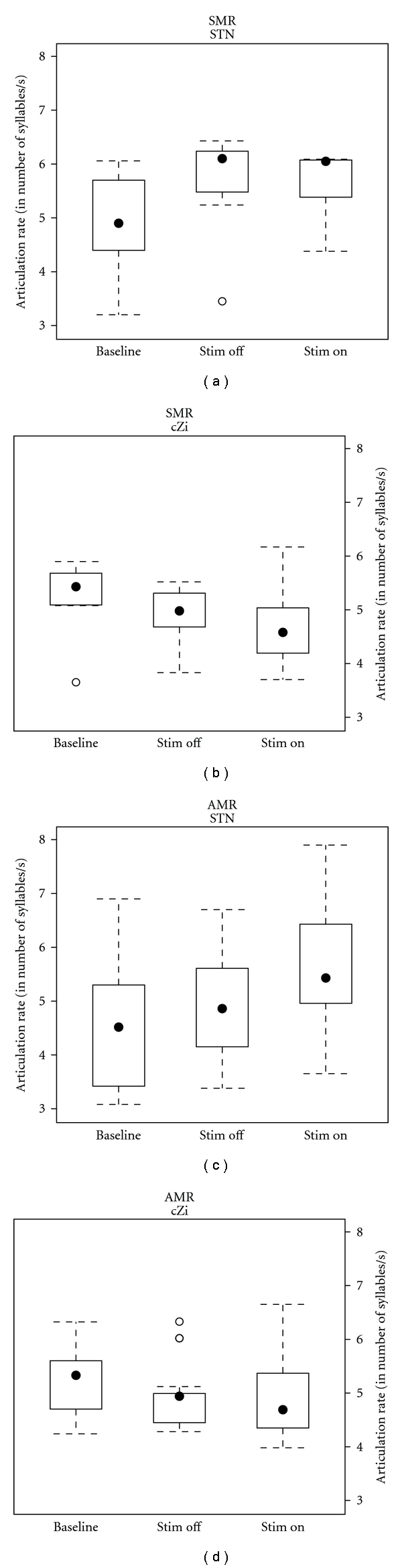
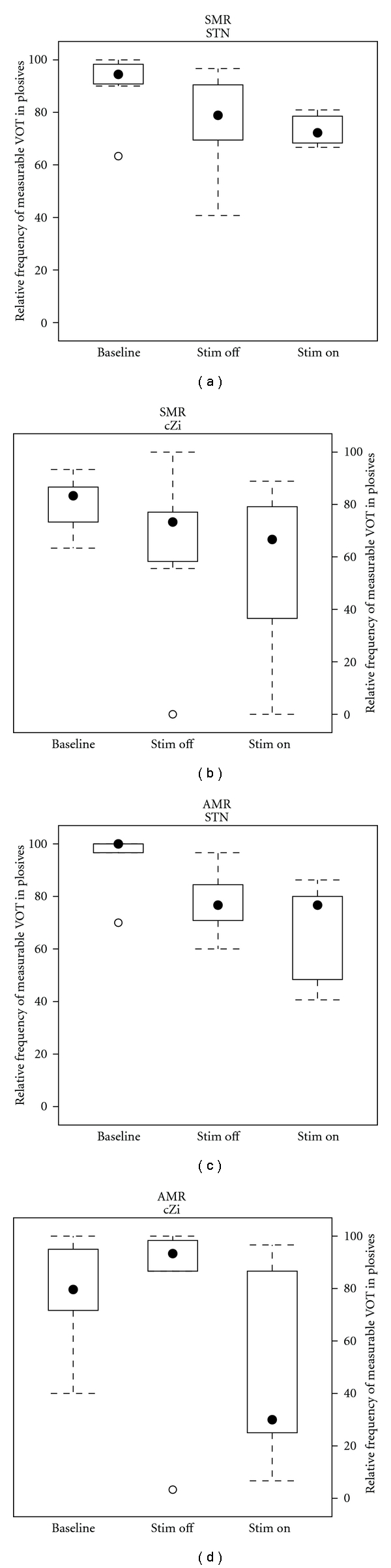
The hypokinetic dysarthria observed in Parkinson's disease (PD) affects the range, speed, and accuracy of articulatory gestures in patients, reducing the perceived quality of speech acoustic output in continuous speech. Deep brain stimulation (DBS) of the subthalamic nucleus (STN-DBS) and of the caudal zona incerta (cZi-DBS) are current surgical treatment options for PD. This study aimed at investigating the outcome of STN-DBS (7 patients) and cZi-DBS (7 patients) in two articulatory diadochokinesis tasks (AMR and SMR) using measurements of articulation rate and quality of the plosive consonants (using the percent measurable VOT metric). The results indicate that patients receiving STN-DBS increased in articulation rate in the Stim-ON condition in the AMR task only, with no effect on production quality. Patients receiving cZi-DBS decreased in articulation rate in the Stim-ON condition and further showed a reduction in production quality. The data therefore suggest that cZi-DBS is more detrimental for extended articulatory movements than STN-DBS.
帕金森病(PD)中观察到的运动障碍性构音障碍影响患者的发音动作范围、速度和准确性,降低了连续言语中言语声学输出的感知质量。丘脑底核(STN)和尾状核下区(cZi)深部脑刺激(DBS)是目前治疗 PD 的手术选择。本研究旨在调查 STN-DBS(7 例)和 cZi-DBS(7 例)在两种发音交替运动任务(AMR 和 SMR)中的结果,使用发音率和爆发音质量的测量值(使用可测量 VOT 百分比的方法)。结果表明,接受 STN-DBS 的患者仅在 AMR 任务的 Stim-ON 条件下增加了发音率,而对产生质量没有影响。接受 cZi-DBS 的患者在 Stim-ON 条件下的发音率降低,并且进一步显示出产生质量的降低。因此,数据表明 cZi-DBS 对扩展发音运动的影响比 STN-DBS 更不利。