Achar Shreepathi Krishna, Shetty Nanda, Joseph Tim Thomas
Department of Anaesthesiology, Kasturba Medical College, Manipal, Karnataka, India.
Indian J Anaesth. 2011 Jul;55(4):399-401. doi: 10.4103/0019-5049.84856.
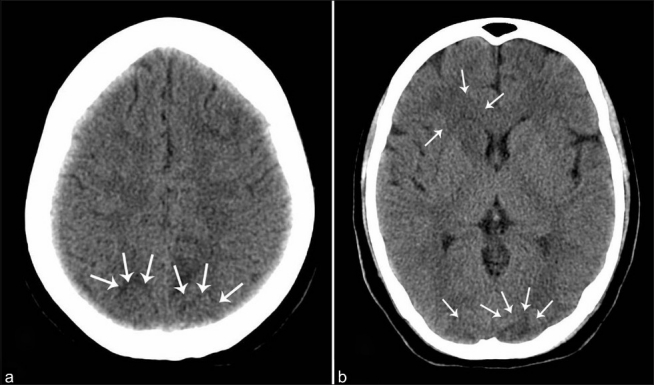
Posterior reversible encephalopathy syndrome (PRES) is a cliniconeuroradiological syndrome associated with various clinical conditions, presenting with headache, encephalopathy, seizures, cortical visual disturbances or blindness. Imaging predominantly shows parieto-occipital white matter changes, with vasogenic oedema being the most accepted pathophysiology. We report a 25-year-old primigravida who presented in term pregnancy with seizures and blindness, scheduled for emergency caesarean section. She was managed peroperatively under general anaesthesia and shifted to intensive care unit. Postoperative computed tomography brain revealed an intra-axial hypodensity involving predominantly white matter regions of bilateral parieto-occipital lobes, right caudate nucleus and right cerebellum, suggestive of PRES. Clinical improvement with complete resolution of visual disturbances was observed with supportive treatment. The importance of prompt suspicion and management in preventing short- and long-term neurological deficits in reversible condition like PRES is highlighted.
后部可逆性脑病综合征(PRES)是一种与多种临床病症相关的临床神经放射学综合征,表现为头痛、脑病、癫痫发作、皮质视觉障碍或失明。影像学主要显示顶枕叶白质改变,血管源性水肿是最被认可的病理生理学机制。我们报告一例25岁初产妇,足月妊娠时出现癫痫发作和失明,计划行急诊剖宫产。她在全身麻醉下接受手术治疗,术后转入重症监护病房。术后脑部计算机断层扫描显示轴内低密度影,主要累及双侧顶枕叶白质区域、右侧尾状核和右侧小脑,提示为PRES。经支持治疗后,视力障碍完全缓解,临床症状改善。强调了在PRES这种可逆性疾病中,及时怀疑和处理对于预防短期和长期神经功能缺损的重要性。