Abed Ahmad Moghareh, Pestekan Rasool Heidari, Yaghini Jaber, Razavi Seyed Mohammad, Tavakoli Mohammad, Amjadi Mohammad
Associate Professor, Department of Periodontics and Torabinejad Dental Research Center, School of Dentistry, Isfahan University of Medical Sciences, Isfahan, Iran.
Dent Res J (Isfahan). 2011 Summer;8(3):132-7.
Decalcified freeze-dried bone allograft (DFDBA) may have the potential to enhance bone formation around dental implants. Our aim in this study was the evaluation and comparison of two types of DFDBA in treatment of dehiscence defects around Euroteknika(®) implants in dogs.
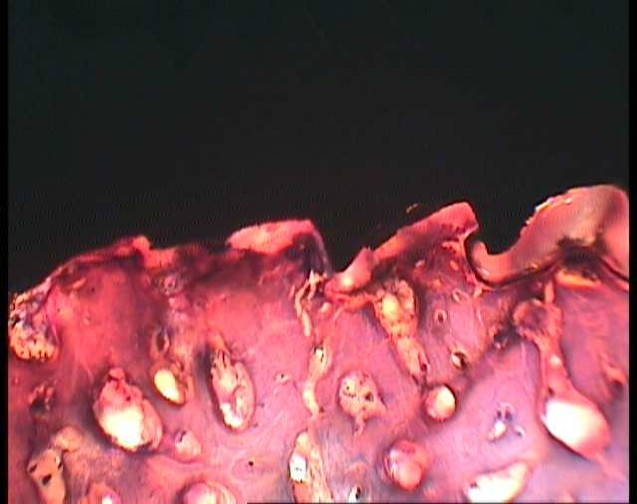
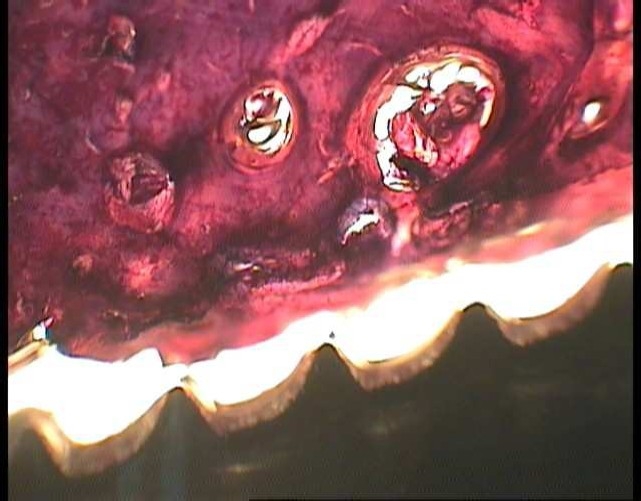
In this prospective clinical trial animal study, all mandibular premolars of three Iranian dogs were extracted. After 3 months of healing, fifteen SLA type Euroteknika(®) dental implants (Natea) with 4.1mm diameter and 10mm length were placed in osteotomy sites with dehiscence defects of 5mm length, 4 mm width, and 3mm depth. Guided bone regeneration (GBR) procedures were performed using Cenobone and collagen membrane for six implants, the other six implants received Dembone and collagen membrane and the final three implants received only collagen membrane. All implants were submerged. After 4 months of healing, implants were uncovered and stability (Implant Stability Quotient) of all implants was measured. Then, block biopsies of each implant site were taken and processed for ground sectioning and histomorphometric analysis. The data was analyzed by ANOVA and Pearson tests. P value less than 0.05 was considered to be significant.
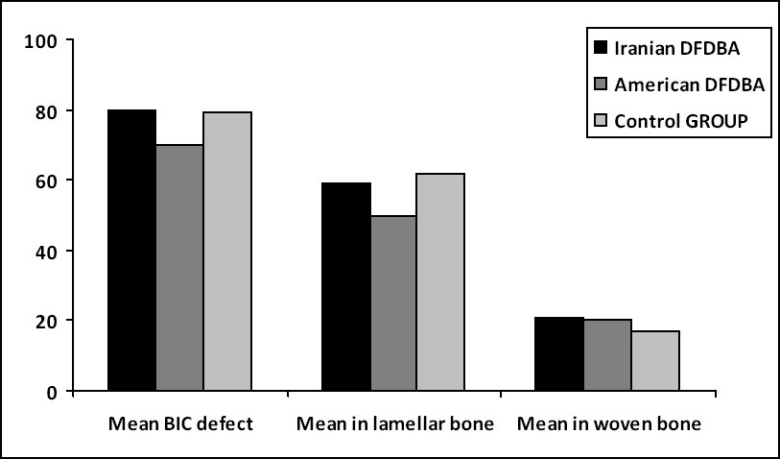
All implants osseointegrated after 4 months. The mean values of bone to implant contact for histomorphometric measurements of Cenobone, Denobone, and control groups were 77.36 ± 9.96%, 78.91 ± 11.9% and 71.56 ± 5.61% respectively, with no significant differences among the various treatment groups. The correlation of Implant Stability Quotient and histomorphometric techniques was 0.692.
In treating of dehiscence defects with GBR technique in this study, adding DFDBA did not significantly enhance the percentages of bone-to-implant contact measurements; and Implant Stability Quotient Resonance Frequency Analysis appeared to be a precise technique.
脱钙冻干骨同种异体移植物(DFDBA)可能具有促进牙种植体周围骨形成的潜力。本研究的目的是评估和比较两种类型的DFDBA在治疗犬Euroteknika(®)种植体周围裂开性骨缺损中的效果。
在这项前瞻性临床试验动物研究中,拔除了3只伊朗犬的所有下颌前磨牙。愈合3个月后,将15颗直径4.1mm、长度10mm的SLA型Euroteknika(®)牙科种植体(Natea)植入长度为5mm、宽度为4mm、深度为3mm的裂开性骨缺损的截骨部位。对6颗种植体使用Cenobone和胶原膜进行引导骨再生(GBR)手术,另外6颗种植体使用Dembone和胶原膜,最后3颗种植体仅使用胶原膜。所有种植体均为埋植式。愈合4个月后,暴露种植体并测量所有种植体的稳定性(种植体稳定性商数)。然后,对每个种植体部位进行整块活检,并进行磨片切片和组织形态计量分析。数据采用方差分析和Pearson检验进行分析。P值小于0.05被认为具有显著性。
4个月后所有种植体均实现骨整合。Cenobone组、Denobone组和对照组组织形态计量学测量的骨与种植体接触的平均值分别为77.36±9.96%、78.91±11.9%和71.56±5.61%,各治疗组之间无显著差异。种植体稳定性商数与组织形态计量学技术的相关性为0.692。
在本研究中使用GBR技术治疗裂开性骨缺损时,添加DFDBA并未显著提高骨与种植体接触测量的百分比;种植体稳定性商数共振频率分析似乎是一种精确的技术。