CNR Institute of Clinical Physiology, via Moruzzi n° 1, Pisa, Italy.
Lipids Health Dis. 2011 Oct 20;10:185. doi: 10.1186/1476-511X-10-185.
Myeloperoxidase (MPO) is a marker of plaque vulnerability and a mechanistic bridge between inflammation and cardiovascular disease, and thus is a suitable target for therapeutic strategy against cardiovascular disease.
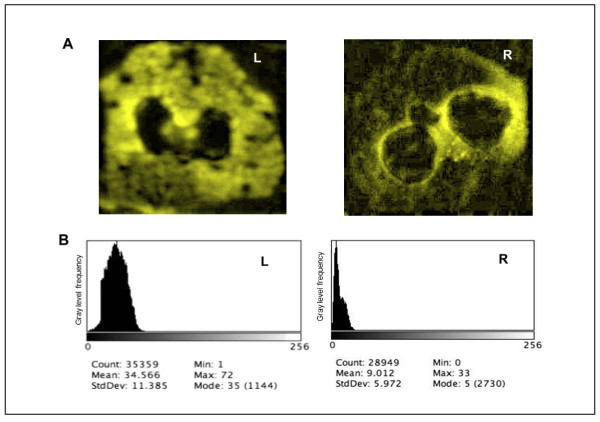
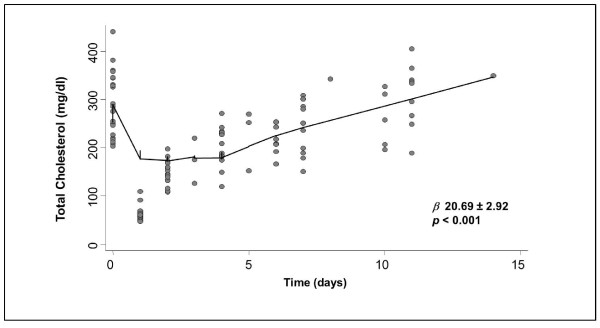
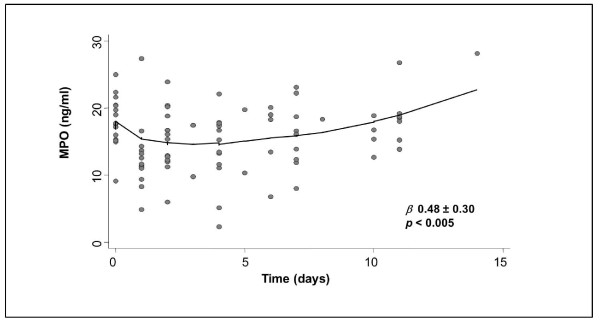
Since hypercholesterolemia is associated with atherosclerosis and inflammation, we tested whether MPO serum levels were up-regulated in Familial Hypercholesterolemia (FH) and whether acute reduction of total cholesterol (TC) would also reduce MPO concentration. FH subjects undergoing LDL-apheresis (LDL-A) treatment are a paradigmatic clinical model where TC rapidly plunges from extremely high to extremely low levels after selective LDL removal, and then spontaneously rebounds to baseline conditions. This clinical setting allows multiple intra-patient observations at different plasma TC concentrations. We measured MPO levels in serum by ELISA tests, and in peripheral leukocytes by immunofluorescence, to learn whether they were affected by the changes in TC levels. Serum MPO was measured before and serially up to the 14th day following LDL-A.
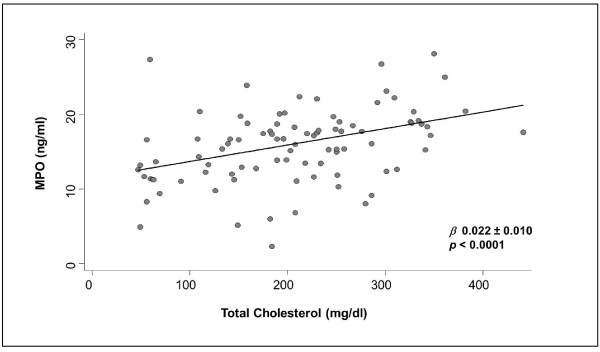
In both serum and peripheral leukocytes, MPO concentrations were i) higher than in sex- and age-matched healthy controls (p < 0.01); ii) decreased with TC reduction; iii) parallel with TC time course; iv) correlated with plasma TC. At regression analysis, plasma TC was the only variable considered that influenced MPO serum levels (β 0.022 ± 0.010, p < 0.0001).
In FH the MPO serum levels were modulated through changes in the TC concentrations carried out by LDL-A. Further study is needed to determine whether reduced MPO levels obtained by LDL-A could have any therapeutic impact.
髓过氧化物酶(MPO)是斑块脆弱性的标志物,也是炎症与心血管疾病之间的机制桥梁,因此是针对心血管疾病的治疗策略的合适靶标。
由于高胆固醇血症与动脉粥样硬化和炎症有关,我们检测了家族性高胆固醇血症(FH)患者的 MPO 血清水平是否升高,以及总胆固醇(TC)的急性降低是否也会降低 MPO 浓度。接受 LDL 吸附(LDL-A)治疗的 FH 患者是一个典型的临床模型,在选择性 LDL 去除后,TC 迅速从极高水平降至极低水平,然后自发反弹至基线水平。这种临床环境允许在不同的血浆 TC 浓度下对多个患者进行多次观察。我们通过 ELISA 试验测量了血清中的 MPO 水平,并通过免疫荧光法测量了外周白细胞中的 MPO 水平,以了解它们是否受到 TC 水平变化的影响。在 LDL-A 之前和之后的第 14 天之前和连续测量了血清 MPO。
在血清和外周白细胞中,MPO 浓度均为:i)高于性别和年龄匹配的健康对照组(p <0.01);ii)随着 TC 降低而降低;iii)与 TC 时间过程平行;iv)与血浆 TC 相关。在回归分析中,TC 是唯一被认为影响 MPO 血清水平的变量(β 0.022 ± 0.010,p <0.0001)。
在 FH 中,MPO 血清水平通过 LDL-A 进行的 TC 浓度变化来调节。需要进一步研究以确定 LDL-A 降低的 MPO 水平是否具有任何治疗作用。