Zanetti Michela, Zenti Mariagrazia, Barazzoni Rocco, Zardi Federica, Semolic Annamaria, Messa Michele Giuseppe, Mearelli Filippo, Russi Gianpaolo, Fonda Maurizio, Scarano Luca, Bonora Enzo, Cattin Luigi
Clinica Medica, Department of Medical, Surgical and Health Sciences, University of Trieste, Trieste, Italy.
Endocrinology, Diabetes and Metabolism, University and Azienda Ospedaliera Universitaria Integrata of Verona, Verona, Italy.
PLoS One. 2014 Jul 11;9(7):e101290. doi: 10.1371/journal.pone.0101290. eCollection 2014.
Pentraxin 3 (PTX3), a key component of the humoral arm of innate immunity, is secreted by vascular cells in response to injury, possibly aiming at tuning arterial activation associated with vascular damage. Severe hypercholesterolemia as in familial hypercholesterolemia (FH) promotes vascular inflammation and atherosclerosis; low-density lipoprotein (LDL) apheresis is currently the treatment of choice to reduce plasma lipids in FH. HELP LDL apheresis affects pro- and antiinflammatory biomarkers, however its effects on PTX3 levels are unknown. We assessed the impact of FH and of LDL removal by HELP apheresis on PTX3.
Plasma lipids, PTX3, and CRP were measured in 19 patients with FH undergoing chronic HELP LDL apheresis before and after treatment and in 20 control subjects. In the patients assessment of inflammation and oxidative stress markers included also plasma TNFα, fibrinogen and TBARS.
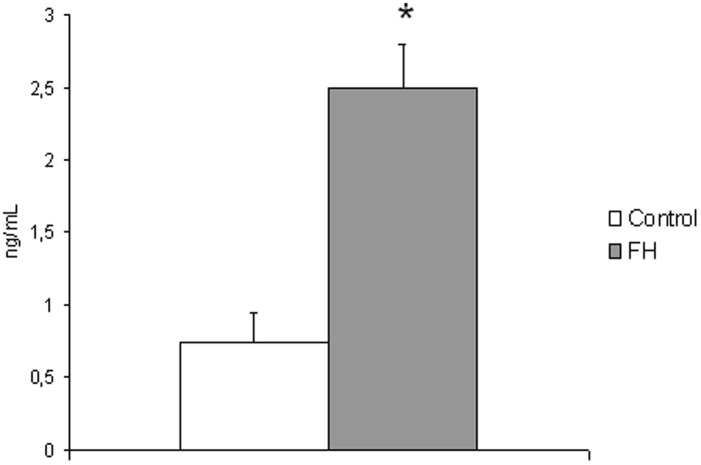
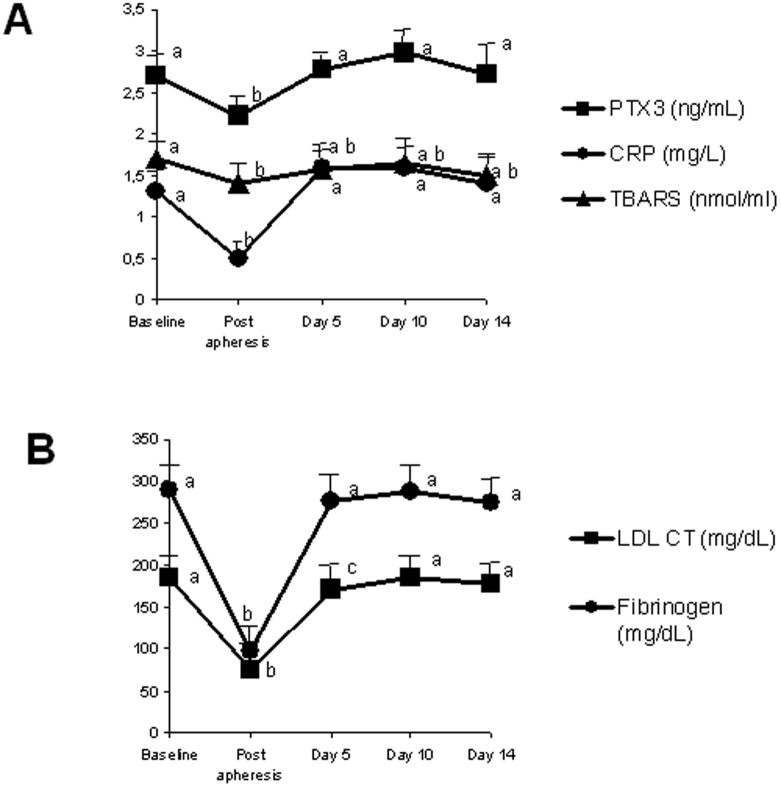
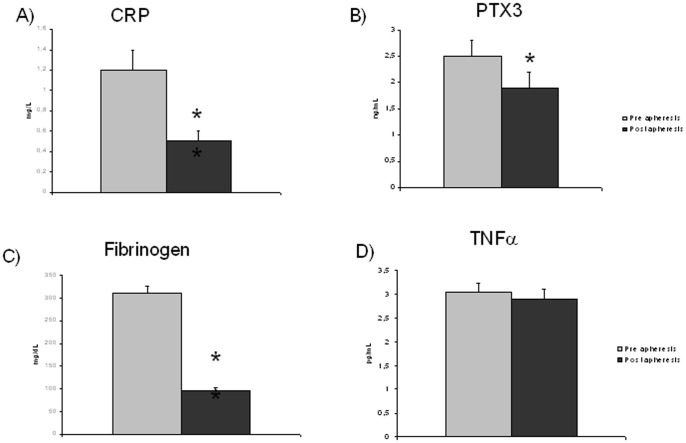
At baseline, FH patients had higher (p = 0.0002) plasma PTX3 than matched control subjects. In FH PTX3 correlated positively (p≤0.05) with age, gender and CRP and negatively (p = 0.01) with HELP LDL apheresis vintage. The latter association was confirmed after correction for age, gender and CRP. HELP LDL apheresis acutely reduced (p≤0.04) plasma PTX3, CRP, fibrinogen, TBARS and lipids, but not TNFα. No association was observed between mean decrease in PTX3 and in LDL cholesterol. PTX3 paralleled lipids, oxidative stress and inflammation markers in time-course study.
FH is associated with increased plasma PTX3, which is acutely reduced by HELP LDL apheresis independently of LDL cholesterol, as reflected by the lack of association between change in PTX3 and in LDL levels. These results, together with the finding of a negative relationship between PTX3 and duration of treatment suggest that HELP LDL apheresis may influence both acutely and chronically cardiovascular outcomes in FH by modulating PTX3.
五聚体蛋白3(PTX3)是天然免疫体液免疫的关键组成部分,由血管细胞在损伤时分泌,可能旨在调节与血管损伤相关的动脉激活。家族性高胆固醇血症(FH)中的严重高胆固醇血症会促进血管炎症和动脉粥样硬化;低密度脂蛋白(LDL)单采目前是降低FH患者血脂的首选治疗方法。HELP LDL单采会影响促炎和抗炎生物标志物,但其对PTX3水平的影响尚不清楚。我们评估了FH以及HELP单采去除LDL对PTX3的影响。
对19例接受慢性HELP LDL单采治疗的FH患者治疗前后以及20名对照受试者测量血浆脂质、PTX3和CRP。在患者中,炎症和氧化应激标志物的评估还包括血浆TNFα、纤维蛋白原和硫代巴比妥酸反应物(TBARS)。
基线时,FH患者的血浆PTX3高于匹配的对照受试者(p = 0.0002)。在FH患者中,PTX3与年龄、性别和CRP呈正相关(p≤0.05),与HELP LDL单采治疗时间呈负相关(p = 0.01)。在校正年龄、性别和CRP后,后者的关联得到证实。HELP LDL单采可急性降低(p≤0.04)血浆PTX3、CRP、纤维蛋白原、TBARS和脂质,但不降低TNFα。未观察到PTX3的平均降低与LDL胆固醇降低之间存在关联。在时间进程研究中,PTX3与脂质、氧化应激和炎症标志物平行。
FH与血浆PTX3升高有关,HELP LDL单采可使其急性降低,且与LDL胆固醇无关,这一点从PTX3变化与LDL水平之间缺乏关联得到反映。这些结果,连同PTX3与治疗持续时间之间存在负相关的发现,表明HELP LDL单采可能通过调节PTX3对FH患者的心血管结局产生急性和慢性影响。