Victorian Infant Brain Studies, Murdoch Childrens Research Institute, Melbourne, VIC, Australia.
Dev Med Child Neurol. 2011 Nov;53(11):1000-6. doi: 10.1111/j.1469-8749.2011.04095.x.
Children born very preterm are at risk for impaired motor performance ranging from cerebral palsy (CP) to milder abnormalities, such as developmental coordination disorder. White matter abnormalities (WMA) at term have been associated with CP in very preterm children; however, little is known about the impact of WMA on the range of motor impairments. The aim of this study was to assess whether WMA were predictive of all levels of motor impairments in very preterm children.
Two hundred and twenty-seven very preterm infants (< 30 wks gestational age or birthweight < 1250 g) had brain magnetic resonance imaging at term-equivalent age to assess for WMA, which were categorized as nil, mild, or moderate to severe. At 5 years of age children were classified as having a moderate to severe motor impairment if they were below the 5th centile or mild to severe motor impairment if their score placed them no higher than the 15th centile on the Movement Assessment Battery for Children (MABC). WMA (nil vs mild and nil vs moderate-severe) were explored as predictors of motor impairment using logistic regression. Analyses were repeated adjusting for the effects of other perinatal variables and excluding children with CP.
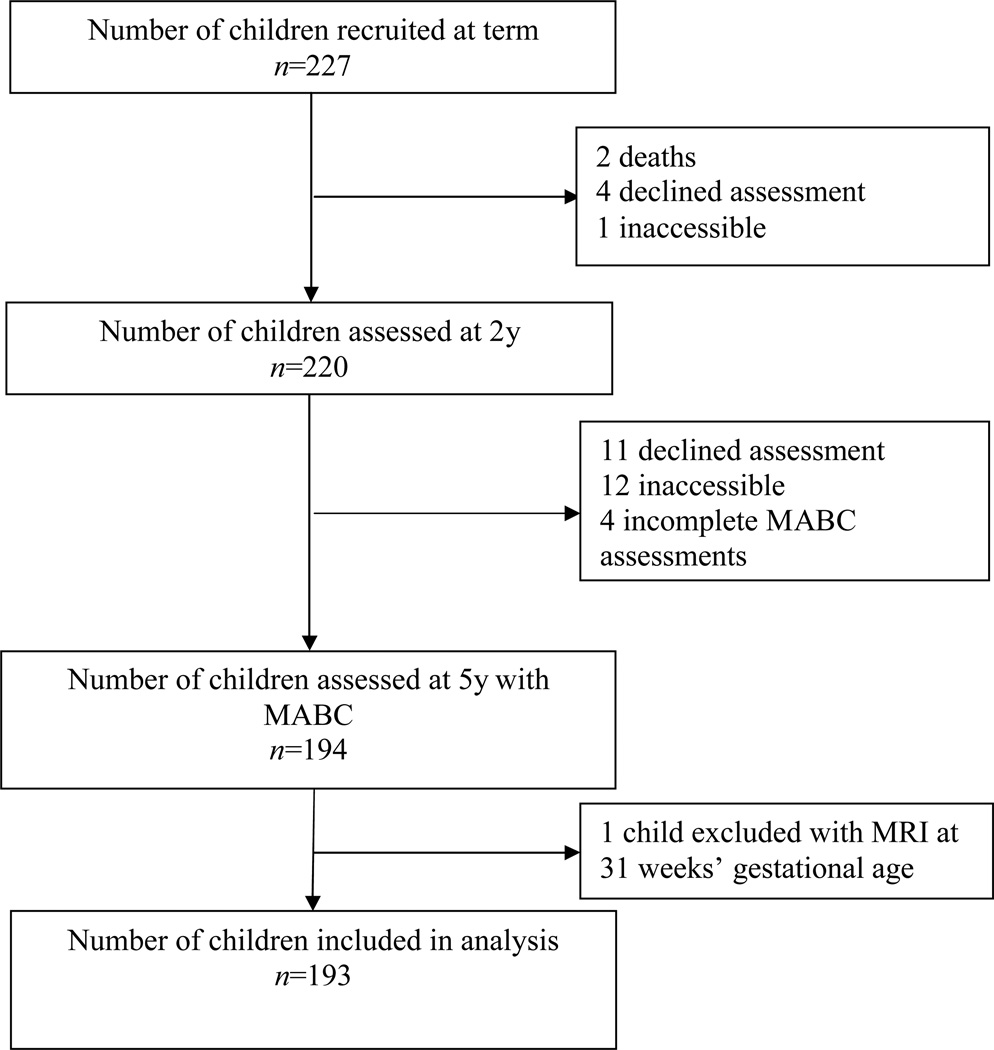
Of the 193 very preterm children (97 males, 96 females) assessed with the MABC, 53 (27%) were classified as having a moderate to severe motor impairment and 96 (50%) a mild to severe motor impairment. WMA were predictive of motor impairment in very preterm children, with mild versus no WMA increasing the odds of moderate to severe motor impairment by over fivefold (odds ratio [OR] 5.6; 95% confidence interval [CI] 1.9-16.1; p=0.002) and mild to severe impairment by twofold (OR 2.2; 95% CI 1.1-4.2; p=0.02). Compared with no WMA, moderate to severe WMA increased the odds for moderate to severe impairment 19-fold (OR 19.4; 95% CI 5.6-66.7; p<0.001) and for mild to severe motor impairment ninefold (OR 9.4; 95% CI 3.2-28.1; p<0.001). Results remained similar after controlling for several potential confounders and after excluding 14 children who had CP at age 2 years.
WMA predict motor impairment at 5 years, with rates of impairment increasing with more severe WMA. Very preterm children with any WMA at term require follow-up throughout childhood.
早产儿存在运动功能障碍的风险,从脑瘫(CP)到发育协调障碍等较轻的异常。足月时有脑白质异常(WMA)与极早产儿 CP 有关;然而,对于 WMA 对运动障碍范围的影响知之甚少。本研究旨在评估 WMA 是否可预测极早产儿所有程度的运动障碍。
227 名极早产儿(<30 周胎龄或出生体重<1250g)在足月时进行脑磁共振成像,以评估 WMA,WMA 分为无、轻度或中重度。在 5 岁时,如果儿童的评分低于第 5 百分位,则被归类为中重度运动障碍,如果他们的评分不高于第 15 百分位,则被归类为轻度至重度运动障碍,即运动评估电池儿童(MABC)。使用逻辑回归探讨 WMA(无与轻度和无与中重度)作为运动障碍的预测因子。分析重复进行,以调整围产期其他变量的影响,并排除患有 CP 的儿童。
在接受 MABC 评估的 193 名极早产儿(97 名男性,96 名女性)中,53 名(27%)被归类为中重度运动障碍,96 名(50%)为轻度至重度运动障碍。WMA 可预测极早产儿的运动障碍,与无 WMA 相比,轻度 WMA 使中重度运动障碍的几率增加五倍以上(优势比[OR]5.6;95%置信区间[CI]1.9-16.1;p=0.002),轻度至重度运动障碍增加两倍(OR 2.2;95%CI 1.1-4.2;p=0.02)。与无 WMA 相比,中重度 WMA 使中重度障碍的几率增加 19 倍(OR 19.4;95%CI 5.6-66.7;p<0.001),轻度至重度运动障碍的几率增加 9 倍(OR 9.4;95%CI 3.2-28.1;p<0.001)。在控制了几个潜在的混杂因素后,以及在排除了 14 名在 2 岁时患有 CP 的儿童后,结果仍然相似。
WMA 可预测 5 岁时的运动障碍,且随 WMA 严重程度的增加而增加。在足月时有任何 WMA 的极早产儿需要在整个儿童期进行随访。