IRIS Group, Centre d'Etudes SensoriMotrices, UMR8194, CNRS, Service d'ophtalmologie, Hôpital Européen Georges Pompidou Paris, France.
Front Hum Neurosci. 2011 Oct 13;5:114. doi: 10.3389/fnhum.2011.00114. eCollection 2011.
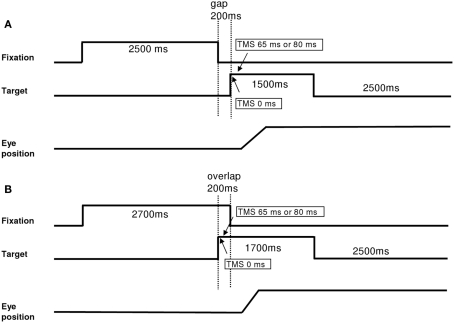
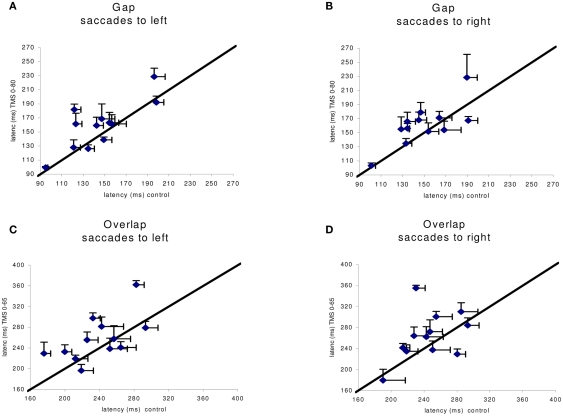
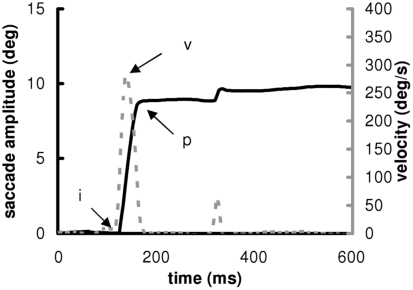
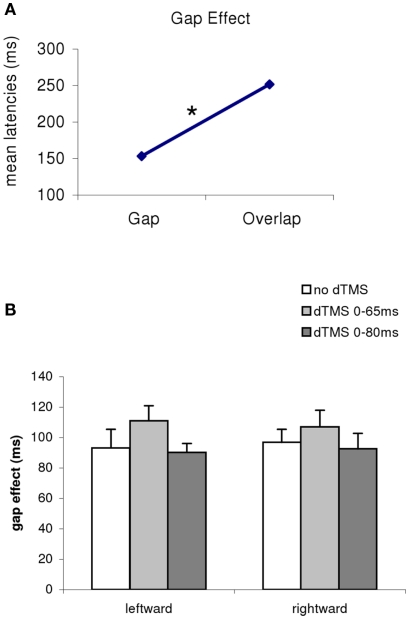
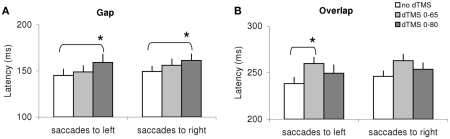
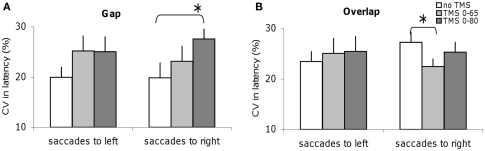
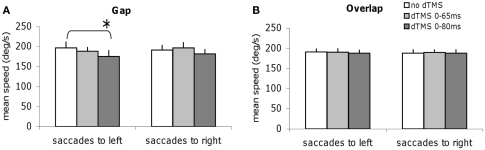
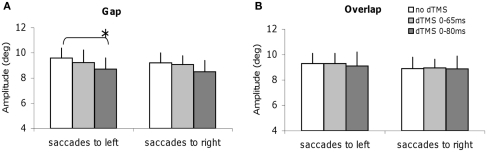
Gap and overlap tasks are widely used to promote automatic versus controlled saccades. This study examines the hypothesis that the right posterior parietal cortex (PPC) is differently involved in the two tasks. Twelve healthy students participated in the experiment. We used double-pulse transcranial magnetic stimulation (dTMS) on the right PPC, the first pulse delivered at the target onset and the second 65 or 80 ms later. Each subject performed several blocks of gap or overlap task with or without dTMS. Eye movements were recorded with an Eyelink device. The results show an increase of latency of saccades after dTMS of the right PPC for both tasks but for different time windows (0-80 ms for the gap task, 0-65 ms for the overlap task). Moreover, for rightward saccades the coefficient of variation of latency increased in the gap task but decreased in the overlap task. Finally, in the gap task and for leftward saccades only, dTMS at 0-80 ms decreased the amplitude and the speed of saccades. Although the study is preliminary and needs further investigation in detail, the results support the hypothesis that the right PPC is involved differently in the initiation of the saccades for the two tasks: in the gap task the PPC controls saccade triggering while in the overlap task it could be a relay to the Frontal Eye Fields which is known to control voluntary saccades, e.g., memory-guided and perhaps the controlled saccades in the overlap task The results have theoretical and clinical significance as gap-overlap tasks are easy to perform even in advanced age and in patients with neurodegenerative diseases.
间隙和重叠任务广泛用于促进自动与受控扫视。本研究检验了右后顶叶皮层(PPC)在这两个任务中是否有不同参与的假设。十二名健康学生参与了实验。我们在右 PPC 上使用双脉冲经颅磁刺激(dTMS),第一个脉冲在目标出现时发出,第二个脉冲在 65 或 80 毫秒后发出。每个被试在有或没有 dTMS 的情况下进行间隙或重叠任务的几个块。眼动使用 Eyelink 设备记录。结果表明,在右 PPC 接受 dTMS 后,两种任务的扫视潜伏期都增加,但时间窗口不同(间隙任务为 0-80 毫秒,重叠任务为 0-65 毫秒)。此外,对于向右的扫视,在间隙任务中,潜伏期的变异系数增加,但在重叠任务中减少。最后,在间隙任务中且仅在向左的扫视时,0-80 毫秒的 dTMS 减少了扫视的幅度和速度。尽管该研究是初步的,需要进一步详细调查,但结果支持了这样的假设,即右 PPC 在这两种任务的扫视启动中扮演不同的角色:在间隙任务中,PPC 控制扫视触发,而在重叠任务中,它可能是一个中继到 Frontal Eye Fields,后者已知控制自愿扫视,例如记忆引导和重叠任务中的受控扫视。这些结果具有理论和临床意义,因为间隙-重叠任务即使在老年人和神经退行性疾病患者中也很容易执行。