Institut Pasteur, Hepacivirus and Innate Immunity, Paris, France.
PLoS Pathog. 2011 Oct;7(10):e1002289. doi: 10.1371/journal.ppat.1002289. Epub 2011 Oct 13.
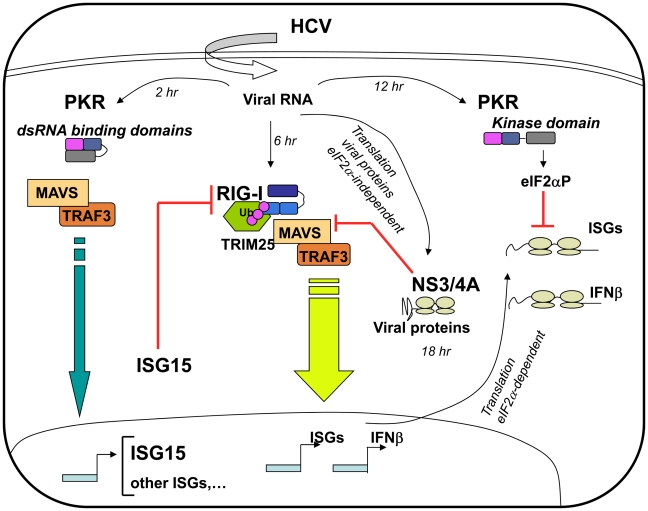
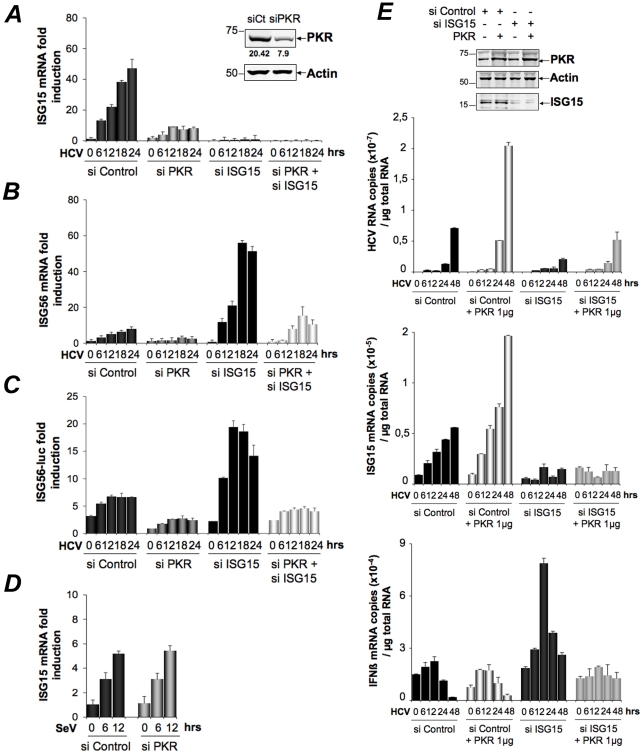
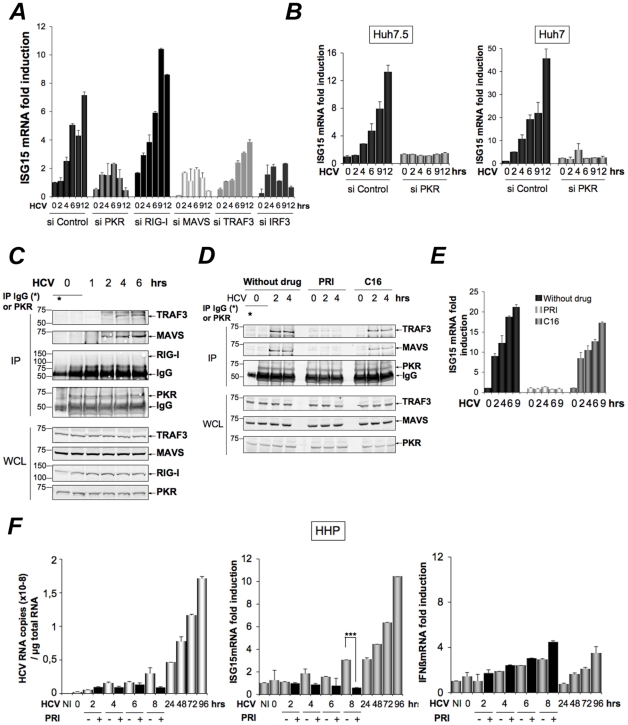
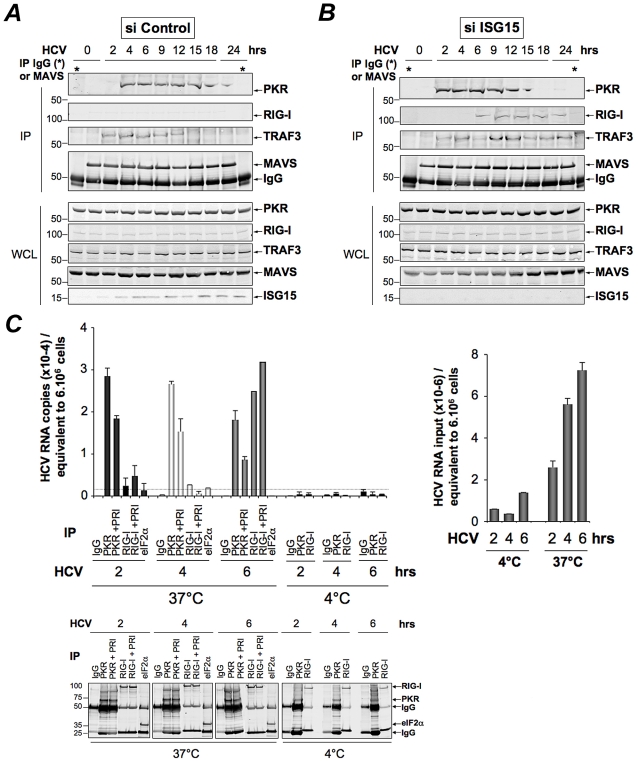
Recognition of viral RNA structures by the intracytosolic RNA helicase RIG-I triggers induction of innate immunity. Efficient induction requires RIG-I ubiquitination by the E3 ligase TRIM25, its interaction with the mitochondria-bound MAVS protein, recruitment of TRAF3, IRF3- and NF-κB-kinases and transcription of Interferon (IFN). In addition, IRF3 alone induces some of the Interferon-Stimulated Genes (ISGs), referred to as early ISGs. Infection of hepatocytes with Hepatitis C virus (HCV) results in poor production of IFN despite recognition of the viral RNA by RIG-I but can lead to induction of early ISGs. HCV was shown to inhibit IFN production by cleaving MAVS through its NS3/4A protease and by controlling cellular translation through activation of PKR, an eIF2α-kinase containing dsRNA-binding domains (DRBD). Here, we have identified a third mode of control of IFN induction by HCV. Using HCVcc and the Huh7.25.CD81 cells, we found that HCV controls RIG-I ubiquitination through the di-ubiquitine-like protein ISG15, one of the early ISGs. A transcriptome analysis performed on Huh7.25.CD81 cells silenced or not for PKR and infected with JFH1 revealed that HCV infection leads to induction of 49 PKR-dependent genes, including ISG15 and several early ISGs. Silencing experiments revealed that this novel PKR-dependent pathway involves MAVS, TRAF3 and IRF3 but not RIG-I, and that it does not induce IFN. Use of PKR inhibitors showed that this pathway requires the DRBD but not the kinase activity of PKR. We then demonstrated that PKR interacts with HCV RNA and MAVS prior to RIG-I. In conclusion, HCV recruits PKR early in infection as a sensor to trigger induction of several IRF3-dependent genes. Among those, ISG15 acts to negatively control the RIG-I/MAVS pathway, at the level of RIG-I ubiquitination.These data give novel insights in the machinery involved in the early events of innate immune response.
细胞溶质 RNA 解旋酶 RIG-I 识别病毒 RNA 可触发先天免疫的诱导。有效的诱导需要 E3 连接酶 TRIM25 对 RIG-I 的泛素化,其与线粒体结合的 MAVS 蛋白相互作用,TRAF3 的募集,IRF3 和 NF-κB 激酶的转录和干扰素(IFN)的转录。此外,IRF3 本身诱导一些干扰素刺激基因(ISGs),称为早期 ISGs。尽管 HCV 感染肝细胞后 RIG-I 识别了病毒 RNA,但 IFN 的产生却很差,但可以诱导早期 ISGs。HCV 通过其 NS3/4A 蛋白酶切割 MAVS 并通过激活 PKR(一种含有 dsRNA 结合结构域(DRBD)的 eIF2α-激酶)来控制细胞翻译,从而抑制 IFN 的产生。在这里,我们确定了 HCV 控制 IFN 诱导的第三种模式。我们使用 HCVcc 和 Huh7.25.CD81 细胞发现,HCV 通过 RIG-I 的二泛素样蛋白 ISG15 控制 RIG-I 的泛素化,ISG15 是早期 ISGs 之一。对沉默或不沉默 PKR 并用 JFH1 感染的 Huh7.25.CD81 细胞进行的转录组分析表明,HCV 感染导致 49 个 PKR 依赖性基因的诱导,包括 ISG15 和几个早期 ISGs。沉默实验表明,这种新的 PKR 依赖性途径涉及 MAVS、TRAF3 和 IRF3,但不涉及 RIG-I,并且不诱导 IFN。使用 PKR 抑制剂表明,该途径需要 DRBD 但不需要 PKR 的激酶活性。然后,我们证明了 PKR 在 RIG-I 之前与 HCV RNA 和 MAVS 相互作用。总之,HCV 在感染早期招募 PKR 作为传感器,以触发几个 IRF3 依赖性基因的诱导。在这些基因中,ISG15 作为负调控物作用于 RIG-I/MAVS 途径,在 RIG-I 泛素化水平上起作用。这些数据为先天免疫反应早期事件中涉及的机制提供了新的见解。