Stereo Vision Ltd., Budapest, Hungary.
PLoS One. 2011;6(10):e26062. doi: 10.1371/journal.pone.0026062. Epub 2011 Oct 13.
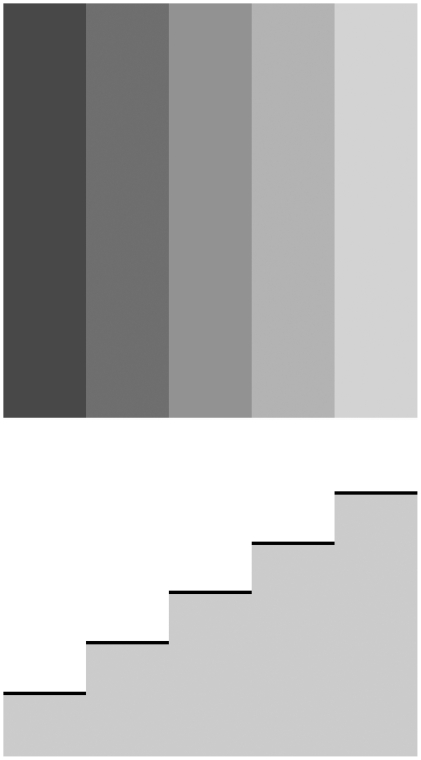
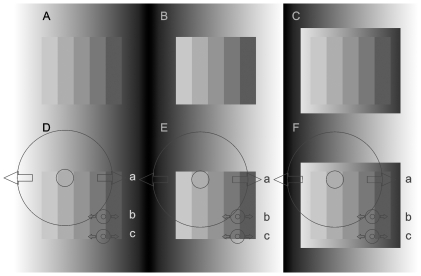
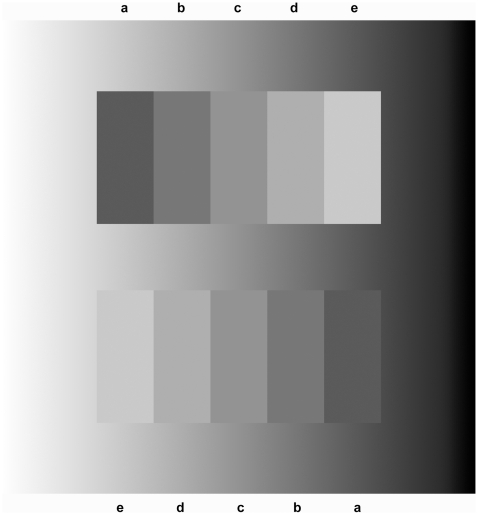
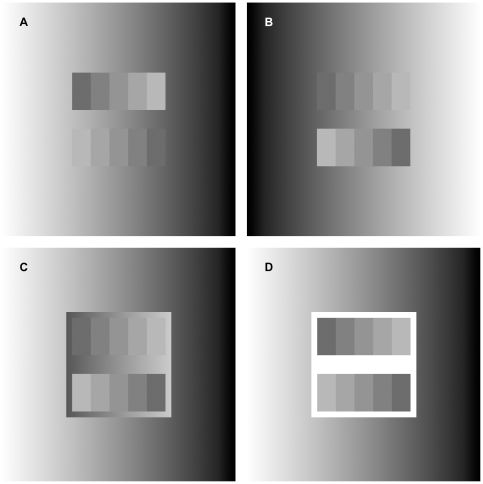
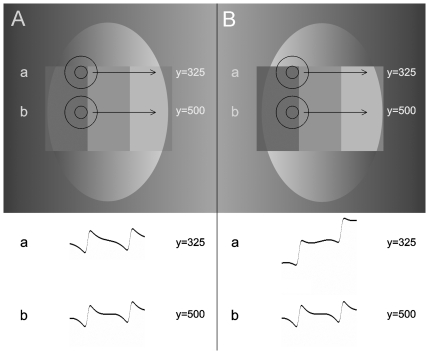
The Chevreul illusion is a well-known 19(th) century brightness illusion, comprising adjacent homogeneous grey bands of different luminance, which are perceived as inhomogeneous. It is generally explained by lateral inhibition, according to which brighter areas projected to the retina inhibit the sensitivity of neighbouring retinal areas. Lateral inhibition has been considered the foundation-stone of early vision for a century, upon which several computational models of brightness perception are built. One of the last strongholds of lateral inhibition is the Chevreul illusion, which is often illustrated even in current textbooks. Here we prove that lateral inhibition is insufficient to explain the Chevreul illusion. For this aim, we placed the Chevreul staircase in a luminance ramp background, which noticeably changed the illusion. In our psychophysical experiments, all 23 observers reported a strong illusion, when the direction of the ramp was identical to that of the staircase, and all reported homogeneous steps (no illusion) when its direction was the opposite. When the background of the staircase was uniform, 14 saw the illusion, and 9 saw no illusion. To see whether the change of the entire background area or that of the staircase boundary edges were more important, we placed another ramp around the staircase, whose direction was opposite to that of the original, larger ramp. The result is that though the inner ramp is rather narrow (mean = 0.51 deg, SD = 0.48 deg, N = 23), it still dominates perception. Since all conditions of the lateral inhibition account were untouched within the staircase, lateral inhibition fails to model these perceptual changes. Area ratios seem insignificant; the role of boundary edges seems crucial. We suggest that long range interactions between boundary edges and areas enclosed by them, such that diffusion-based models describe, provide a much more plausible account for these brightness phenomena, and local models are insufficient.
凯夫勒尔错觉是一种著名的 19 世纪亮度错觉,由不同亮度的相邻同质灰色带组成,这些带被感知为不均匀的。它通常根据侧抑制来解释,根据侧抑制,投射到视网膜上的较亮区域会抑制相邻视网膜区域的敏感性。侧抑制被认为是早期视觉的基石已有一个世纪之久,在此基础上构建了几个亮度感知的计算模型。侧抑制的最后一个据点之一是凯夫勒尔错觉,即使在当前的教科书中,它也经常被举例说明。在这里,我们证明侧抑制不足以解释凯夫勒尔错觉。为此,我们将凯夫勒尔阶梯放置在亮度斜坡背景中,这明显改变了错觉。在我们的心理物理实验中,当斜坡的方向与阶梯的方向相同时,所有 23 位观察者都报告了强烈的错觉,而当方向相反时,他们都报告了均匀的台阶(没有错觉)。当阶梯的背景均匀时,有 14 人看到了错觉,而有 9 人没有看到。为了确定整个背景区域的变化还是阶梯边界边缘的变化更重要,我们在阶梯周围放置了另一个斜坡,其方向与原始的较大斜坡相反。结果是,尽管内部斜坡相当狭窄(平均值为 0.51 度,标准差为 0.48 度,N=23),但它仍然主导了感知。由于阶梯内的侧抑制解释的所有条件都未改变,侧抑制无法模拟这些感知变化。区域比似乎不重要;边界边缘的作用似乎至关重要。我们建议,边界边缘之间的长程相互作用以及它们所包围的区域,例如扩散模型所描述的,为这些亮度现象提供了更合理的解释,而局部模型则不够充分。