Stanford University, Department of Microbiology and Immunology, Stanford, California, United States of America.
PLoS One. 2011;6(10):e26369. doi: 10.1371/journal.pone.0026369. Epub 2011 Oct 13.
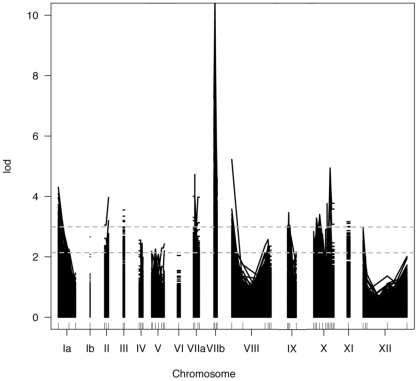
Toxoplasma gondii has a remarkable ability to infect an enormous variety of mammalian and avian species. Given this, it is surprising that three strains (Types I/II/III) account for the majority of isolates from Europe/North America. The selective pressures that have driven the emergence of these particular strains, however, remain enigmatic. We hypothesized that strain selection might be partially driven by adaptation of strains for mammalian versus avian hosts. To test this, we examine in vitro, strain-dependent host responses in fibroblasts of a representative avian host, the chicken (Gallus gallus). Using gene expression profiling of infected chicken embryonic fibroblasts and pathway analysis to assess host response, we show here that chicken cells respond with distinct transcriptional profiles upon infection with Type II versus III strains that are reminiscent of profiles observed in mammalian cells. To identify the parasite drivers of these differences, chicken fibroblasts were infected with individual F1 progeny of a Type II x III cross and host gene expression was assessed for each by microarray. QTL mapping of transcriptional differences suggested, and deletion strains confirmed, that, as in mammalian cells, the polymorphic rhoptry kinase ROP16 is the major driver of strain-specific responses. We originally hypothesized that comparing avian versus mammalian host response might reveal an inversion in parasite strain-dependent phenotypes; specifically, for polymorphic effectors like ROP16, we hypothesized that the allele with most activity in mammalian cells might be less active in avian cells. Instead, we found that activity of ROP16 alleles appears to be conserved across host species; moreover, additional parasite loci that were previously mapped for strain-specific effects on mammalian response showed similar strain-specific effects in chicken cells. These results indicate that if different hosts select for different parasite genotypes, the selection operates downstream of the signaling occurring during the beginning of the host's immune response.
刚地弓形虫具有感染大量哺乳动物和鸟类物种的惊人能力。考虑到这一点,令人惊讶的是,三种菌株(I/II/III 型)占欧洲/北美大多数分离株。然而,导致这些特定菌株出现的选择压力仍然是个谜。我们假设,菌株选择可能部分是由菌株适应哺乳动物和鸟类宿主驱动的。为了检验这一点,我们在鸡(Gallus gallus)的代表性禽类宿主的成纤维细胞中,体外检查了菌株依赖性的宿主反应。我们使用感染的鸡胚胎成纤维细胞的基因表达谱和途径分析来评估宿主反应,结果表明,与在哺乳动物细胞中观察到的相似,鸡细胞在感染 II 型和 III 型菌株时会产生截然不同的转录谱。为了确定这些差异的寄生虫驱动因素,我们用 II 型和 III 型交叉的单个 F1 后代感染鸡成纤维细胞,并通过微阵列评估每个细胞的宿主基因表达。转录差异的 QTL 图谱表明,并且缺失株证实,与在哺乳动物细胞中一样,多态性的棒状体激酶 ROP16 是菌株特异性反应的主要驱动因素。我们最初假设,比较禽类与哺乳动物宿主反应可能会揭示寄生虫菌株依赖性表型的反转;具体来说,对于 ROP16 等多态效应物,我们假设在哺乳动物细胞中活性最高的等位基因在禽类细胞中的活性可能较低。相反,我们发现 ROP16 等位基因的活性似乎在宿主物种之间是保守的;此外,先前在哺乳动物反应中针对菌株特异性效应映射的其他寄生虫基因座在鸡细胞中也显示出类似的菌株特异性效应。这些结果表明,如果不同的宿主选择了不同的寄生虫基因型,那么选择作用于宿主免疫反应开始时发生的信号传递的下游。