Department of Animal Ecology, Uppsala University, Norbyvägen 18D, S-752 36 Uppsala, Sweden.
BMC Evol Biol. 2011 Oct 24;11:313. doi: 10.1186/1471-2148-11-313.
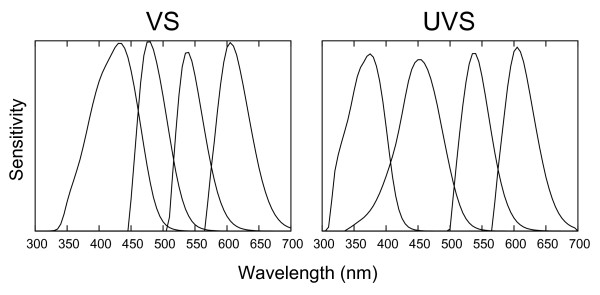
Interspecific variation in avian colour vision falls into two discrete classes: violet sensitive (VS) and ultraviolet sensitive (UVS). They are characterised by the spectral sensitivity of the most shortwave sensitive of the four single cones, the SWS1, which is seemingly under direct control of as little as one amino acid substitution in the cone opsin protein. Changes in spectral sensitivity of the SWS1 are ecologically important, as they affect the abilities of birds to accurately assess potential mates, find food and minimise visibility of social signals to predators. Still, available data have indicated that shifts between classes are rare, with only four to five independent acquisitions of UV sensitivity in avian evolution.
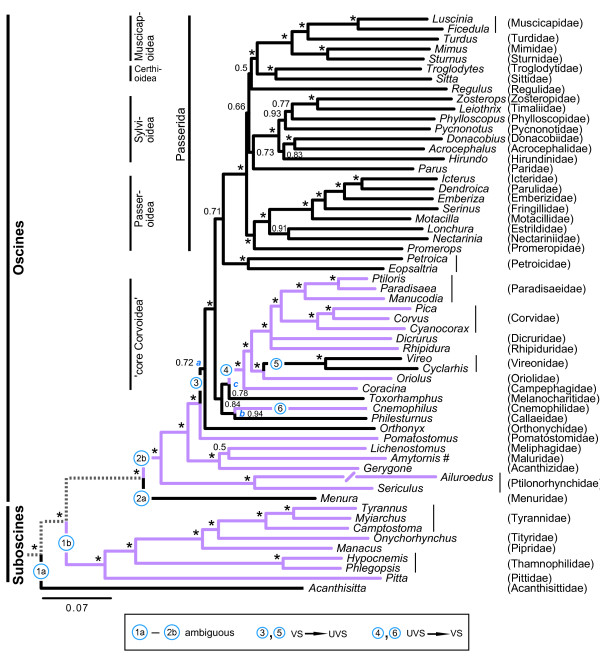
We have classified a large sample of passeriform species as VS or UVS from genomic DNA and mapped the evolution of this character on a passerine phylogeny inferred from published molecular sequence data. Sequencing a small gene fragment has allowed us to trace the trait changing from one stable state to another through the radiation of the passeriform birds. Their ancestor is hypothesised to be UVS. In the subsequent radiation, colour vision changed between UVS and VS at least eight times.
The phylogenetic distribution of SWS1 cone opsin types in Passeriformes reveals a much higher degree of complexity in avian colour vision evolution than what was previously indicated from the limited data available. Clades with variation in the colour vision system are nested among clades with a seemingly stable VS or UVS state, providing a rare opportunity to understand how an ecologically important trait under simple genetic control may co-evolve with, and be stabilised by, associated traits in a character complex.
鸟类的种间色彩视觉差异分为两类:紫敏(VS)和紫外敏(UVS)。它们的特点是四个单圆锥体中最敏感的短波的光谱灵敏度,即 SWS1,它似乎只受到一个氨基酸取代的直接控制,这种取代发生在圆锥感受蛋白中。SWS1 光谱灵敏度的变化在生态学上很重要,因为它们影响鸟类准确评估潜在配偶、寻找食物和最大限度地减少社交信号对捕食者可见性的能力。尽管如此,现有数据表明,类间转变很少见,鸟类进化中只有四到五次独立获得 UV 敏感性。
我们从基因组 DNA 中对大量雀形目物种进行了 VS 或 UVS 分类,并根据已发表的分子序列数据推断的雀形目系统发育图上对该特征的进化进行了定位。对一小段基因片段进行测序,使我们能够通过雀形目鸟类的辐射追踪从一种稳定状态转变为另一种稳定状态的特征。假设它们的祖先为 UVS。在随后的辐射中,颜色视觉在 UVS 和 VS 之间至少发生了八次变化。
雀形目 SWS1 圆锥感受蛋白类型的系统发育分布揭示了鸟类色彩视觉进化的复杂性比之前从有限的数据中所表明的要高得多。在色彩视觉系统发生变化的进化枝中嵌套着看似稳定的 VS 或 UVS 状态的进化枝,这为了解一个在简单遗传控制下具有生态重要性的特征如何与相关特征共同进化并通过特征复合体而稳定提供了一个难得的机会。