Department of Chemistry, College of Science, King Saud University, P.O. Box 2455, Riyadh 11451, Saudi Arabia.
Molecules. 2011 Oct 24;16(10):8919-29. doi: 10.3390/molecules16108919.
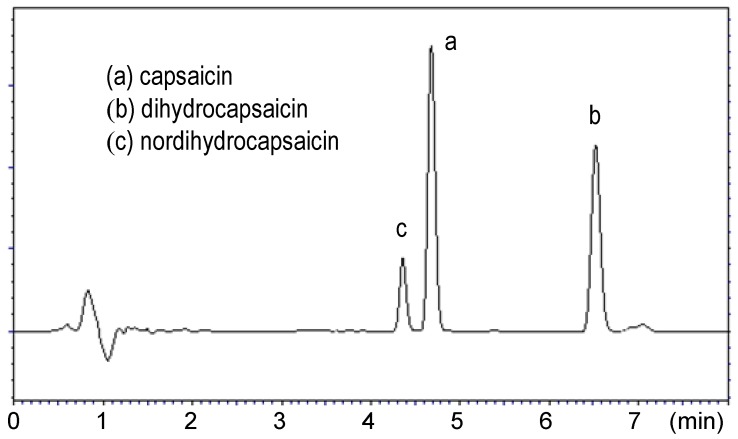
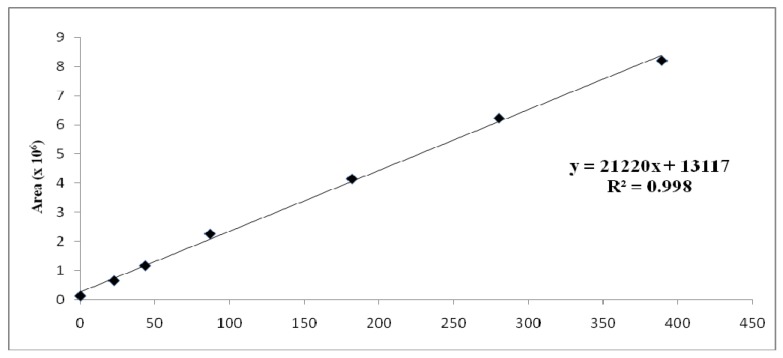
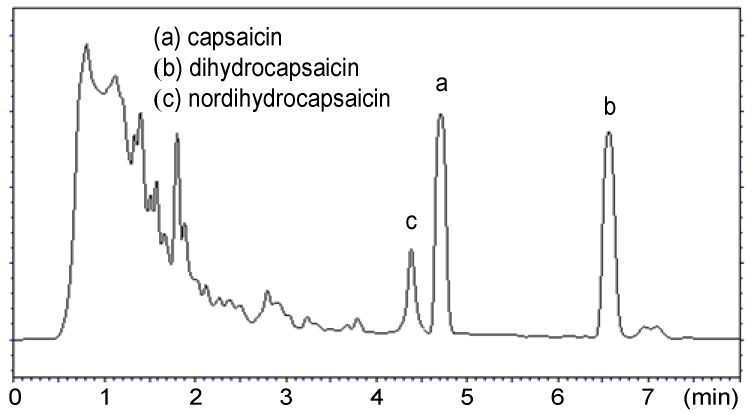
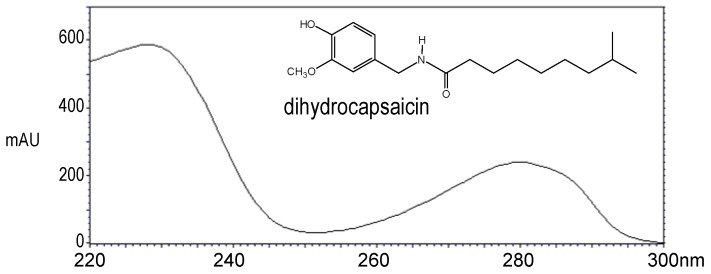
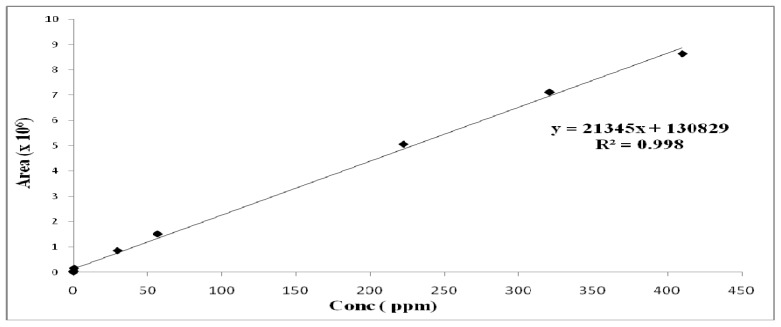
The aim of the present study was to determine the content of capsaicin and dihydrocapsaicin in Capsicum samples collected from city markets in Riyadh (Saudi Arabia), calculate their pungency in Scoville heat units (SHU) and evaluate the average daily intake of capsaicin for the population of Riyadh. The investigated samples consisted of hot chillies, red chillies, green chillies, green peppers, red peppers and yellow peppers. Extraction of capsaicinoids was done using ethanol as solvent, while high performance liquid chromatography (HPLC) was used for separation, identification and quantitation of the components. The limit of detection (LOD) of the method was 0.09 and 0.10 µg/g for capsaicin and dihydrocapsaicin, respectively, while the limit of quantification (LOQ) was 0.30 and 0.36 µg/g for capsaicin and dihydrocapsaicin, respectively. Hot chillies showed the highest concentration of capsaicin (4249.0 ± 190.3 µg/g) and the highest pungency level (67984.60 SHU), whereas green peppers had the lowest detected concentration (1.0 ± 0.9 µg/g); green peppers, red peppers and yellow peppers were non pungent. The mean consumption of peppers for Riyadh city population was determined to be 15.5 g/person/day while the daily capsaicin intake was 7.584 mg/person/day.
本研究旨在测定从沙特阿拉伯利雅得市农贸市场采集的辣椒样品中辣椒素和二氢辣椒素的含量,用斯科维尔热单位(SHU)计算其辣度,并评估利雅得市居民的辣椒素平均日摄入量。研究样品包括辣椒、红辣椒、绿辣椒、青椒、红椒和黄椒。采用乙醇作为溶剂提取辣椒素类物质,采用高效液相色谱(HPLC)对成分进行分离、鉴定和定量。该方法的检测限(LOD)分别为 0.09 和 0.10 µg/g,定量限(LOQ)分别为 0.30 和 0.36 µg/g。辣椒素含量最高的是辣椒(4249.0 ± 190.3 µg/g),辣度最高(67984.60 SHU),而青椒中的辣椒素含量最低(1.0 ± 0.9 µg/g);青椒、红椒和黄椒无辣味。确定利雅得市居民的辣椒摄入量为 15.5 g/人/天,辣椒素日摄入量为 7.584 毫克/人/天。