Division of Cardiology, Yonsei University College of Medicine, Seoul, Korea.
Yonsei Med J. 2011 Nov;52(6):1025-7. doi: 10.3349/ymj.2011.52.6.1025.
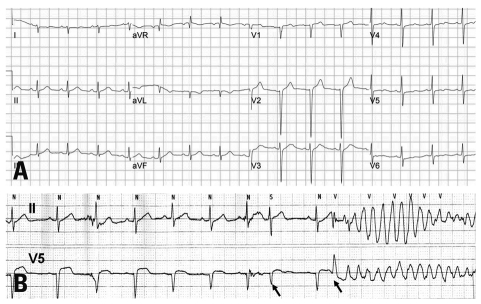
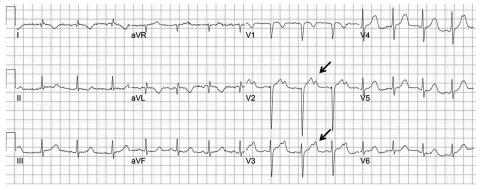
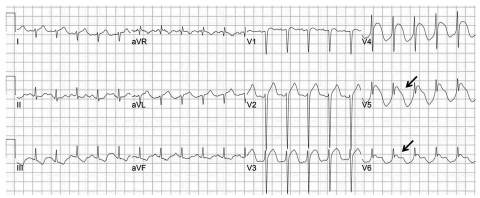
Long QT syndrome is associated with lethal tachyarrhythmia that can lead to syncope, seizure, and sudden death. Congenital long QT syndrome is a genetic disorder, characterized by delayed cardiac repolarization and prolongation of the QT interval on the electrocardiogram (ECG). Type 2 congenital long QT is linked to mutations in the human ether a go-go-related gene (HERG). There are environmental triggers of adverse cardiac events such as emotional and acoustic stimuli, but fever can also be a potential trigger of life-threatening arrhythmias in long QT syndrome type 2 patients. Herein, we report a healthy young man who experienced fever-induced polymorphic ventricular tachycardia and QT interval prolongation.
长 QT 综合征与致命性心动过速有关,可导致晕厥、癫痫发作和猝死。先天性长 QT 综合征是一种遗传性疾病,其特征为心脏复极延迟和心电图(ECG)上 QT 间期延长。2 型先天性长 QT 与人类 ether-a-go-go 相关基因(HERG)的突变有关。情绪和声音刺激等环境因素可引发不良心脏事件,但发热也可能是 2 型长 QT 综合征患者发生危及生命的心律失常的潜在诱因。在此,我们报告一例健康年轻男性,其因发热诱发多形性室性心动过速和 QT 间期延长。