Department of Physiology and Pharmacology, University of Western Ontario, London, N6A 5C1, Canada.
Dis Model Mech. 2012 Jan;5(1):73-82. doi: 10.1242/dmm.008128. Epub 2011 Oct 25.
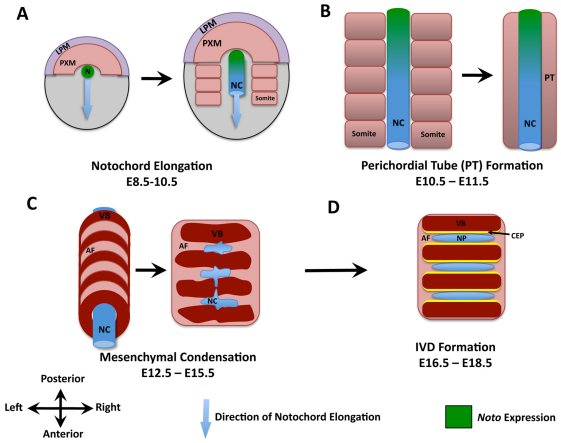
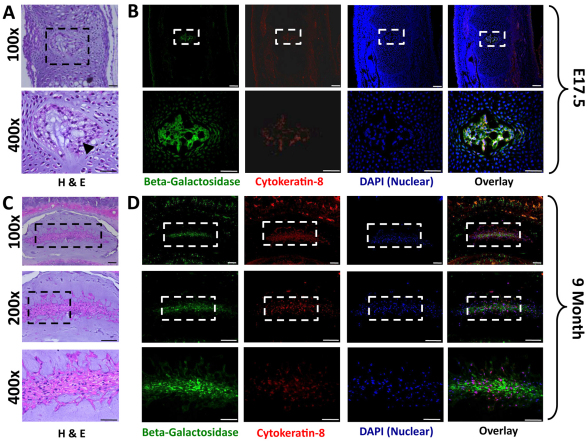
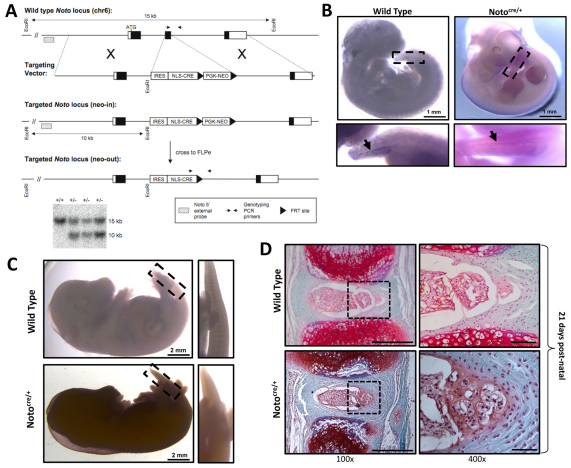
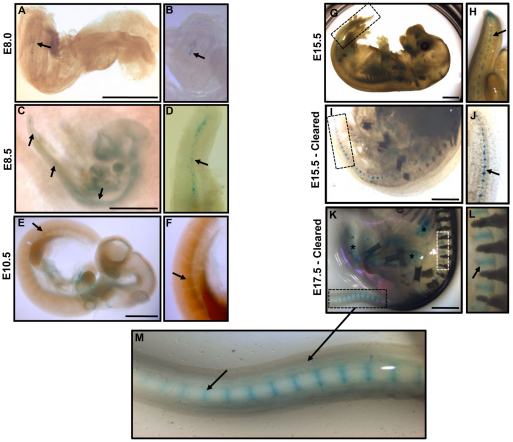
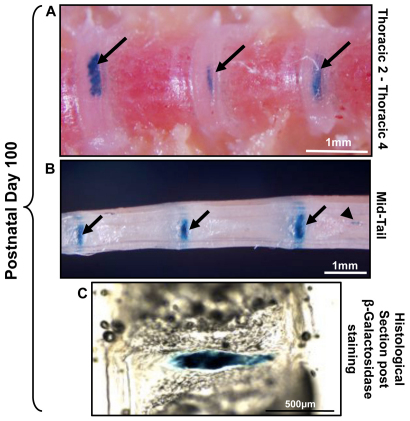
Back pain related to intervertebral disc degeneration is the most common musculoskeletal problem, with a lifetime prevalence of 82%. The lack of effective treatment for this widespread problem is directly related to our limited understanding of disc development, maintenance and degeneration. The aim of this study was to determine the developmental origins of nucleus pulposus cells within the intervertebral disc using a novel notochord-specific Cre mouse. To trace the fate of notochordal cells within the intervertebral disc, we derived a notochord-specific Cre mouse line by targeting the homeobox gene Noto. Expression of this gene is restricted to the node and the posterior notochord during gastrulation [embryonic day 7.5 (E7.5)-E12.5]. The Noto-cre mice were crossed with a conditional lacZ reporter for visualization of notochord fate in whole-mount embryos. We performed lineage-tracing experiments to examine the contribution of the notochord to spinal development from E12.5 through to skeletally mature mice (9 months). Fate mapping studies demonstrated that, following elongation and formation of the primitive axial skeleton, the notochord gives rise to the nucleus pulposus in fully formed intervertebral discs. Cellular localization of β-galactosidase (encoded by lacZ) and cytokeratin-8 demonstrated that both notochordal cells and chondrocyte-like nucleus pulposus cells are derived from the embryonic notochord. These studies establish conclusively that notochordal cells act as embryonic precursors to all cells found within the nucleus pulposus of the mature intervertebral disc. This suggests that notochordal cells might serve as tissue-specific progenitor cells within the disc and establishes the Noto-cre mouse as a unique tool to interrogate the contribution of notochordal cells to both intervertebral disc development and disc degeneration.
与椎间盘退行性变相关的背痛是最常见的肌肉骨骼问题,终生患病率为 82%。对于这种广泛存在的问题,缺乏有效的治疗方法,这直接与我们对椎间盘发育、维持和退变的有限认识有关。本研究旨在使用新型脊索特异性 Cre 小鼠确定椎间盘内髓核细胞的发育起源。为了追踪椎间盘内脊索细胞的命运,我们通过靶向同源盒基因 Noto 构建了一种脊索特异性 Cre 小鼠系。该基因的表达在原肠胚形成期(胚胎第 7.5 天[E7.5]-E12.5)局限于节点和后脊索。Noto-cre 小鼠与一个条件性 lacZ 报告基因杂交,以可视化整个胚胎中脊索命运。我们进行了谱系追踪实验,以检查脊索对 E12.5 至骨骼成熟(9 个月)小鼠脊柱发育的贡献。命运图谱研究表明,在原始轴向骨骼伸长和形成后,脊索产生完全形成的椎间盘内的髓核。β-半乳糖苷酶(由 lacZ 编码)和细胞角蛋白-8 的细胞定位表明,脊索细胞和软骨样髓核细胞均来自胚胎脊索。这些研究明确证实,脊索细胞作为成熟椎间盘髓核内所有细胞的胚胎前体细胞发挥作用。这表明脊索细胞可能作为椎间盘内组织特异性祖细胞,并确立了 Noto-cre 小鼠作为一种独特的工具,用于探究脊索细胞对椎间盘发育和退变的贡献。