Department of Genetics, University of Cambridge, Cambridge, United Kingdom.
PLoS Genet. 2011 Oct;7(10):e1002337. doi: 10.1371/journal.pgen.1002337. Epub 2011 Oct 20.
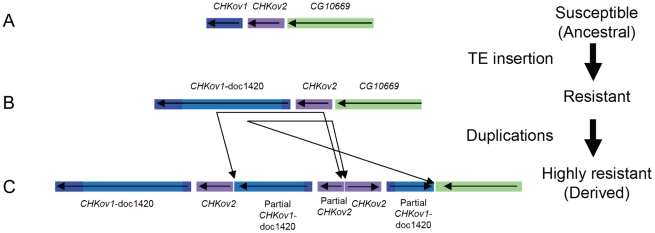
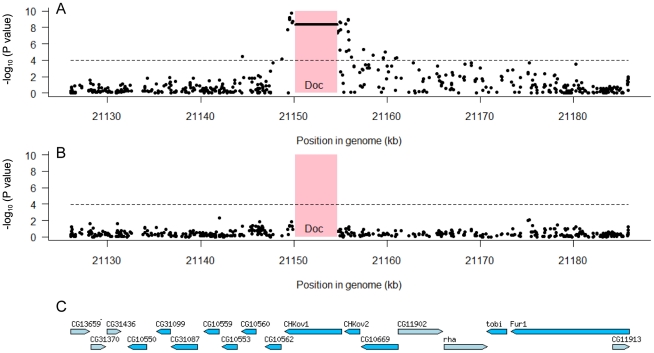
To understand the molecular basis of how hosts evolve resistance to their parasites, we have investigated the genes that cause variation in the susceptibility of Drosophila melanogaster to viral infection. Using a host-specific pathogen of D. melanogaster called the sigma virus (Rhabdoviridae), we mapped a major-effect polymorphism to a region containing two paralogous genes called CHKov1 and CHKov2. In a panel of inbred fly lines, we found that a transposable element insertion in the protein coding sequence of CHKov1 is associated with increased resistance to infection. Previous research has shown that this insertion results in a truncated messenger RNA that encodes a far shorter protein than the susceptible allele. This resistant allele has rapidly increased in frequency under directional selection and is now the commonest form of the gene in natural populations. Using genetic mapping and site-specific recombination, we identified a third genotype with considerably greater resistance that is currently rare in the wild. In these flies there have been two duplications, resulting in three copies of both the truncated allele of CHKov1 and CHKov2 (one of which is also truncated). Remarkably, the truncated allele of CHKov1 has previously been found to confer resistance to organophosphate insecticides. As estimates of the age of this allele predate the use of insecticides, it is likely that this allele initially functioned as a defence against viruses and fortuitously "pre-adapted" flies to insecticides. These results demonstrate that strong selection by parasites for increased host resistance can result in major genetic changes and rapid shifts in allele frequencies; and, contrary to the prevailing view that resistance to pathogens can be a costly trait to evolve, the pleiotropic effects of these changes can have unexpected benefits.
为了理解宿主对寄生虫产生抗性的分子基础,我们研究了导致黑腹果蝇对病毒感染易感性发生变异的基因。利用一种针对黑腹果蝇的宿主特异性病原体——西格玛病毒(Rhabdoviridae),我们将一个主要效应多态性映射到包含两个同源基因 CHKov1 和 CHKov2 的区域。在一组近交系果蝇品系中,我们发现 CHKov1 蛋白编码序列中的转座元件插入与感染抗性增加有关。先前的研究表明,这种插入导致编码比易感等位基因短得多的蛋白质的信使 RNA 截断。这种抗性等位基因在定向选择下迅速增加频率,现已成为自然种群中最常见的基因形式。通过遗传图谱和位点特异性重组,我们确定了第三种具有更高抗性的基因型,目前在野外非常罕见。在这些果蝇中,发生了两次重复,导致 CHKov1 和 CHKov2 的截断等位基因都有三个拷贝(其中一个也被截断)。值得注意的是,CHKov1 的截断等位基因先前被发现可赋予对有机磷杀虫剂的抗性。由于对该等位基因的年龄估计早于杀虫剂的使用,因此该等位基因最初可能是作为一种针对病毒的防御手段,并偶然地使果蝇对杀虫剂具有“预先适应”能力。这些结果表明,寄生虫对宿主抗性增强的强烈选择会导致重大遗传变化和等位基因频率的快速变化;与普遍观点相反,病原体抗性的进化可能是一种代价高昂的特征,这些变化的多效性可能会带来意想不到的好处。