Department of Botany, Institute of Ecology and Earth Sciences, University of Tartu, Tartu, Estonia.
PLoS One. 2011;6(10):e26505. doi: 10.1371/journal.pone.0026505. Epub 2011 Oct 20.
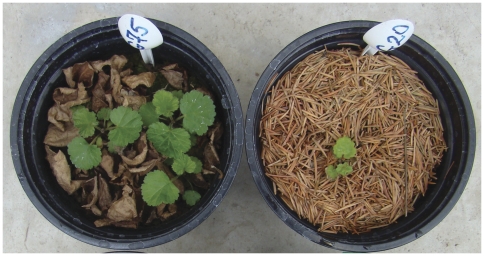
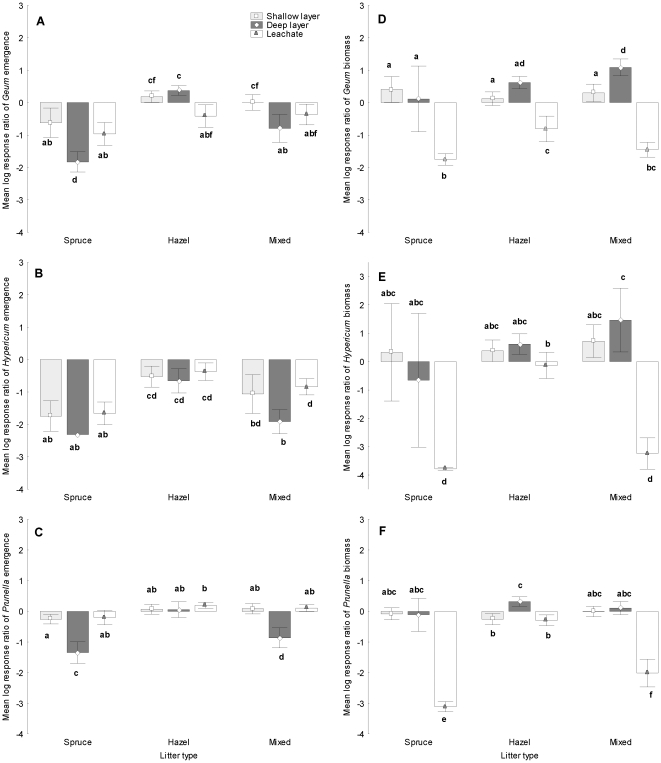
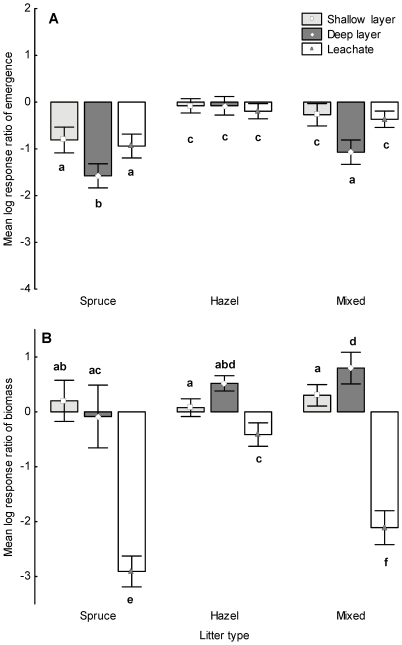
The effect of litter on seedling establishment can influence species richness in plant communities. The effect of litter depends on amount, and also on litter type, but relatively little is known about the species-specific effects of litter. We conducted a factorial greenhouse experiment to examine the effect of litter type, using two woody species that commonly co-occur in boreonemoral forest--evergreen spruce (Picea abies), deciduous hazel (Corylus avellana), and a mixture of the two species--and litter amount--shallow (4 mm), deep (12 mm) and leachate--on seedling emergence and biomass of three understorey species. The effect of litter amount on seedling emergence was highly dependent on litter type; while spruce needle litter had a significant negative effect that increased with depth, seedling emergence in the presence of hazel broadleaf litter did not differ from control pots containing no litter. Mixed litter of both species also had a negative effect on seedling emergence that was intermediate compared to the single-species treatments. Spruce litter had a marginally positive (shallow) or neutral effect (deep) on seedling biomass, while hazel and mixed litter treatments had significant positive effects on biomass that increased with depth. We found non-additive effects of litter mixtures on seedling biomass indicating that high quality hazel litter can reduce the negative effects of spruce. Hazel litter does not inhibit seedling emergence; it increases seedling growth, and creates better conditions for seedling growth in mixtures by reducing the suppressive effect of spruce litter, having a positive effect on understorey species richness.
凋落物对幼苗建立的影响会影响植物群落的物种丰富度。凋落物的影响取决于数量,也取决于凋落物类型,但对凋落物的物种特异性影响知之甚少。我们进行了一个析因温室实验,使用两种常见于北方森林的木本物种——常绿云杉(Picea abies)、落叶榛(Corylus avellana)和两种物种的混合物,以及凋落物量——浅层(4 毫米)、深层(12 毫米)和淋滤液——来研究凋落物类型、凋落物量对三种林下物种幼苗出现和生物量的影响。凋落物量对幼苗出现的影响高度依赖于凋落物类型;虽然云杉针叶凋落物具有显著的负效应,随着深度的增加而增加,但在含有榛子阔叶凋落物的情况下,幼苗的出现与不含凋落物的对照盆没有区别。两种物种的混合凋落物对幼苗出现的影响也介于单种处理之间,具有负效应。云杉凋落物对幼苗生物量有轻微的正(浅层)或中性(深层)影响,而榛子和混合凋落物处理对生物量有显著的正影响,随着深度的增加而增加。我们发现凋落物混合物对幼苗生物量的非加性效应表明,高质量的榛子凋落物可以减少云杉的负面影响。榛子凋落物不会抑制幼苗的出现;它通过减少云杉凋落物的抑制作用,增加幼苗的生长,并为混合物中的幼苗生长创造更好的条件,对林下物种丰富度有积极影响。