Khoury George A, Baliban Richard C, Floudas Christodoulos A
Department of Chemical and Biological Engineering, A325 Engineering Quadrangle, Princeton University, Princeton, NJ 08544.
Sci Rep. 2011 Sep 13;1. doi: 10.1038/srep00090.
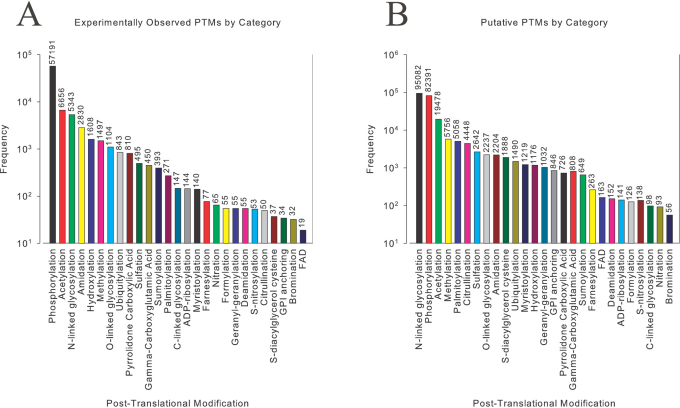
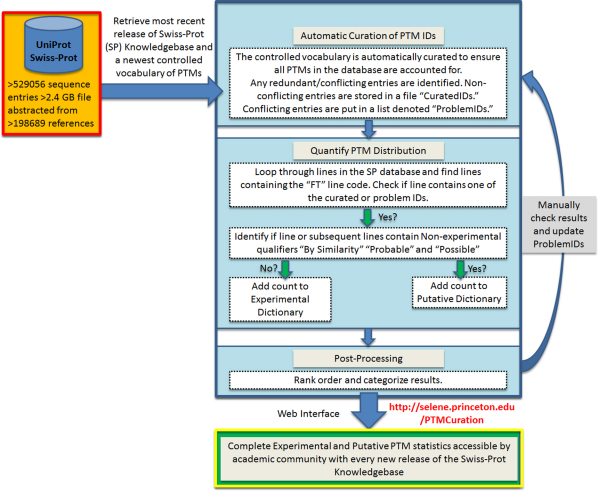
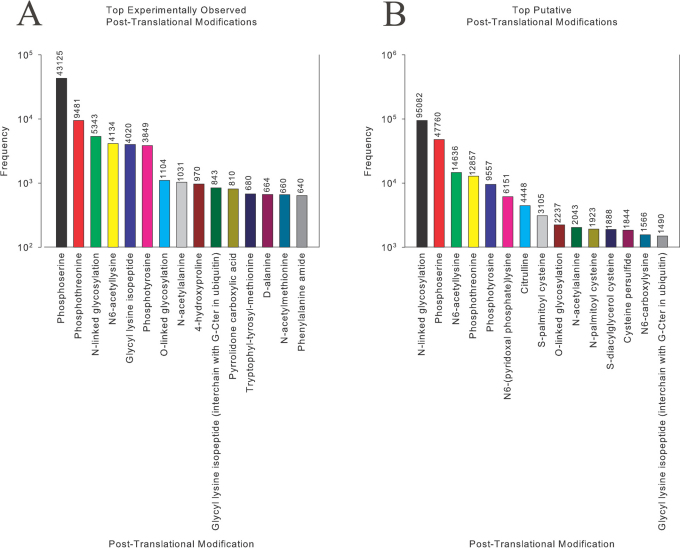
Post-translational modifications (PTMs) broadly contribute to the recent explosion of proteomic data and possess a complexity surpassing that of protein design. PTMs are the chemical modification of a protein after its translation, and have wide effects broadening its range of functionality. Based on previous estimates, it is widely believed that more than half of proteins are glycoproteins. Whereas mutations can only occur once per position, different forms of post-translational modifications may occur in tandem. With the number and abundances of modifications constantly being discovered, there is no method to readily assess their relative levels. Here we report the relative abundances of each PTM found experimentally and putatively, from high-quality, manually curated, proteome-wide data, and show that at best, less than one-fifth of proteins are glycosylated. We make available to the academic community a continuously updated resource (http://selene.princeton.edu/PTMCuration) containing the statistics so scientists can assess "how many" of each PTM exists.
翻译后修饰(PTMs)在很大程度上推动了近期蛋白质组学数据的激增,其复杂性超过了蛋白质设计。翻译后修饰是蛋白质翻译后发生的化学修饰,具有广泛的影响,拓宽了其功能范围。根据先前的估计,人们普遍认为超过一半的蛋白质是糖蛋白。虽然每个位置只能发生一次突变,但不同形式的翻译后修饰可能会串联出现。随着修饰的数量和丰度不断被发现,目前还没有方法能够轻松评估它们的相对水平。在此,我们报告了从高质量、人工整理的全蛋白质组数据中通过实验发现和推测出的每种翻译后修饰的相对丰度,并表明最多只有不到五分之一的蛋白质发生了糖基化。我们向学术界提供了一个不断更新的资源(http://selene.princeton.edu/PTMCuration),其中包含这些统计数据,以便科学家们能够评估每种翻译后修饰“有多少”。