Division of Pulmonary Medicine, Infection and Oncology, Nippon Medical School, Tokyo, Japan.
Respir Res. 2011 Oct 28;12(1):143. doi: 10.1186/1465-9921-12-143.
A phase III trial in Japan showed that pirfenidone is effective for idiopathic pulmonary fibrosis (IPF). To find out which patients specifically benefit from pirfenidone, we analyzed in an exploratory manner the data from the phase III trial.
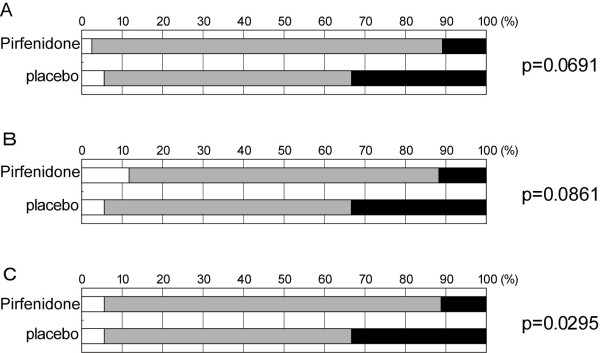
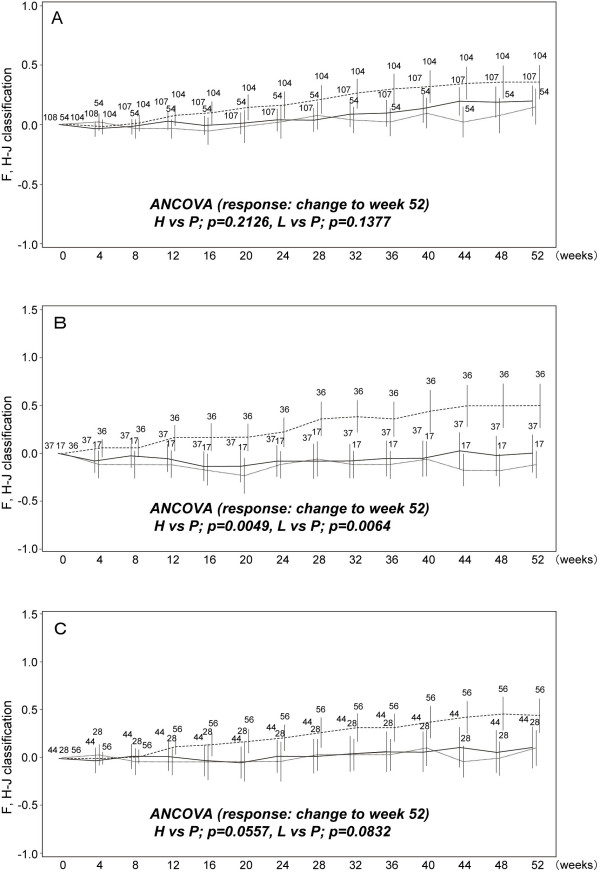
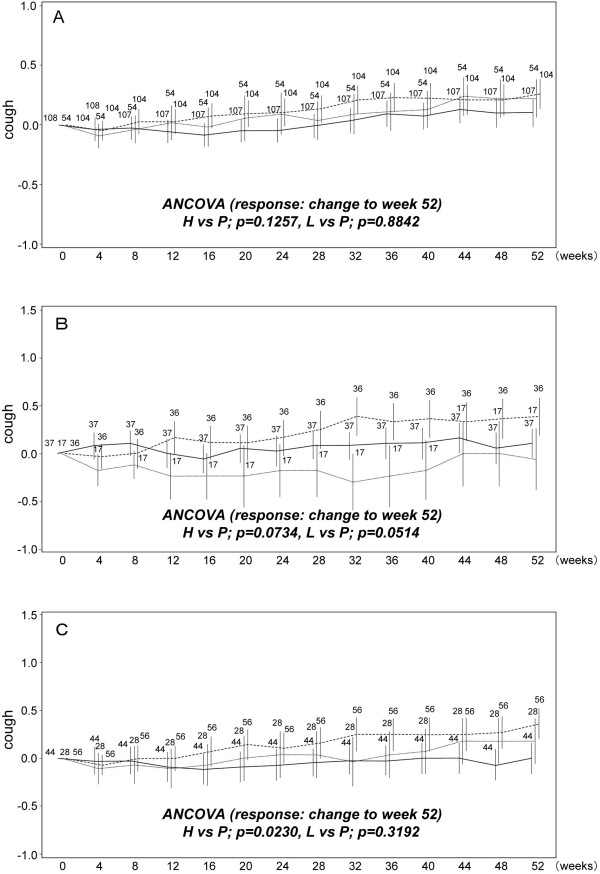
The patients in the phase III trial were stratified by baseline percentage predicted vital capacity (%VC), arterial oxygen partial pressure (PaO(2)), and the lowest oxygen saturation by pulse oximetry (SpO(2)) during the 6-minute steady-state exercise test (6MET). In the subpopulations, changes in VC and subjective symptoms (cough and dyspnea on the Fletcher, Hugh-Jones [F, H-J] Classification scale) were evaluated in patients treated with high-dose (1800 mg/day) pirfenidone, low-dose (1200 mg/day) pirfenidone, and placebo at week 52.
Significant efficacy of pirfenidone in reducing the decline in VC could be seen in a subpopulation having %VC ≥ 70% and SpO(2) < 90% at baseline. This favorable effect was accompanied by categorical change in VC and progression-free survival time. In the subpopulation, pirfenidone significantly suppressed cough and dyspnea.
IPF patients having %VC ≥ 70% and SpO(2) < 90% at baseline will most likely benefit from pirfenidone when evaluated using changes in VC (and %VC), and cough and dyspnea symptoms. This subpopulation could expect to benefit most from pirfenidone treatment.
This clinical trial was registered with the Japan Pharmaceutical Information Center (JAPIC) on September 13th, 2005 (REGISTRATION NUMBER: JAPICCTI-050121).
日本的一项 III 期临床试验表明,吡非尼酮对特发性肺纤维化(IPF)有效。为了找出哪些患者特别受益于吡非尼酮,我们以探索性的方式分析了 III 期临床试验的数据。
III 期临床试验的患者根据基线预计肺活量百分比(%VC)、动脉血氧分压(PaO2)和 6 分钟稳态运动试验(6MET)中最低脉搏血氧饱和度(SpO2)进行分层。在亚组中,评估了接受高剂量(1800 mg/天)吡非尼酮、低剂量(1200 mg/天)吡非尼酮和安慰剂治疗的患者在第 52 周时 VC 和主观症状(咳嗽和弗莱彻-休斯-琼斯[F、H-J]分类量表上的呼吸困难)的变化。
在基线时 %VC≥70%和 SpO2<90%的亚组中,吡非尼酮可显著减少 VC 的下降,具有疗效。这种有利的效果伴随着 VC 的分类变化和无进展生存时间。在该亚组中,吡非尼酮显著抑制了咳嗽和呼吸困难。
基线时 %VC≥70%和 SpO2<90%的 IPF 患者,通过 VC(和%VC)以及咳嗽和呼吸困难症状的变化,最有可能从吡非尼酮治疗中受益。该亚组最有可能从吡非尼酮治疗中获益。
本临床试验于 2005 年 9 月 13 日在日本药品信息中心(JAPIC)注册(注册号:JAPICCTI-050121)。