Department of Cardiology, Shanghai Ninth People's Hospital, Shanghai JiaoTong University School of Medicine, Shanghai, China.
PLoS One. 2011;6(10):e26441. doi: 10.1371/journal.pone.0026441. Epub 2011 Oct 24.
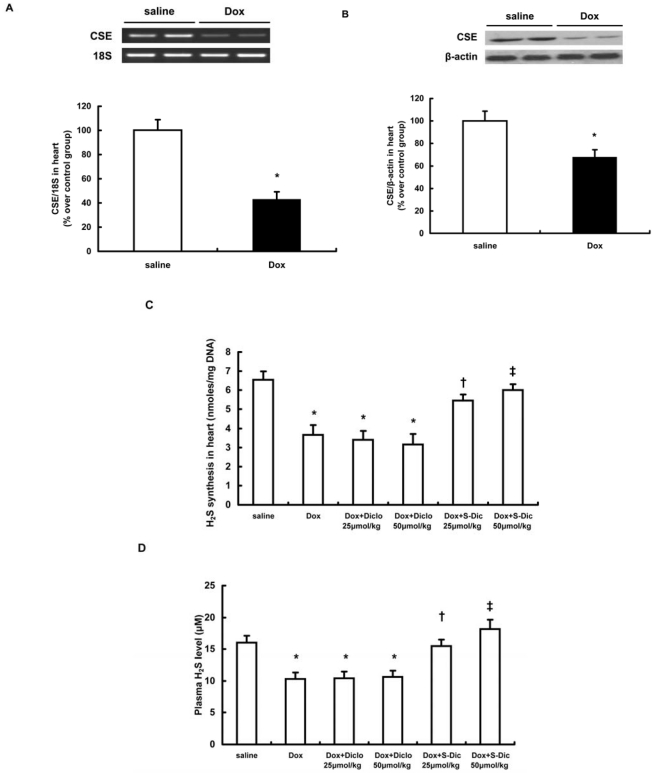
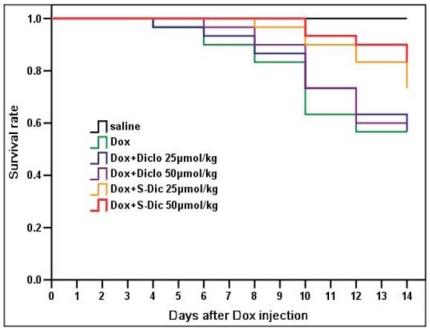
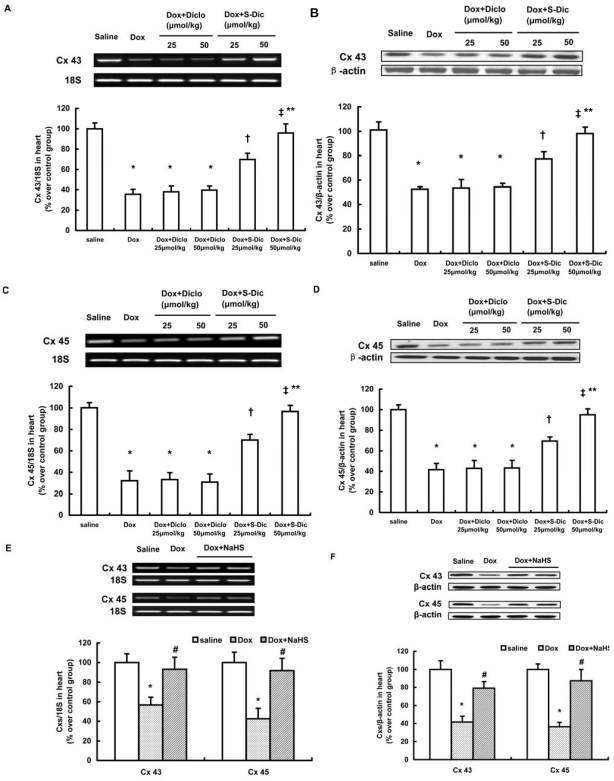
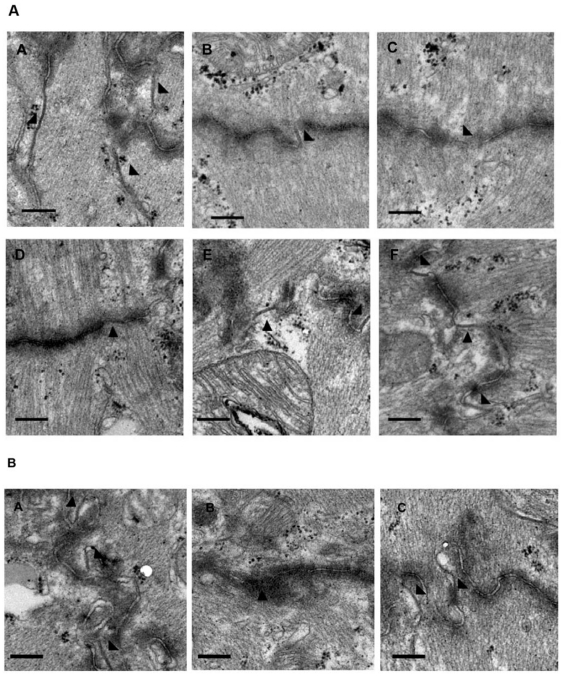
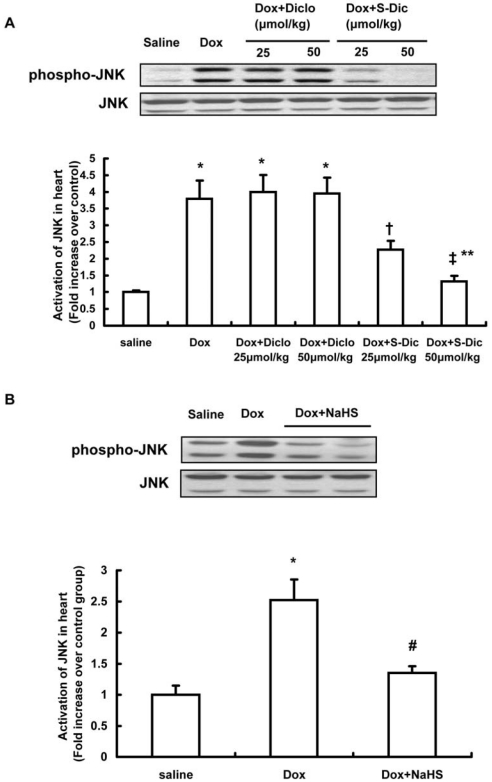
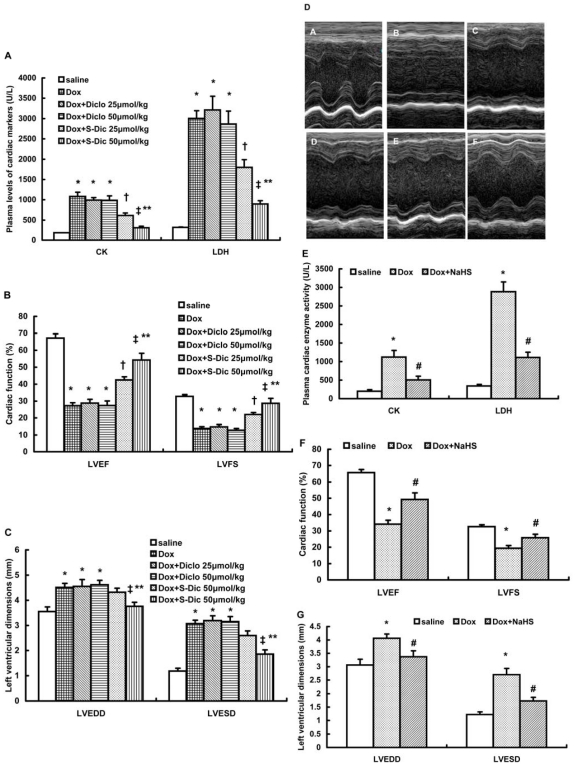
Hydrogen sulfide (H(2)S), as a novel gaseous mediator, plays important roles in mammalian cardiovascular tissues. In the present study, we investigated the cardioprotective effect of S-diclofenac (2-[(2,6-dichlorophenyl)amino] benzeneacetic acid 4-(3H-1,2,dithiol-3-thione-5-yl)phenyl ester), a novel H(2)S-releasing derivative of diclofenac, in a murine model of doxorubicin-induced cardiomyopathy. After a single dose injection of doxorubicin (15 mg/kg, i.p.), male C57BL/6J mice were given daily treatment of S-diclofenac (25 and 50 µmol/kg, i.p.), diclofenac (25 and 50 µmol/kg, i.p.), NaHS (50 µmol/kg, i.p.), or same volume of vehicle. The cardioprotective effect of S-diclofenac was observed after 14 days. It showed that S-diclofenac, but not diclofenac, dose-dependently inhibited the doxorubicin-induced downregulation of cardiac gap junction proteins (connexin 43 and connexin 45) and thus reversed the remodeling of gap junctions in hearts. It also dose-dependently suppressed doxorubicin-induced activation of JNK in hearts. Furthermore, S-diclofenac produced a dose-dependent anti-inflammatory and anti-oxidative effect in this model. As a result, S-diclofenac significantly attenuated doxorubicin-related cardiac injury and cardiac dysfunction, and improved the survival rate of mice with doxorubicin-induced cardiomyopathy. These effects of S-diclofenac were mimicked in large part by NaHS. Therefore, we propose that H(2)S released from S-diclofenac in vivo contributes to the protective effect in doxorubicin-induced cardiomyopathy. These data also provide evidence for a critical role of H(2)S in the pathogenesis of doxorubicin-induced cardiomyopathy.
硫化氢 (H(2)S) 作为一种新型气态介质,在哺乳动物心血管组织中发挥重要作用。在本研究中,我们研究了 S-双氯芬酸(2-[(2,6-二氯苯基)氨基]苯乙酸 4-(3H-1,2,二硫醇-3-噻酮-5-基)苯基酯),一种新型的双氯芬酸 H(2)S 释放衍生物,在阿霉素诱导的心肌病小鼠模型中的心脏保护作用。在单次注射阿霉素 (15mg/kg,ip) 后,雄性 C57BL/6J 小鼠每天接受 S-双氯芬酸 (25 和 50µmol/kg,ip)、双氯芬酸 (25 和 50µmol/kg,ip)、NaHS (50µmol/kg,ip) 或相同体积的载体治疗。S-双氯芬酸的心脏保护作用在 14 天后观察到。结果表明,S-双氯芬酸而非双氯芬酸剂量依赖性地抑制阿霉素诱导的心脏缝隙连接蛋白 (连接蛋白 43 和连接蛋白 45) 下调,从而逆转心脏缝隙连接的重构。它还剂量依赖性地抑制阿霉素诱导的 JNK 在心脏中的激活。此外,S-双氯芬酸在该模型中产生了剂量依赖性的抗炎和抗氧化作用。结果,S-双氯芬酸显著减轻了阿霉素相关的心脏损伤和心功能障碍,并提高了阿霉素诱导的心肌病小鼠的存活率。S-双氯芬酸的这些作用在很大程度上被 NaHS 模拟。因此,我们提出 S-双氯芬酸在体内释放的 H(2)S 有助于阿霉素诱导的心肌病的保护作用。这些数据还为 H(2)S 在阿霉素诱导的心肌病发病机制中的关键作用提供了证据。