Department of Epidemiology, Bloomberg School of Public Health, Johns Hopkins University, 615 North Wolfe Street, Baltimore, MD, USA.
Malar J. 2011 Oct 31;10:324. doi: 10.1186/1475-2875-10-324.
Malaria elimination will require that both symptomatic- and asymptomatic-infected persons be identified and treated. However, well-characterized, individual-level risk factors for malaria may not be valid in regions with declining malaria transmission. Changes in individual-level correlates of malaria infection were evaluated over three years in a region of declining malaria transmission in southern Zambia.
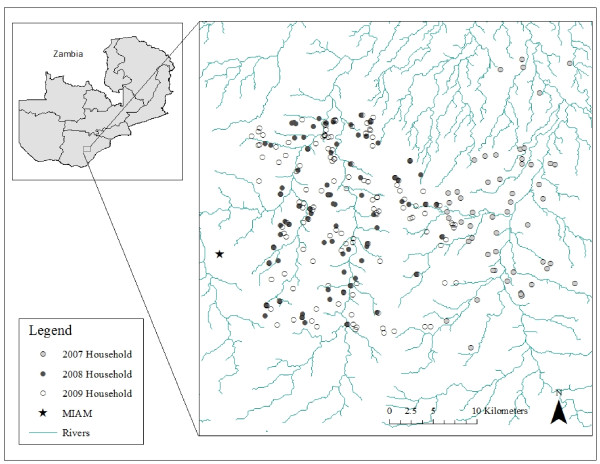
Malaria surveys were conducted in two study areas within the catchment area of Macha Hospital, Zambia in 2007 and 2008/2009. A random sample of households was identified from a digitized satellite image of the study areas. Cross-sectional surveys were conducted approximately five times throughout the year in each of the two study areas. During study visits, adults and caretakers of children were administered questionnaires and a blood sample was obtained for a rapid diagnostic test (RDT) for malaria.
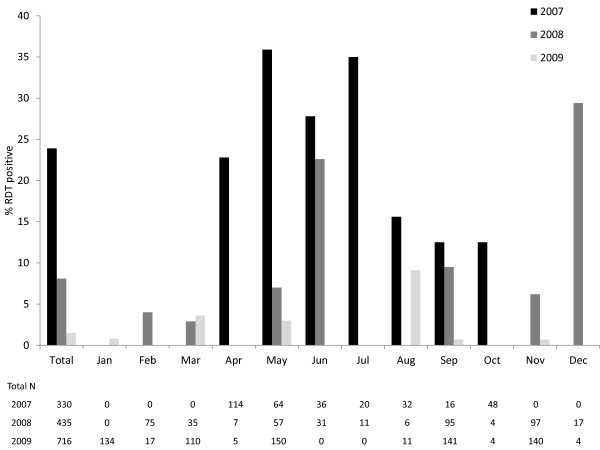
In the 2007 study area, 330 individuals were surveyed. 40.9% of participants lived in a household with at least one insecticide-treated bed net (ITN); however, only 45.2% reported sleeping under the ITN. 23.9% of participants were RDT positive. Correlates of RDT positivity included younger age, the presence of symptoms, testing during the rainy season, using an open water source, and not sleeping under an ITN. In the 2008 study area, 435 individuals were surveyed. 77.0% of participants lived in a household with at least one ITN; however, only 56.4% reported sleeping under the ITN. 8.1% of participants were RDT positive. RDT positivity was negatively correlated with the presence of symptoms within the last two weeks but positively correlated with documented fever. In 2009, 716 individuals were surveyed in the same area as 2008. 63.7% of participants lived in a household with at least one ITN; however, only 57.7% reported sleeping under the ITN. 1.5% of participants were RDT positive. Only self-reported fever was significantly correlated with RDT positivity.
With declining malaria prevalence, few individual-level characteristics were correlated with RDT positivity. This lack of correlation with individual characteristics hampers identification of individuals infected with malaria. Strategies based on ecological or environmental risk factors may be needed to target control efforts and achieve further reductions and elimination.
消除疟疾需要发现和治疗有症状和无症状感染者。然而,在疟疾传播率下降的地区,经过充分研究的个人疟疾感染的风险因素可能并不适用。本研究旨在评估赞比亚南部疟疾传播率下降地区三年内个体水平疟疾感染的相关因素变化。
2007 年和 2008/2009 年在赞比亚马查医院集水区内的两个研究地区进行疟疾调查。从研究地区的数字化卫星图像中确定随机抽样的家庭。在两个研究地区的每一年中,大约在五个不同时间点进行横断面调查。在研究访问期间,为成年人和儿童看护者进行问卷调查,并采集血样进行快速诊断检测(RDT)以检测疟疾。
在 2007 年的研究地区,共调查了 330 人。40.9%的参与者居住在至少有一个驱虫蚊帐(ITN)的家庭中,但只有 45.2%的参与者报告说睡觉时使用了 ITN。23.9%的参与者 RDT 检测呈阳性。RDT 检测阳性的相关因素包括年龄较小、有症状、雨季检测、使用开放水源和未使用 ITN。在 2008 年的研究地区,共调查了 435 人。77.0%的参与者居住在至少有一个 ITN 的家庭中,但只有 56.4%的参与者报告说睡觉时使用了 ITN。8.1%的参与者 RDT 检测呈阳性。RDT 阳性与最近两周内的症状呈负相关,但与有记录的发热呈正相关。2009 年,在 2008 年的同一地区调查了 716 人。63.7%的参与者居住在至少有一个 ITN 的家庭中,但只有 57.7%的参与者报告说睡觉时使用了 ITN。1.5%的参与者 RDT 检测呈阳性。只有自我报告的发热与 RDT 阳性显著相关。
随着疟疾流行率的下降,很少有个体特征与 RDT 阳性相关。这与个体特征的缺乏相关性阻碍了对疟疾感染者的识别。可能需要基于生态或环境风险因素的策略来确定控制措施的目标,以进一步减少和消除疟疾。