Federal Institute for Risk Assessment, Berlin, Germany.
Virol J. 2011 Oct 31;8:487. doi: 10.1186/1743-422X-8-487.
Hepatitis E virus (HEV) is a pathogen of emerging concern in industrialized countries. The consumption of wild boar meat has been identified as one risk factor for autochthonous HEV infections. Only limited information is available about thermal stability of HEV, mainly due to the lack of rapid and efficient cell culture systems for measurement of HEV infectivity.
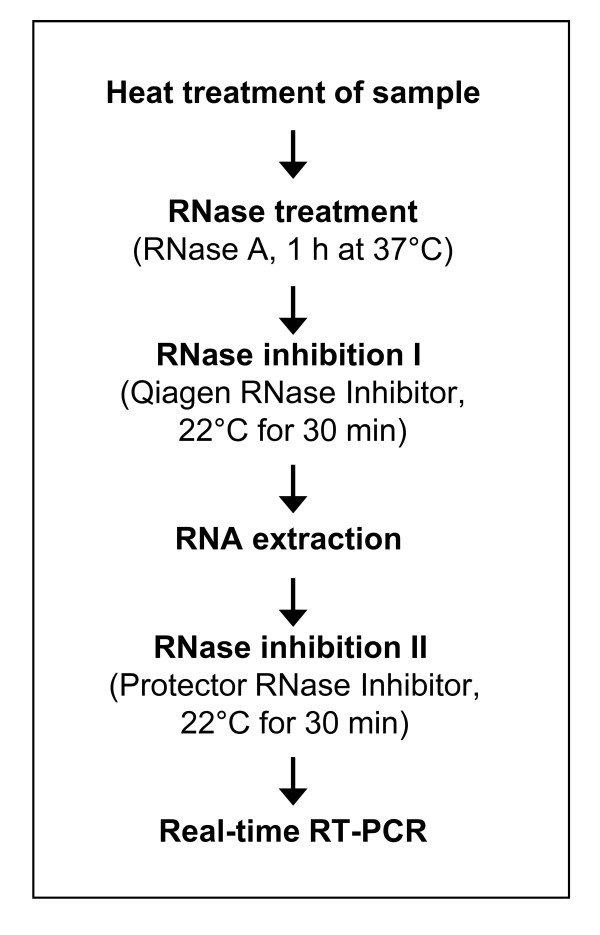
A molecular biological method was implemented in order to distinguish disassembled from intact viral particles using RNase treatment followed by quantitative real-time RT-PCR. The method was applied to a wild boar liver suspension containing HEV genotype 3.
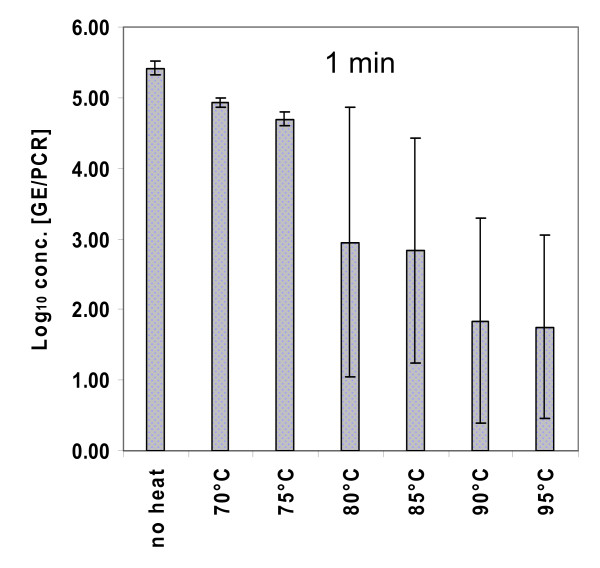
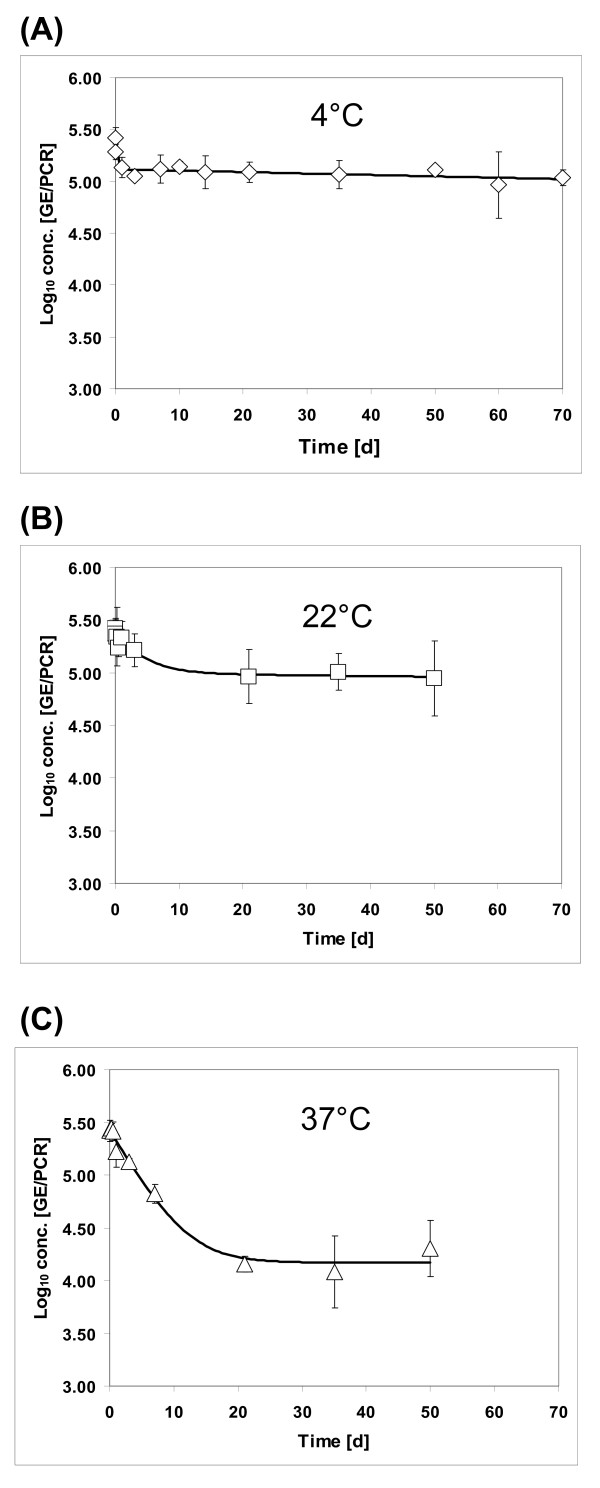
Time-course analyses indicated that the decline of protected RNA could be described by a biphasic model with an initial decrease followed by a stationary phase. The stationary phase was reached after 1 hour at 4°C, 3 days at 22°C and 7 days at 37°C with log reductions of 0.34, 0.45 and 1.24, respectively. Protected RNA was detectable until the end of the experiments at day 50 or 70. Heat exposure for 1 minute resulted in a log reduction of 0.48 at 70°C and increased with higher temperatures to 3.67 at 95°C. Although HEV infectivity titration by inoculation of the liver suspension onto three cell lines did not succeed, the results of the RNase-based method are in accordance with published cell culture-based data.
Measurement of intact viral particles using the RNase-based method may provide data on the stability of RNA viruses when cell culture-based infectivity titrations are not efficient or not available. The method enables processing of large sample numbers and may be suitable to estimate stability of HEV in different types of food.
戊型肝炎病毒(HEV)是发达国家新兴关注的病原体。食用野猪肉已被确定为本土 HEV 感染的一个风险因素。由于缺乏用于测量 HEV 感染性的快速有效的细胞培养系统,因此有关 HEV 的热稳定性的信息有限。
采用分子生物学方法,用 RNase 处理后进行定量实时 RT-PCR 来区分已解体和完整的病毒颗粒。该方法应用于含有 HEV 基因型 3 的野猪肝悬浮液。
时间过程分析表明,保护 RNA 的减少可以用双相模型来描述,初始下降后进入稳定阶段。在 4°C 下 1 小时、22°C 下 3 天和 37°C 下 7 天,初始下降后达到稳定阶段,对数减少分别为 0.34、0.45 和 1.24。在第 50 天或第 70 天实验结束时仍可检测到保护 RNA。在 70°C 下加热 1 分钟导致对数减少 0.48,随着温度升高至 95°C,减少增加至 3.67。尽管未能通过将肝悬浮液接种到三种细胞系来进行 HEV 感染性滴度测定,但基于 RNase 的方法的结果与已发表的基于细胞培养的研究数据一致。
使用基于 RNase 的方法测量完整病毒颗粒可以提供有关 RNA 病毒稳定性的数据,而细胞培养的感染性滴度测定既不高效也不可用时。该方法可处理大量样本,并且可能适合估计不同类型食品中 HEV 的稳定性。