State Key Laboratory of Cancer Biology, Xijing Hospital of Digestive Diseases, the Fourth Military Medical University, Xi'an, Shaanxi, China.
PLoS One. 2011;6(10):e26401. doi: 10.1371/journal.pone.0026401. Epub 2011 Oct 17.
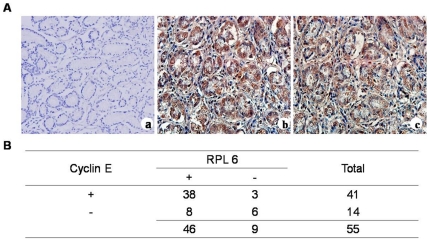
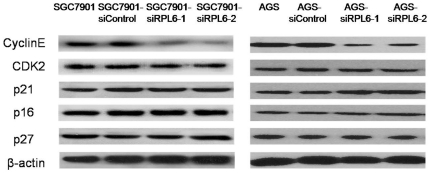
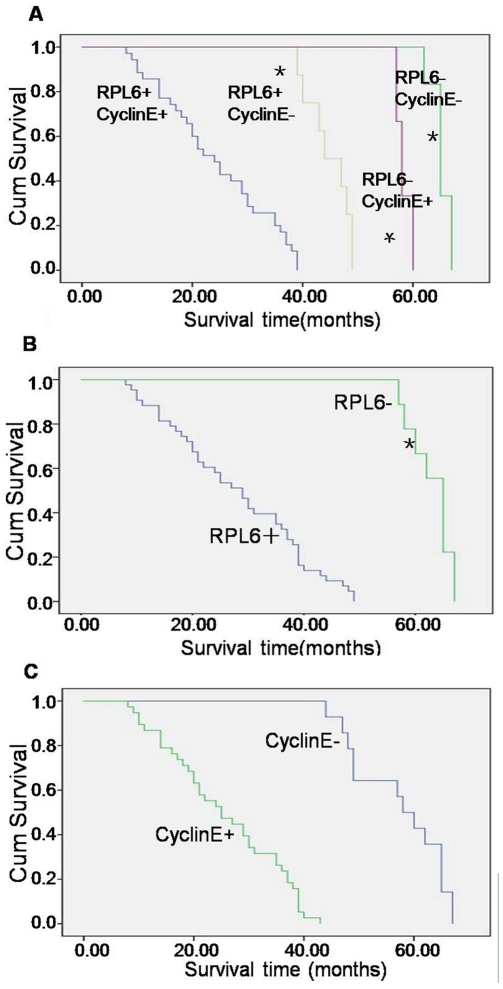
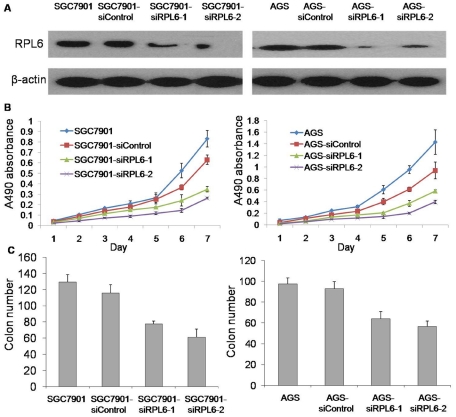
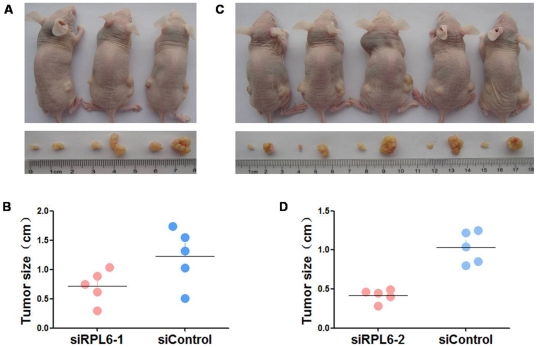
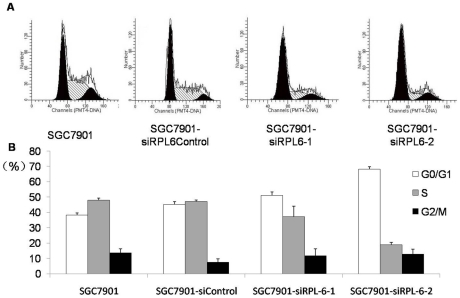
Our previous study revealed that human ribosomal protein L6 (RPL6) was up-regulated in multidrug-resistant gastric cancer cells and over-expression of RPL6 could protect gastric cancer from drug-induced apoptosis. It was further demonstrated that up-regulation of RPL6 accelerated growth and enhanced in vitro colony forming ability of GES cells while down-regulation of RPL6 exhibited the opposite results. The present study was designed to investigate the potential role of RPL6 in therapy of gastric cancer for clinic. The expression of RPL6 and cyclin E in gastric cancer tissues and normal gastric mucosa was evaluated by immunohistochemisty. It was found that RPL6 and cyclin E were expressed at a higher level in gastric cancer tissues than that in normal gastric mucosa and the two were correlative in gastric cancer. Survival time of postoperative patients was analyzed by Kaplan- Meier analysis and it was found that patients with RPL6 positive expression showed shorter survival time than patients that with RPL6 negative expression. RPL6 was then genetically down-regulated in gastric cancer SGC7901 and AGS cell lines by siRNA. It was demonstrated that down-regulation of RPL6 reduced colony forming ability of gastric cancer cells in vitro and reduced cell growth in vivo. Moreover, down-regulation of RPL6 could suppress G1 to S phase transition in these cells. Further, we evidenced that RPL6 siRNA down-regulated cyclin E expression in SGC7901 and AGS cells. Taken together, these data suggested that RPL6 was over-expressed in human gastric tissues and caused poor prognosis. Down-regulation of RPL6 could suppress cell growth and cell cycle progression at least through down-regulating cyclin E and which might be used as a novel approach to gastric cancer therapy.
我们之前的研究表明,人核糖体蛋白 L6(RPL6)在多药耐药胃癌细胞中上调,并且 RPL6 的过表达可以保护胃癌细胞免受药物诱导的凋亡。进一步的研究表明,RPL6 的上调加速了 GES 细胞的生长,并增强了其体外集落形成能力,而 RPL6 的下调则表现出相反的结果。本研究旨在探讨 RPL6 在胃癌治疗中的潜在临床价值。通过免疫组织化学方法评估了胃癌组织和正常胃黏膜中 RPL6 和细胞周期蛋白 E 的表达。结果发现,RPL6 和细胞周期蛋白 E 在胃癌组织中的表达水平高于正常胃黏膜,并且两者在胃癌中相关。通过 Kaplan-Meier 分析对术后患者的生存时间进行分析,发现 RPL6 阳性表达的患者生存时间短于 RPL6 阴性表达的患者。然后,通过 siRNA 对胃癌 SGC7901 和 AGS 细胞系中的 RPL6 进行基因下调。结果表明,RPL6 的下调降低了胃癌细胞的体外集落形成能力和体内细胞生长。此外,RPL6 的下调可抑制这些细胞中 G1 期到 S 期的转变。进一步的研究表明,RPL6 siRNA 下调了 SGC7901 和 AGS 细胞中细胞周期蛋白 E 的表达。综上所述,这些数据表明 RPL6 在人胃癌组织中过表达,并导致不良预后。下调 RPL6 可通过下调细胞周期蛋白 E 至少抑制细胞生长和细胞周期进程,这可能成为胃癌治疗的新方法。