Department of Animal Sciences, Federal University of Minas Gerais, 30123-970, Brazil.
Genet Sel Evol. 2011 Nov 2;43(1):37. doi: 10.1186/1297-9686-43-37.
Structural equation models (SEM) are used to model multiple traits and the casual links among them. The number of different causal structures that can be used to fit a SEM is typically very large, even when only a few traits are studied. In recent applications of SEM in quantitative genetics mixed model settings, causal structures were pre-selected based on prior beliefs alone. Alternatively, there are algorithms that search for structures that are compatible with the joint distribution of the data. However, such a search cannot be performed directly on the joint distribution of the phenotypes since causal relationships are possibly masked by genetic covariances. In this context, the application of the Inductive Causation (IC) algorithm to the joint distribution of phenotypes conditional to unobservable genetic effects has been proposed.
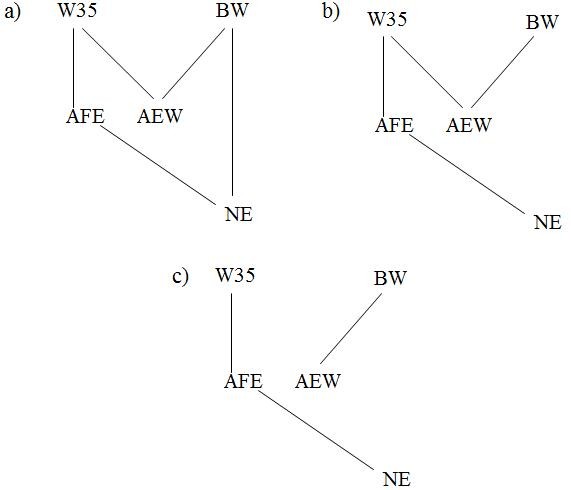
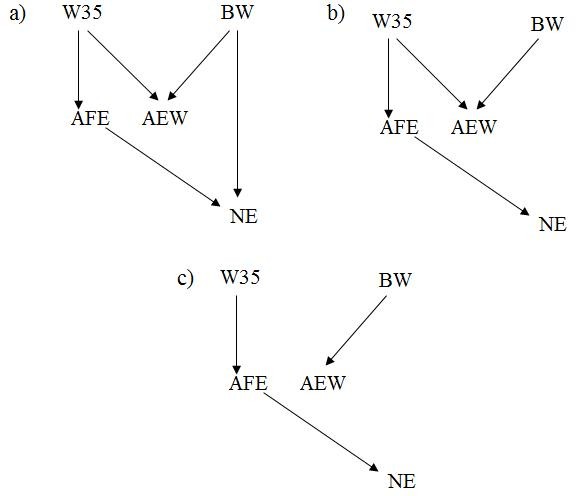
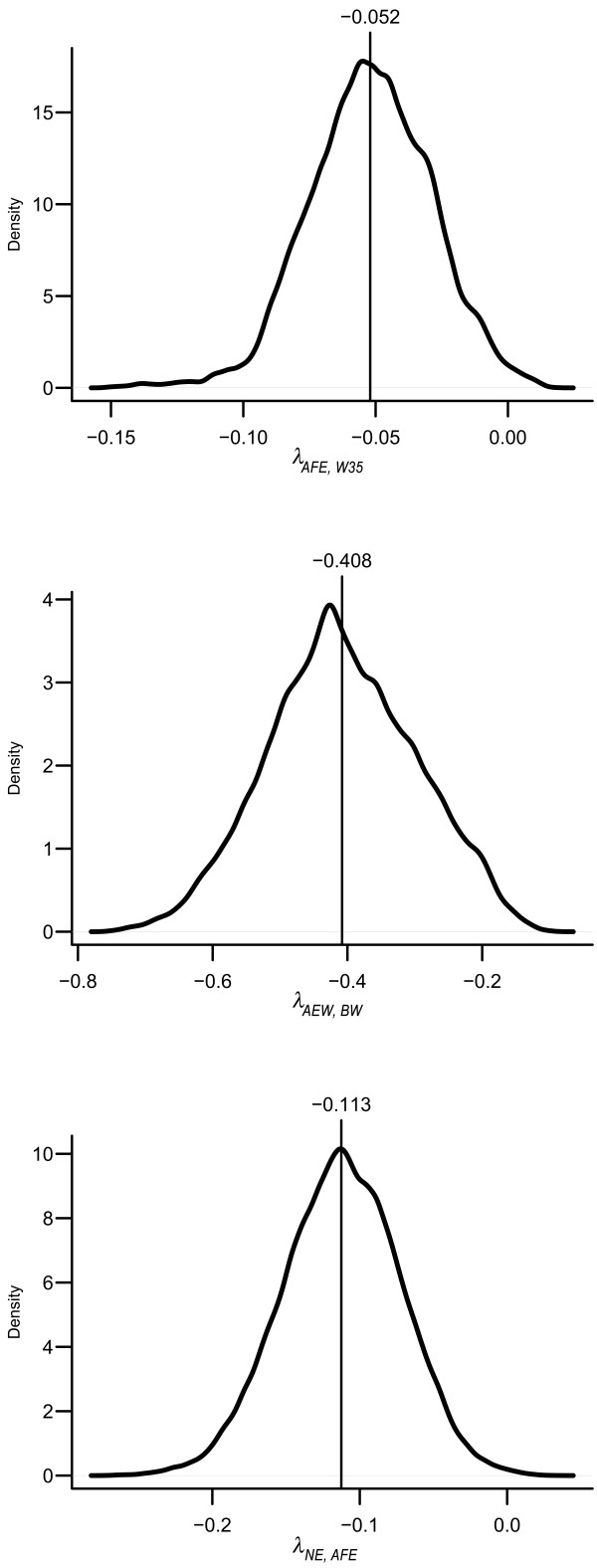
Here, we applied this approach to five traits in European quail: birth weight (BW), weight at 35 days of age (W35), age at first egg (AFE), average egg weight from 77 to 110 days of age (AEW), and number of eggs laid in the same period (NE). We have focused the discussion on the challenges and difficulties resulting from applying this method to field data. Statistical decisions regarding partial correlations were based on different Highest Posterior Density (HPD) interval contents and models based on the selected causal structures were compared using the Deviance Information Criterion (DIC). In addition, we used temporal information to perform additional edge orienting, overriding the algorithm output when necessary.
As a result, the final causal structure consisted of two separated substructures: BW→AEW and W35→AFE→NE, where an arrow represents a direct effect. Comparison between a SEM with the selected structure and a Multiple Trait Animal Model using DIC indicated that the SEM is more plausible.
Coupling prior knowledge with the output provided by the IC algorithm allowed further learning regarding phenotypic causal structures when compared to standard mixed effects SEM applications.
结构方程模型(SEM)用于对多个性状及其之间的因果关系进行建模。即使只研究几个性状,也可以使用大量不同的因果结构来拟合 SEM。在最近 SEM 在数量遗传学混合模型中的应用中,因果结构仅基于先验信念进行预选择。或者,还有一些算法可以搜索与数据联合分布兼容的结构。然而,由于遗传协方差可能掩盖因果关系,因此不能直接在表型的联合分布上进行这样的搜索。在这种情况下,已经提出将归纳因果(IC)算法应用于表型的联合分布,条件是不可观测的遗传效应。
在这里,我们将这种方法应用于欧洲鹌鹑的五个性状:初生重(BW)、35 日龄体重(W35)、首次产卵日龄(AFE)、77 至 110 日龄的平均蛋重(AEW)和同一时期产蛋数(NE)。我们将讨论重点放在将这种方法应用于田间数据时所面临的挑战和困难上。关于偏相关的统计决策是基于不同的最高后验密度(HPD)区间内容,并且基于所选因果结构的模型使用偏差信息准则(DIC)进行比较。此外,我们还利用时间信息进行额外的边定向,在必要时覆盖算法输出。
最终的因果结构由两个独立的子结构组成:BW→AEW 和 W35→AFE→NE,其中箭头表示直接效应。使用 DIC 对具有所选结构的 SEM 与多性状动物模型进行比较表明,SEM 更合理。
将先验知识与 IC 算法提供的输出相结合,与标准混合效应 SEM 应用相比,可以进一步了解表型因果结构。