Division of Orthopaedic Surgery, McMaster University, Hamilton, Ontario, Canada.
Trials. 2011 Nov 3;12:237. doi: 10.1186/1745-6215-12-237.
Radiographic healing is a common outcome measure in orthopedic trials and adjudication by outcome assessors is often conducted on the basis of plain films alone. The degree to which this process reflects clinical practice, in which both plain films and clinical notes are available, is uncertain. We explored the effect of adding clinical notes to radiographs in the adjudication process of a feasibility trial of tibial shaft fractures.
Radiographic and clinical data from a multicenter randomized controlled trial of 51 patients with operatively treated tibial fractures formed the basis of the study data. At the completion of the trial, serial radiographs (anteroposterior and lateral) were independently evaluated for progression of fracture healing, defined as bridging of at least 3 of 4 cortices, by an adjudication committee comprised of 3 blinded orthopaedic trauma surgeons. Immediately after determination of radiographic time to healing, each surgeon was provided with clinical notes associated with each radiographic follow up visit and asked to re-visit their initial impression. Consensus was achieved for both adjudications. We calculated the percentage of time to healing consensus decisions that changed after evaluation of clinical notes. We further examined the contents of clinical notes and their relative influence on the committee's decisions.
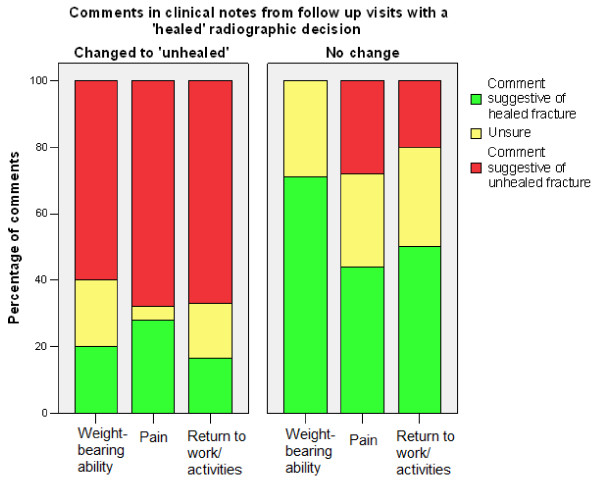
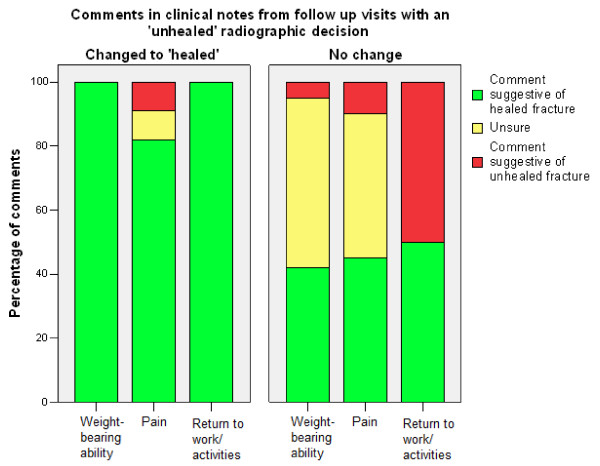
47 of 51 patients were determined to have healed radiographically during the trial follow-up period, and consideration of clinical notes resulted in a change of 40% (19 of 47) of time to healing consensus decisions; however, revised decisions were equally likely to support an earlier or a later time to healing. Clinical notes that resulted in a change to either a 'healed' or a 'not healed' decision contained significantly more comments of either pain resolution or deterioration, respectively, resumption of or failure to resume weightbearing, or either return or no return to work/pre-injury activities (p < 0.001).
The addition of clinical notes to the adjudication of radiographic fracture healing changed the outcome decision in a substantial number of cases. Orthopedic trialists should consider the addition of clinical notes to adjudication material in studies of fracture healing in order to enhance the generalizability of their results.
The TRUST trial was registered [ID NCT00667849] at http://clinicaltrials.gov/ct2/show/NCT00667849.
影像学愈合是骨科试验中常用的结果测量指标,结果评估员的评估通常仅基于平片进行。在多大程度上,这一过程反映了临床实践,在临床实践中,平片和临床记录都可用,这是不确定的。我们探讨了在胫骨骨干骨折的可行性试验的裁决过程中,将临床记录添加到 X 光片中对结果的影响。
研究数据来源于一项多中心随机对照试验的 51 例手术治疗胫骨骨折患者的放射学和临床资料。在试验结束时,由 3 名盲法骨科创伤外科医生组成的裁决委员会,对至少有 4 个皮质中有 3 个桥接的骨折愈合进展情况(前后位和侧位)进行独立评估。在确定 X 光愈合时间后,每位外科医生立即获得与每次 X 光随访相关的临床记录,并要求重新评估他们的初步印象。对两次裁决都达成了共识。我们计算了在评估临床记录后,愈合时间共识决定发生变化的百分比。我们进一步研究了临床记录的内容及其对委员会决策的相对影响。
在试验随访期间,51 例患者中有 47 例被确定为影像学愈合,考虑临床记录导致愈合时间共识决定的 40%(47 例中的 19 例)发生变化;然而,修订后的决定同样可能支持更早或更晚的愈合时间。导致对“愈合”或“未愈合”决定进行更改的临床记录分别包含更多关于疼痛缓解或恶化、负重恢复或未恢复、或恢复或未恢复工作/受伤前活动的评论(p<0.001)。
将临床记录添加到 X 光骨折愈合的裁决中,在大量病例中改变了结果决定。骨科试验者在研究骨折愈合时,应考虑将临床记录添加到裁决材料中,以提高其结果的普遍性。
TRUST 试验在 http://clinicaltrials.gov/ct2/show/NCT00667849 进行注册[标识符 NCT00667849]。