Wu Li-Tzy, Woody George E, Yang Chongming, Pan Jeng-Jong, Blazer Dan G
Department of Psychiatry and Behavioral Sciences, Duke University Medical Center, Durham, NC 27710, USA.
Arch Gen Psychiatry. 2011 Nov;68(11):1176-85. doi: 10.1001/archgenpsychiatry.2011.120.
While young racial/ethnic groups are the fastest growing population in the United States, data about substance-related disorders among adolescents of various racial/ethnic backgrounds are lacking.
To examine the magnitude of past-year DSM-IV substance-related disorders (alcohol, marijuana, cocaine, inhalants, hallucinogens, heroin, analgesic opioids, stimulants, sedatives, and tranquilizers) among adolescents of white, Hispanic, African American, Native American, Asian or Pacific Islander, and multiple race/ethnicity.
The 2005 to 2008 National Survey on Drug Use and Health.
Academic research.
Noninstitutionalized household adolescents aged 12 to 17 years.
Substance-related disorders were assessed by standardized survey questions administered using the audio computer-assisted self-interviewing method.
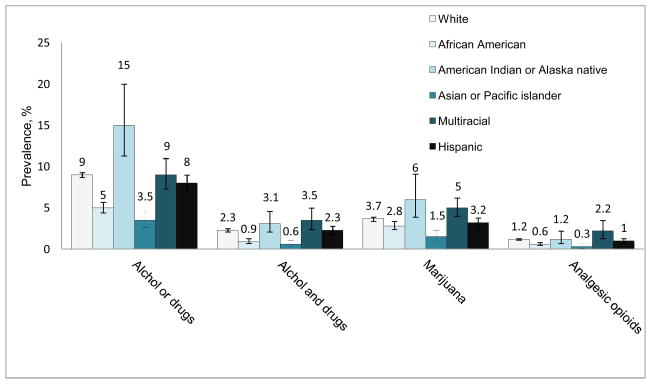
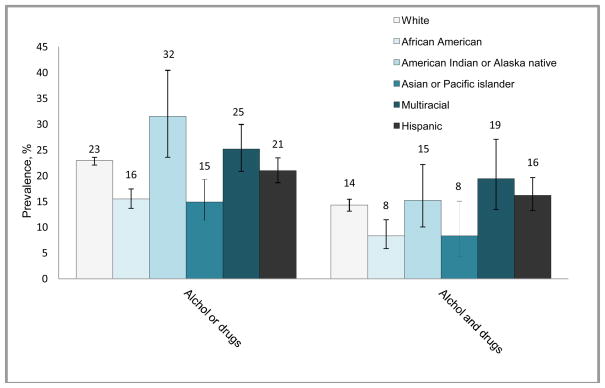
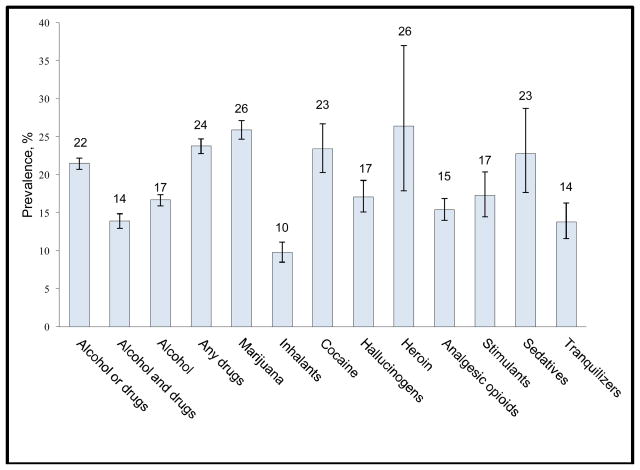
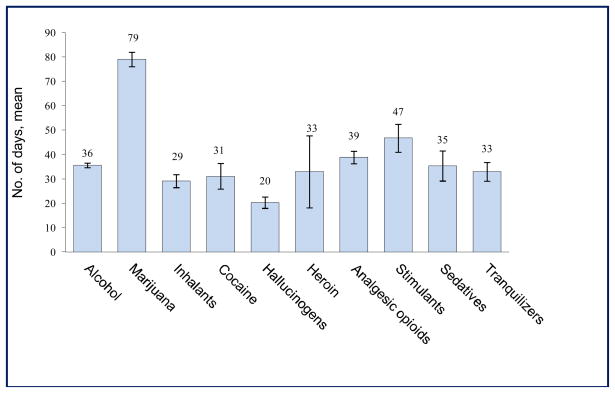
Of 72 561 adolescents aged 12 to 17 years, 37.0% used alcohol or drugs in the past year; 7.9% met criteria for a substance-related disorder, with Native Americans having the highest prevalence of use (47.5%) and disorder (15.0%). Analgesic opioids were the second most commonly used illegal drugs, following marijuana, in all racial/ethnic groups; analgesic opioid use was comparatively prevalent among adolescents of Native American (9.7%) and multiple race/ethnicity (8.8%). Among 27 705 past-year alcohol or drug users, Native Americans (31.5%), adolescents of multiple race/ethnicity (25.2%), adolescents of white race/ethnicity (22.9%), and Hispanics (21.0%) had the highest rates of substance-related disorders. Adolescents used marijuana more frequently than alcohol or other drugs, and 25.9% of marijuana users met criteria for marijuana abuse or dependence. After controlling for adolescents' age, socioeconomic variables, population density of residence, self-rated health, and survey year, adjusted analyses of adolescent substance users indicated elevated odds of substance-related disorders among Native Americans, adolescents of multiple race/ethnicity, adolescents of white race/ethnicity, and Hispanics compared with African Americans; African Americans did not differ from Asians or Pacific Islanders.
Substance use is widespread among adolescents of Native American, white, Hispanic, and multiple race/ethnicity. These groups also are disproportionately affected by substance-related disorders.
虽然年轻的种族/族裔群体是美国增长最快的人口群体,但缺乏关于不同种族/族裔背景青少年物质使用障碍的数据。
研究过去一年中白人、西班牙裔、非裔美国人、美洲原住民、亚裔或太平洋岛民以及多种族/族裔青少年中《精神疾病诊断与统计手册》第四版(DSM-IV)物质使用障碍(酒精、大麻、可卡因、吸入剂、致幻剂、海洛因、镇痛性阿片类药物、兴奋剂、镇静剂和 tranquilizers)的严重程度。
2005年至2008年全国药物使用和健康调查。
学术研究。
12至17岁的非机构化家庭青少年。
通过使用音频计算机辅助自我访谈方法进行的标准化调查问题评估物质使用障碍。
在72561名12至17岁的青少年中,37.0%在过去一年中使用过酒精或毒品;7.9%符合物质使用障碍标准,其中美洲原住民的使用率(47.5%)和障碍率(15.0%)最高。在所有种族/族裔群体中,镇痛性阿片类药物是仅次于大麻的第二大最常用非法药物;美洲原住民(9.7%)和多种族/族裔(8.8%)的青少年中镇痛性阿片类药物的使用相对普遍。在27705名过去一年使用过酒精或毒品的人中,美洲原住民(31.5%)、多种族/族裔青少年(25.2%)、白人种族/族裔青少年(22.9%)和西班牙裔(21.0%)物质使用障碍率最高。青少年使用大麻的频率高于酒精或其他毒品,25.9%的大麻使用者符合大麻滥用或依赖标准。在控制了青少年的年龄、社会经济变量、居住人口密度、自我评估健康状况和调查年份后,对青少年物质使用者的调整分析表明,与非裔美国人相比,美洲原住民、多种族/族裔青少年、白人种族/族裔青少年和西班牙裔物质使用障碍的几率升高;非裔美国人与亚裔或太平洋岛民没有差异。
物质使用在美洲原住民、白人、西班牙裔和多种族/族裔青少年中普遍存在。这些群体也受到物质使用障碍的影响尤为严重。