Department of Oral and Maxillofacial Surgery, Shanghai Jiao Tong University School of Medicine, Ninth People's Hospital, Shanghai, China.
PLoS One. 2011;6(10):e26399. doi: 10.1371/journal.pone.0026399. Epub 2011 Oct 31.
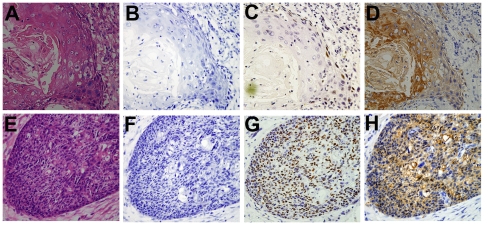
Cyclin D1 (CCND1) has been associated with chemotherapy resistance and poor prognosis. In this study, we tested the hypothesis that CCND1 expression determines response and clinical outcomes in locally advanced head and neck squamous cell carcinoma (HNSCC) patients treated with neoadjuvant chemotherapy followed by surgery and radiotherapy.
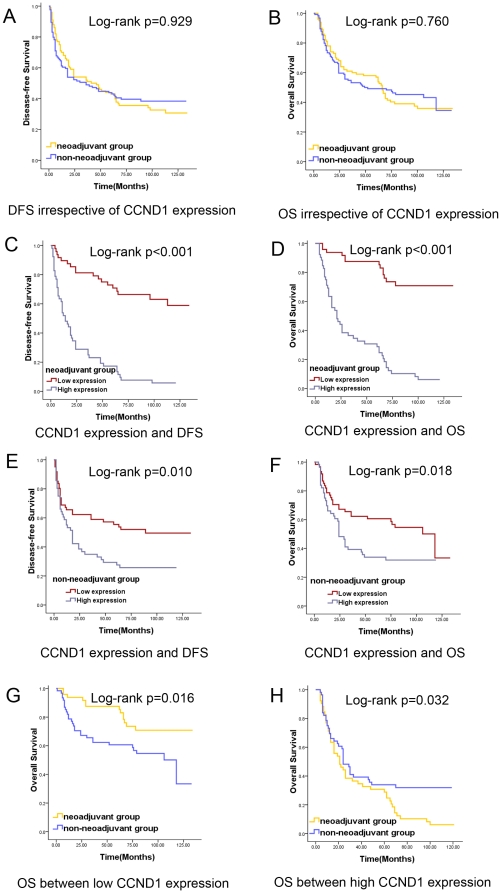
224 patients with HNSCC were treated with either cisplatin-based chemotherapy followed by surgery and radiotherapy (neoadjuvant group, n = 100) or surgery and radiotherapy (non-neoadjuvant group, n = 124). CCND1 expression was assessed by immunohistochemistry. CCND1 levels were analyzed with chemotherapy response, disease-free survival (DFS) and overall survival (OS). There was no significant difference between the neoadjuvant group and non-neoadjuvant group in DFS and OS (p = 0.929 and p = 0.760) when patients treated with the indiscriminate administration of cisplatin-based chemotherapy. However, in the neoadjuvant group, patients whose tumors showed a low CCND1 expression more likely respond to chemotherapy (p<0.001) and had a significantly better OS and DFS than those whose tumors showed a high CCND1 expression (73% vs 8%, p<0.001; 63% vs 6%, p<0.001). Importantly, patients with a low CCND1 expression in neoadjuvant group received more survival benefits than those in non-neoadjuvant group (p = 0.016), however patients with a high CCND1 expression and treated with neoadjuvant chemotherapy had a significantly poor OS compared to those treated with surgery and radiotherapy (p = 0.032). A multivariate survival analysis also showed CCND1 expression was an independent predictive factor (p<0.001).
This study suggests that some but not all patients with HNSCC may benefit from neoadjuvant chemotherapy with cisplatin-based regimen and CCND1 expression may serve as a predictive biomarker in selecting patients undergo less than two cycles of neoadjuvant chemotherapy.
细胞周期蛋白 D1(CCND1)与化疗耐药和预后不良有关。在这项研究中,我们检验了这样一个假设,即 CCND1 表达决定了接受新辅助化疗后接受手术和放疗的局部晚期头颈部鳞状细胞癌(HNSCC)患者的反应和临床结局。
224 例 HNSCC 患者分别接受顺铂为基础的化疗后手术和放疗(新辅助组,n = 100)或手术和放疗(非新辅助组,n = 124)。通过免疫组织化学检测 CCND1 表达。分析 CCND1 水平与化疗反应、无病生存(DFS)和总生存(OS)的关系。当使用顺铂为基础的化疗进行无差别治疗时,新辅助组和非新辅助组在 DFS 和 OS 方面没有显著差异(p = 0.929 和 p = 0.760)。然而,在新辅助组中,肿瘤 CCND1 低表达的患者更可能对化疗有反应(p < 0.001),并且 OS 和 DFS 明显优于肿瘤 CCND1 高表达的患者(73%比 8%,p < 0.001;63%比 6%,p < 0.001)。重要的是,新辅助组中 CCND1 低表达的患者比非新辅助组的患者获得更多的生存获益(p = 0.016),然而,接受新辅助化疗的 CCND1 高表达患者的 OS 明显低于接受手术和放疗的患者(p = 0.032)。多变量生存分析也显示 CCND1 表达是一个独立的预测因素(p < 0.001)。
本研究表明,一些而非所有 HNSCC 患者可能受益于顺铂为基础的新辅助化疗,CCND1 表达可作为选择接受少于两个周期新辅助化疗患者的预测生物标志物。