Eo Hyun-Seon, Lee Kyung-Bok, Kim Ae-Kyeong, Kim Min-Hee, Kim Do-Hyung, Kim Dong-Ik
Division of Vascular Surgery, Samsung Medical Center, Sungkyunkwan University School of Medicine, Seoul, Korea.
J Korean Surg Soc. 2011 Apr;80(4):289-96. doi: 10.4174/jkss.2011.80.4.289. Epub 2011 Apr 12.
Inflammatory cells are known to be associated with the progression of atherosclerosis and plaque rupture. However, the relation to inflammatory cells and apolipoproteins on the progression of atherosclerosis is unknown. This study was aimed at examining the different expressions of inflammatory cells and evaluate the effect of apolipoprotein (APO) C1 and APO E during the progression of atherosclerosis.
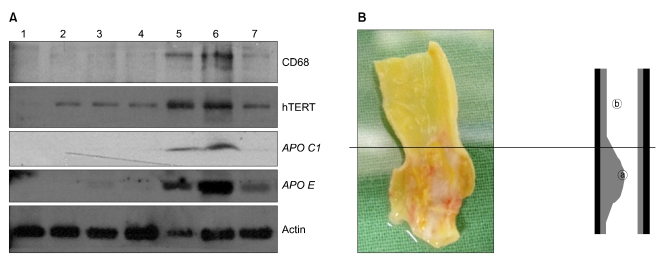
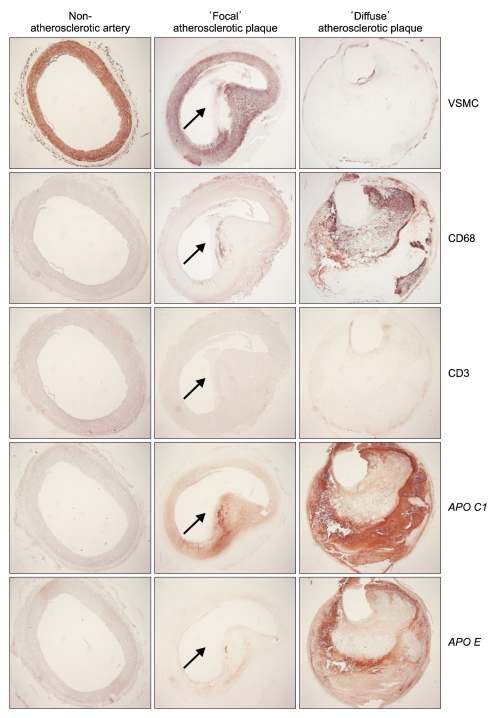
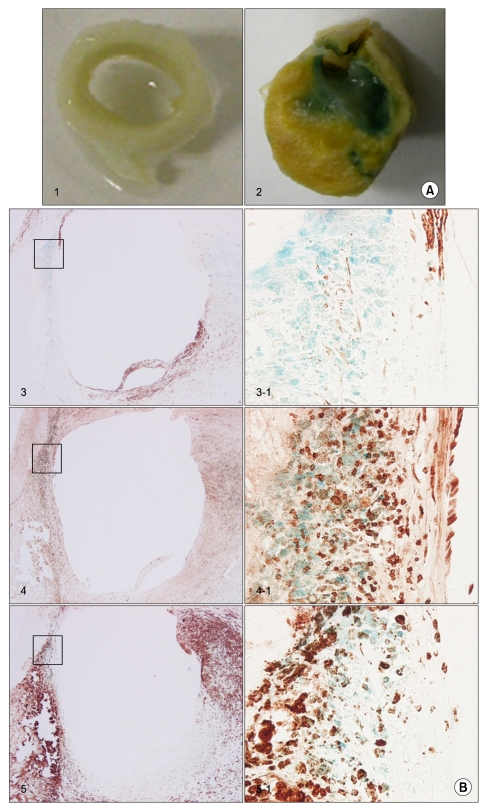
Ten atherosclerotic tissues were compared with five non-atherosclerotic tissues. The presence of vascular smooth muscle cells (VSMCs), macrophages, T-cells, APO C1, and APO E were identified by Western blotting and immunohistochemical analysis with antibodies. The senescence was analyzed by senescence-associated β-galactosidase.
The protein expression and senescence of macrophages, APO C1 and APO E were significantly higher in the main atherosclerotic lesion than the non-atherosclerotic lesion. A high concentration of inflammatory cells and the paucity of VSMCs were present in the shoulder area. In addition, macrophage and T-cells are expressed in the early stage of atherosclerotic development and more expanded in advanced atherosclerotic plaques. APO C1 was expressed mainly within the necrotic core, and APO E existed mostly around the necrotic core and the fibrous cap in advanced atherosclerotic plaques.
Our study indicated that the expression and the senescence of macrophage and T-cells may be closelyrelated to induction and deposition of APO C1 and APO E. This contributes to the development and progression of atherosclerotic plaque by expanding the necrotic core.
已知炎症细胞与动脉粥样硬化的进展和斑块破裂相关。然而,炎症细胞和载脂蛋白与动脉粥样硬化进展之间的关系尚不清楚。本研究旨在检测炎症细胞的不同表达,并评估载脂蛋白(APO)C1和APO E在动脉粥样硬化进展过程中的作用。
将10个动脉粥样硬化组织与5个非动脉粥样硬化组织进行比较。通过蛋白质免疫印迹法以及使用抗体的免疫组织化学分析来鉴定血管平滑肌细胞(VSMC)、巨噬细胞、T细胞、APO C1和APO E的存在情况。通过衰老相关β-半乳糖苷酶分析衰老情况。
主要动脉粥样硬化病变中巨噬细胞、APO C1和APO E的蛋白质表达及衰老程度显著高于非动脉粥样硬化病变。肩部区域存在高浓度的炎症细胞且VSMC数量稀少。此外,巨噬细胞和T细胞在动脉粥样硬化发展的早期阶段表达,并在晚期动脉粥样硬化斑块中进一步增多。APO C1主要在坏死核心内表达,而在晚期动脉粥样硬化斑块中,APO E大多存在于坏死核心周围和纤维帽处。
我们的研究表明,巨噬细胞和T细胞的表达及衰老可能与APO C1和APO E的诱导和沉积密切相关。这通过扩大坏死核心促进了动脉粥样硬化斑块的发生和发展。