Laboratory for Clinical Thrombosis and Haemostasis, Department of Internal Medicine, Cardiovascular Research Institute Maastricht, Maastricht University Medical Centre, Maastricht, The Netherlands.
Department of Surgery, Amsterdam University Medical Center, Location AMC, Amsterdam, The Netherlands.
Sci Rep. 2019 Mar 7;9(1):3909. doi: 10.1038/s41598-019-40602-w.
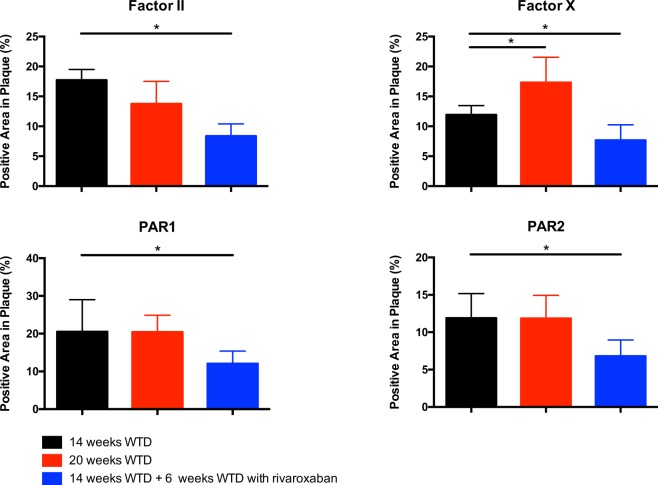
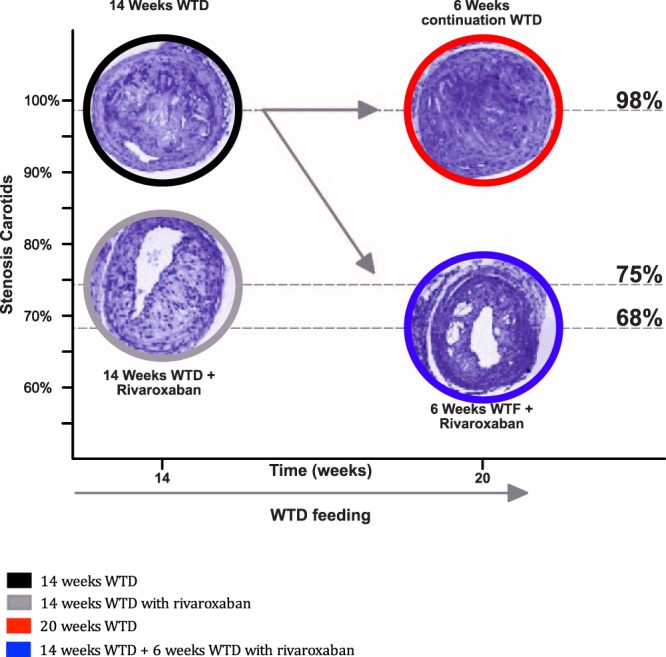
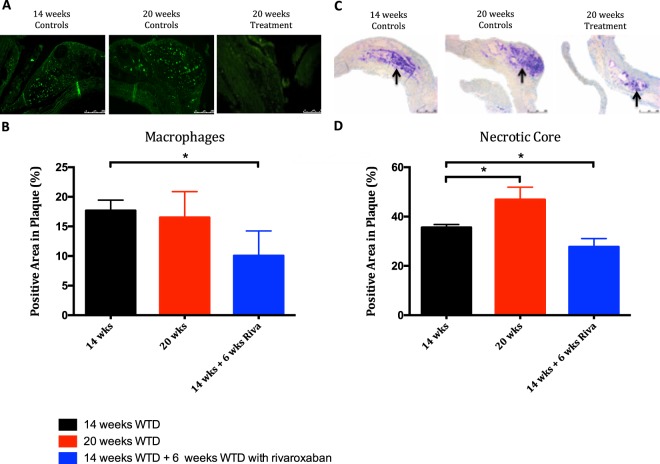
Atherosclerosis is a progressive inflammatory vascular disorder, complicated by plaque rupture and subsequently atherothrombosis. In vitro studies indicate that key clotting proteases, such as factor Xa (FXa), can promote atherosclerosis, presumably mediated through protease activated receptors (PARs). Although experimental studies showed reduced onset of atherosclerosis upon FXa inhibition, the effect on pre-existing plaques has never been studied. Therefore, we investigated effects of FXa inhibition by rivaroxaban on both newly-formed and pre-existing atherosclerotic plaques in apolipoprotein-e deficient (ApoE) mice. Female ApoE mice (age: 8-9 weeks, n = 10/group) received western type diet (WTD) or WTD supplemented with rivaroxaban (1.2 mg/g) for 14 weeks. In a second arm, mice received a WTD for 14 weeks, followed by continuation with either WTD or WTD supplemented with rivaroxaban (1.2 mg/g) for 6 weeks (total 20 weeks). Atherosclerotic burden in aortic arch was assessed by haematoxilin & eosin immunohistochemistry (IHC); plaque vulnerability was examined by IHC against macrophages, collagen, vascular smooth muscle cells (VSMC) and matrix metalloproteinases (MMPs). In addition, PAR1 and -2 expressions and their main activators thrombin and FXa in the plaque were determined in the plaque. Administration of rivaroxaban at human therapeutic concentrations reduced the onset of atherosclerosis (-46%, p < 0.05), and promoted a regression of pre-existing plaques in the carotids (-24%, p < 0.001). In addition, the vulnerability of pre-existing plaques was reduced by FXa inhibition as reflected by reduced macrophages (-39.03%, p < 0.05), enhanced collagen deposition (+38.47%, p < 0.05) and diminished necrotic core (-31.39%, p < 0.05). These findings were accompanied with elevated vascular smooth muscle cells and reduced MMPs. Furthermore, expression of PARs and their activators, thrombin and FXa was diminished after rivaroxaban treatment. Pharmacological inhibition of FXa promotes regression of advanced atherosclerotic plaques and enhances plaque stability. These data suggest that inhibition of FXa may be beneficial in prevention and regression of atherosclerosis, possibly mediated through reduced activation of PARs.
动脉粥样硬化是一种进行性炎症性血管疾病,其并发症包括斑块破裂和随后的动脉血栓形成。体外研究表明,关键的凝血蛋白酶,如因子 Xa(FXa),可以促进动脉粥样硬化的发生,推测是通过蛋白酶激活受体(PARs)介导的。尽管实验研究表明,FXa 抑制可减少动脉粥样硬化的发生,但从未研究过其对已存在斑块的影响。因此,我们研究了在载脂蛋白 E 缺陷(ApoE)小鼠中,利伐沙班对新形成和已存在的动脉粥样硬化斑块的影响。雌性 ApoE 小鼠(年龄:8-9 周,每组 n=10)接受西方饮食(WTD)或 WTD 加利伐沙班(1.2mg/g)喂养 14 周。在第二组中,小鼠接受 WTD 喂养 14 周,然后继续接受 WTD 或 WTD 加利伐沙班(1.2mg/g)喂养 6 周(共 20 周)。主动脉弓处的动脉粥样硬化负担通过苏木精和伊红免疫组织化学(IHC)评估;斑块易损性通过针对巨噬细胞、胶原蛋白、血管平滑肌细胞(VSMC)和基质金属蛋白酶(MMPs)的 IHC 检查。此外,还在斑块中测定了 PAR1 和 -2 的表达及其主要激活物凝血酶和 FXa。在人类治疗浓度下给予利伐沙班可减少动脉粥样硬化的发生(-46%,p<0.05),并促进颈动脉中已存在的斑块消退(-24%,p<0.001)。此外,FXa 抑制可降低斑块中巨噬细胞的数量(-39.03%,p<0.05)、增加胶原蛋白的沉积(+38.47%,p<0.05)和减少坏死核心(-31.39%,p<0.05),从而降低已存在的斑块的易损性。这些发现伴随着血管平滑肌细胞的增加和 MMPs 的减少。此外,利伐沙班治疗后 PARs 及其激活物凝血酶和 FXa 的表达减少。FXa 的药理学抑制促进晚期动脉粥样硬化斑块的消退并增强斑块稳定性。这些数据表明,FXa 抑制可能通过减少 PARs 的激活而有益于动脉粥样硬化的预防和消退。