Structural Genomics Consortium, University of Toronto, Toronto, Ontario M5G 1L7, Canada.
J Biol Chem. 2012 Jan 20;287(4):2317-27. doi: 10.1074/jbc.M111.273730. Epub 2011 Nov 8.
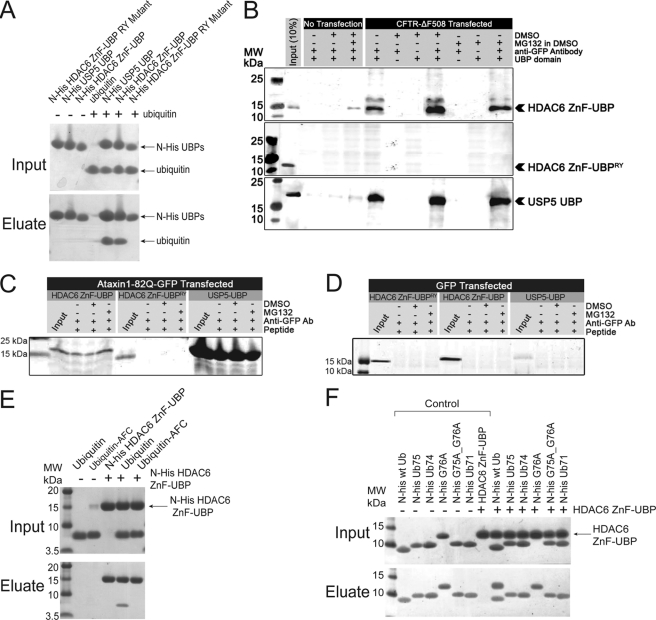
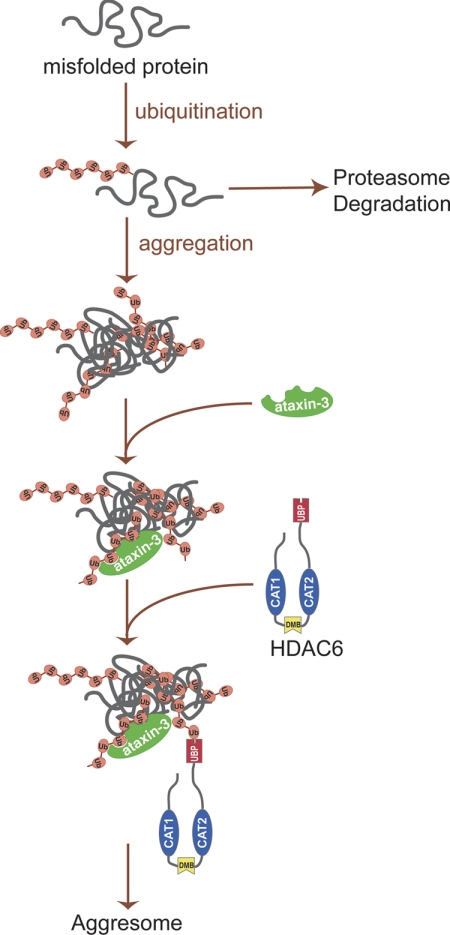
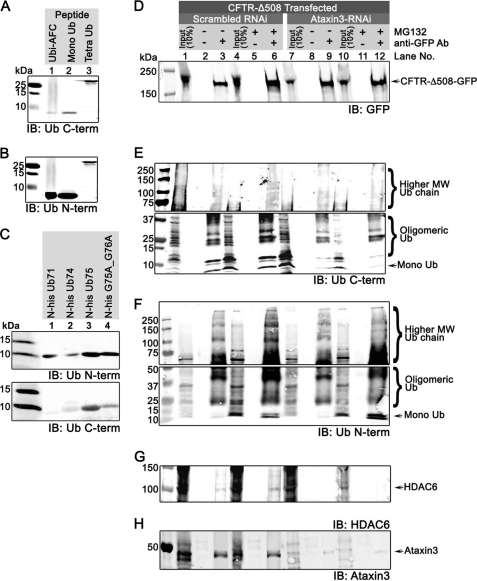
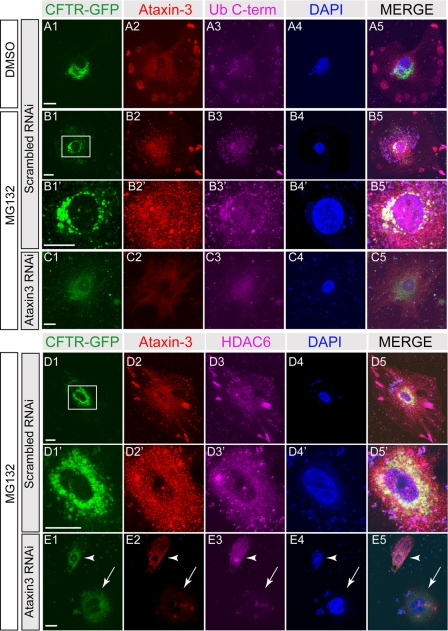
The aggresome pathway is activated when proteasomal clearance of misfolded proteins is hindered. Misfolded polyubiquitinated protein aggregates are recruited and transported to the aggresome via the microtubule network by a protein complex consisting of histone deacetylase 6 (HDAC6) and the dynein motor complex. The current model suggests that HDAC6 recognizes protein aggregates by binding directly to polyubiquitinated proteins. Here, we show that there are substantial amounts of unanchored ubiquitin in protein aggregates with solvent-accessible C termini. The ubiquitin-binding domain (ZnF-UBP) of HDAC6 binds exclusively to the unanchored C-terminal diglycine motif of ubiquitin instead of conjugated polyubiquitin. The unanchored ubiquitin C termini in the aggregates are generated in situ by aggregate-associated deubiquitinase ataxin-3. These results provide structural and mechanistic bases for the role of HDAC6 in aggresome formation and further suggest a novel ubiquitin-mediated signaling pathway, where the exposure of ubiquitin C termini within protein aggregates enables HDAC6 recognition and transport to the aggresome.
当蛋白酶体清除错误折叠的蛋白质受到阻碍时,聚集物途径就会被激活。错误折叠的多聚泛素化蛋白聚集体通过由组蛋白去乙酰化酶 6 (HDAC6) 和动力蛋白复合物组成的蛋白质复合物被招募并通过微管网络运输到聚集物。目前的模型表明,HDAC6 通过直接结合多聚泛素化蛋白质来识别蛋白质聚集体。在这里,我们表明在溶剂可及的 C 末端具有大量未连接的泛素的蛋白质聚集体。HDAC6 的泛素结合结构域 (ZnF-UBP) 仅与未连接的 C 末端二甘氨酸基序的泛素结合,而不是与共轭的多聚泛素结合。聚集体中的未连接的泛素 C 末端是由聚集体相关的去泛素酶 ataxin-3 原位生成的。这些结果为 HDAC6 在聚集物形成中的作用提供了结构和机制基础,并进一步表明了一种新的泛素介导的信号通路,其中蛋白质聚集体中泛素 C 末端的暴露使 HDAC6 能够识别并运输到聚集物。