Research Centre for Infectious Diseases, School of Molecular and Biomedical Science, University of Adelaide, Adelaide, South Australia, Australia.
PLoS Pathog. 2011 Nov;7(11):e1002357. doi: 10.1371/journal.ppat.1002357. Epub 2011 Nov 3.
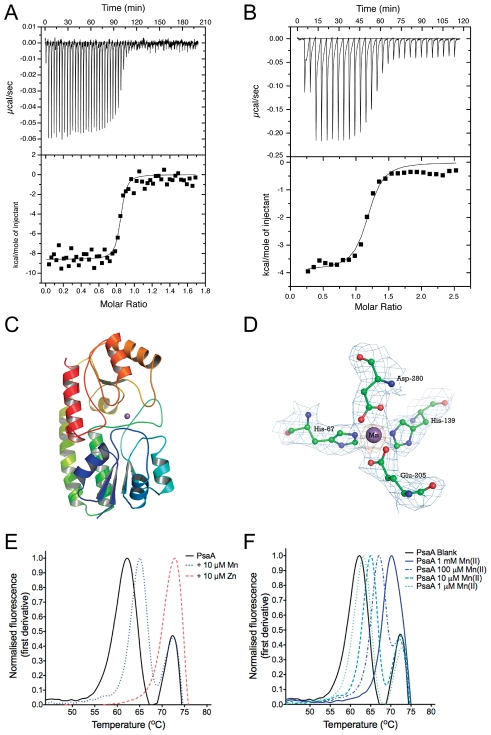
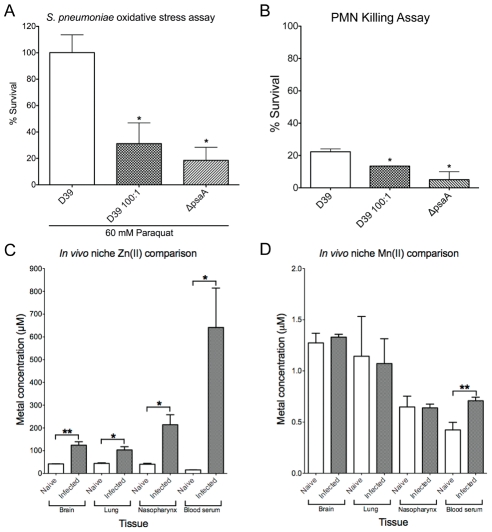
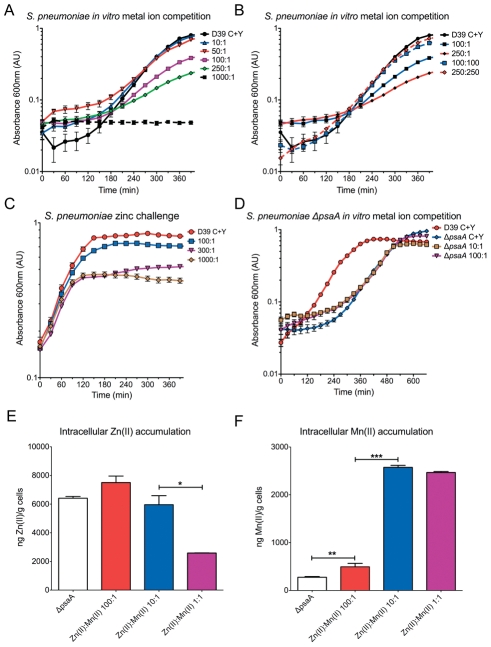
Transition row metal ions are both essential and toxic to microorganisms. Zinc in excess has significant toxicity to bacteria, and host release of Zn(II) at mucosal surfaces is an important innate defence mechanism. However, the molecular mechanisms by which Zn(II) affords protection have not been defined. We show that in Streptococcus pneumoniae extracellular Zn(II) inhibits the acquisition of the essential metal Mn(II) by competing for binding to the solute binding protein PsaA. We show that, although Mn(II) is the high-affinity substrate for PsaA, Zn(II) can still bind, albeit with a difference in affinity of nearly two orders of magnitude. Despite the difference in metal ion affinities, high-resolution structures of PsaA in complex with Mn(II) or Zn(II) showed almost no difference. However, Zn(II)-PsaA is significantly more thermally stable than Mn(II)-PsaA, suggesting that Zn(II) binding may be irreversible. In vitro growth analyses show that extracellular Zn(II) is able to inhibit Mn(II) intracellular accumulation with little effect on intracellular Zn(II). The phenotype of S. pneumoniae grown at high Zn(II):Mn(II) ratios, i.e. induced Mn(II) starvation, closely mimicked a ΔpsaA mutant, which is unable to accumulate Mn(II). S. pneumoniae infection in vivo elicits massive elevation of the Zn(II):Mn(II) ratio and, in vitro, these Zn(II):Mn(II) ratios inhibited growth due to Mn(II) starvation, resulting in heightened sensitivity to oxidative stress and polymorphonuclear leucocyte killing. These results demonstrate that microbial susceptibility to Zn(II) toxicity is mediated by extracellular cation competition and that this can be harnessed by the innate immune response.
过渡金属离子对微生物既必需又有毒。锌过量对细菌有显著毒性,而宿主在黏膜表面释放 Zn(II)是一种重要的先天防御机制。然而,Zn(II)提供保护的分子机制尚未确定。我们表明,在肺炎链球菌中,细胞外 Zn(II)通过与溶质结合蛋白 PsaA 竞争结合来抑制必需金属 Mn(II)的摄取。我们表明,尽管 Mn(II)是 PsaA 的高亲和力底物,但 Zn(II)仍然可以结合,尽管亲和力差异近两个数量级。尽管金属离子亲和力存在差异,但 PsaA 与 Mn(II)或 Zn(II)复合物的高分辨率结构几乎没有差异。然而,Zn(II)-PsaA 的热稳定性明显高于 Mn(II)-PsaA,表明 Zn(II)结合可能是不可逆的。体外生长分析表明,细胞外 Zn(II)能够抑制 Mn(II)的细胞内积累,而对细胞内 Zn(II)几乎没有影响。在高 Zn(II):Mn(II) 比下生长的肺炎链球菌的表型,即诱导的 Mn(II)饥饿,与无法积累 Mn(II)的 ΔpsaA 突变体非常相似。体内肺炎链球菌感染会引发 Zn(II):Mn(II) 比的大量升高,并且在体外,这些 Zn(II):Mn(II) 比由于 Mn(II)饥饿而抑制生长,导致对氧化应激和多形核白细胞杀伤的敏感性增加。这些结果表明,微生物对 Zn(II)毒性的敏感性是由细胞外阳离子竞争介导的,而先天免疫反应可以利用这种竞争。