Functional Neuroimaging Laboratory, School of Psychology, Centre for Brain and Mental Health Research, University of Newcastle Callaghan, NSW, Australia.
Front Psychol. 2011 Nov 8;2:318. doi: 10.3389/fpsyg.2011.00318. eCollection 2011.
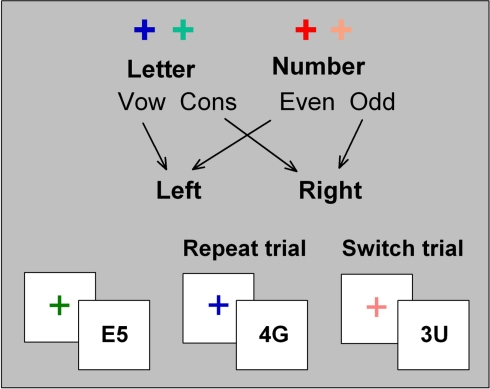
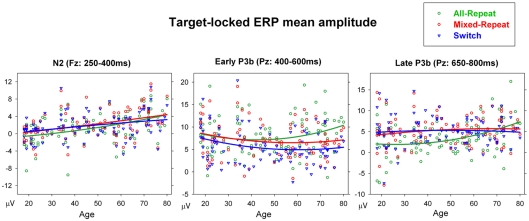
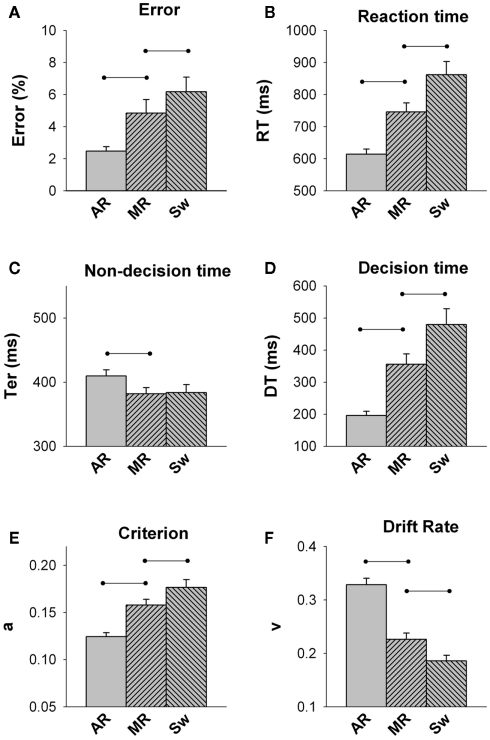
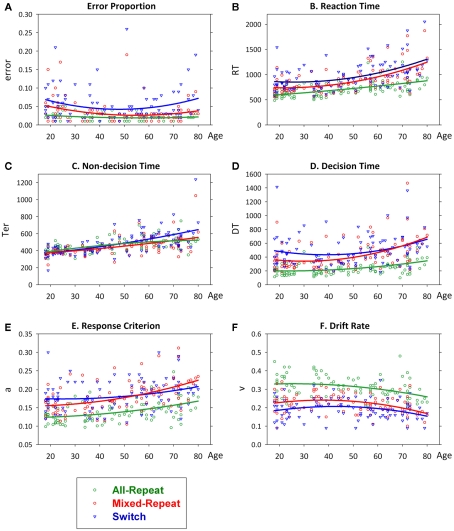
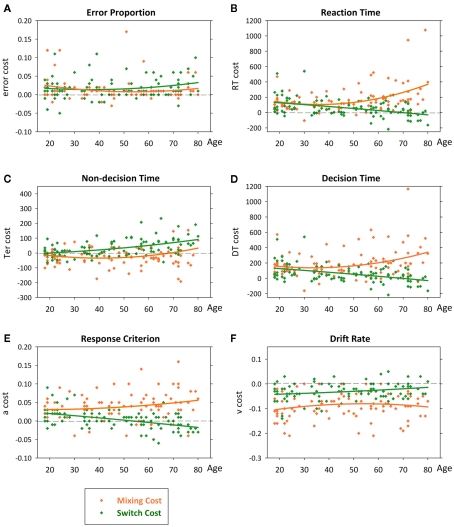
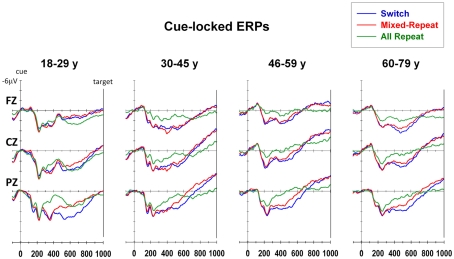
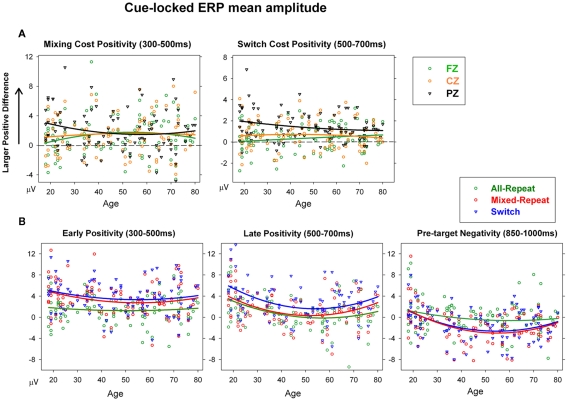
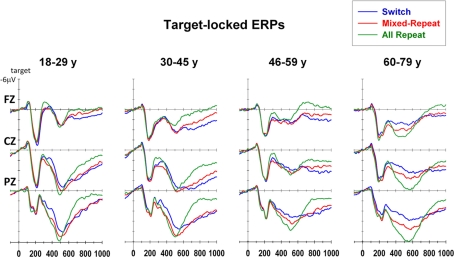
Task-switching paradigms produce a highly consistent age-related increase in mixing cost [longer response time (RT) on repeat trials in mixed-task than single-task blocks] but a less consistent age effect on switch cost (longer RT on switch than repeat trials in mixed-task blocks). We use two approaches to examine the adult lifespan trajectory of control processes contributing to mixing cost and switch cost: latent variables derived from an evidence accumulation model of choice, and event-related potentials (ERP) that temporally differentiate proactive (cue-driven) and reactive (target-driven) control processes. Under highly practiced and prepared task conditions, aging was associated with increasing RT mixing cost but reducing RT switch cost. Both effects were largely due to the same cause: an age effect for mixed-repeat trials. In terms of latent variables, increasing age was associated with slower non-decision processes, slower rate of evidence accumulation about the target, and higher response criterion. Age effects on mixing costs were evident only on response criterion, the amount of evidence required to trigger a decision, whereas age effects on switch cost were present for all three latent variables. ERPs showed age-related increases in preparation for mixed-repeat trials, anticipatory attention, and post-target interference. Cue-locked ERPs that are linked to proactive control were associated with early emergence of age differences in response criterion. These results are consistent with age effects on strategic processes controlling decision caution. Consistent with an age-related decline in cognitive flexibility, younger adults flexibly adjusted response criterion from trial-to-trial on mixed-task blocks, whereas older adults maintained a high criterion for all trials.
任务转换范式产生了高度一致的与年龄相关的混合成本增加[混合任务中重复试验的响应时间(RT)较长,而单一任务块中则较短],但转换成本的年龄效应则不太一致(混合任务块中转换试验的 RT 较长,而重复试验则较短)。我们使用两种方法来检验控制过程对混合成本和转换成本的成人寿命轨迹:源自选择的证据积累模型的潜在变量,以及区分前摄(线索驱动)和反应(目标驱动)控制过程的事件相关电位(ERP)。在高度练习和准备的任务条件下,随着年龄的增长,反应时混合成本增加,但反应时转换成本降低。这两个效应主要归因于同一个原因:混合重复试验的年龄效应。就潜在变量而言,年龄的增长与较慢的非决策过程,较慢的目标证据积累速度以及较高的反应标准有关。年龄对混合成本的影响仅在反应标准上显现,即触发决策所需的证据量,而年龄对转换成本的影响则存在于所有三个潜在变量上。ERP 显示出与混合重复试验准备,预期注意和目标后干扰相关的年龄相关增加。与前摄控制相关的线索锁定 ERP 与反应标准中年龄差异的早期出现有关。这些结果与控制决策谨慎的策略过程的年龄效应一致。与认知灵活性随年龄下降一致,年轻成年人在混合任务块中可以灵活地调整每个试验的反应标准,而老年人则在所有试验中保持较高的标准。