Department of Children Health Care, Nanjing Medical University, Nanjing Children's Hospital, Nanjing, China.
PLoS One. 2011;6(11):e25726. doi: 10.1371/journal.pone.0025726. Epub 2011 Nov 4.
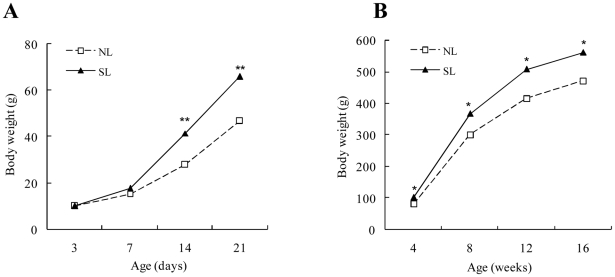
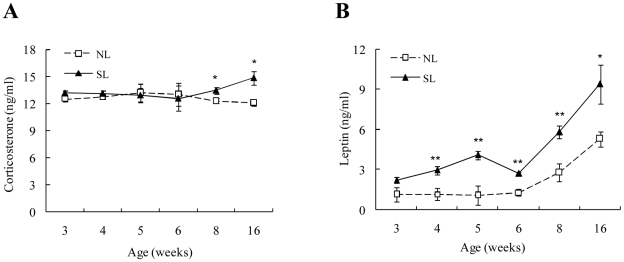
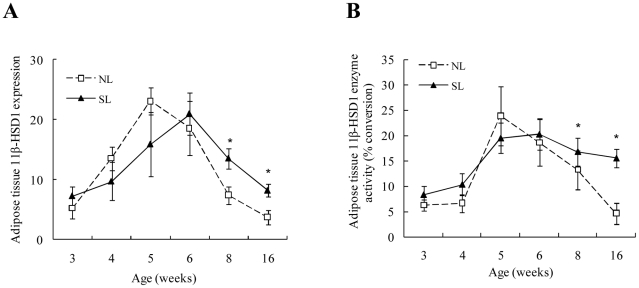
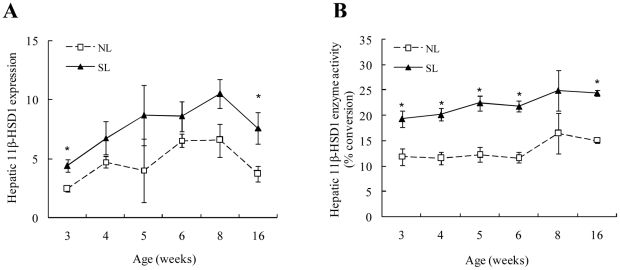
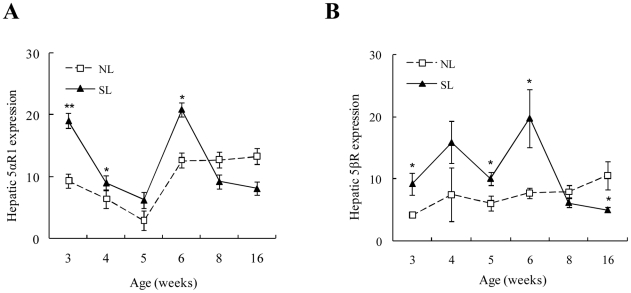
Elevated glucocorticoid (GC) activity may be involved in the development of the metabolic syndrome. Tissue GC exposure is determined by the tissue-specific GC-activating enzyme 11β-hydroxysteriod dehydrogenase type 1 (11β-HSD1) and the GC-inactivating enzyme 5α-reductase type 1 (5αR1), as well as 5β-reductase (5βR). Our aim was to study the effects of neonatal overfeeding induced by small litter rearing on the expression of GC-regulating enzymes in adipose tissue and/or liver and on obesity-related metabolic disturbances during development. Male Sprague-Dawley rat pup litters were adjusted to litter sizes of three (small litters, SL) or ten (normal litters, NL) on postnatal day 3 and then given standard chow from postnatal week 3 onward (W3). Small litter rearing induced obesity, hyperinsulinemia, and higher circulating corticosterone in adults. 11β-HSD1 expression and enzyme activity in retroperitoneal, but not in epididymal, adipose tissue increased with postnatal time and peaked at W5/W6 in both groups before declining. From W8, 11β-HSD1 expression and enzyme activity levels in retroperitoneal fat persisted at significantly higher levels in SL compared to NL rats. Hepatic 11β-HSD1 enzyme activity in SL rats was elevated from W3 to W16 compared to NL rats. Hepatic 5αR1 and 5βR expression was higher in SL compared to NL rats after weaning until W6, whereupon expression decreased in the SL rats and remained similar to that in NL rats. In conclusion, small litter rearing in rats induced peripheral tissue-specific alterations in 11β-HSD1 expression and activity and 5αR1 and 5βR expression during puberty, which could contribute to elevated tissue-specific GC exposure and aggravate the development of metabolic dysregulation in adults.
糖皮质激素(GC)活性升高可能与代谢综合征的发生有关。组织 GC 暴露取决于组织特异性 GC 激活酶 11β-羟甾类脱氢酶 1 型(11β-HSD1)和 GC 失活酶 5α-还原酶 1 型(5αR1)以及 5β-还原酶(5βR)。我们的目的是研究新生期通过小窝养育引起的过度喂养对脂肪组织和/或肝脏中 GC 调节酶表达的影响,以及对发育过程中肥胖相关代谢紊乱的影响。雄性 Sprague-Dawley 大鼠窝仔在出生后第 3 天被调整为 3 只(小窝仔,SL)或 10 只(正常窝仔,NL)的窝仔大小,然后从第 3 周开始给予标准饲料(W3)。小窝仔养育导致成年肥胖、高胰岛素血症和更高的循环皮质酮。腹膜后脂肪组织中 11β-HSD1 的表达和酶活性随产后时间增加,并在两组中均在 W5/W6 时达到峰值,然后下降。从 W8 开始,SL 大鼠腹膜后脂肪中的 11β-HSD1 表达和酶活性水平持续高于 NL 大鼠。与 NL 大鼠相比,SL 大鼠的肝 11β-HSD1 酶活性从 W3 到 W16 升高。断奶后,SL 大鼠的肝 5αR1 和 5βR 表达高于 NL 大鼠,直到 W6,此时 SL 大鼠的表达下降,与 NL 大鼠相似。总之,大鼠的小窝仔养育在青春期诱导了外周组织特异性的 11β-HSD1 表达和活性以及 5αR1 和 5βR 表达改变,这可能导致组织特异性 GC 暴露增加,并加重成年期代谢紊乱的发生。