Department of Psychiatry and Psychotherapy, University of Regensburg, Regensburg, Germany.
PLoS One. 2011;6(11):e27088. doi: 10.1371/journal.pone.0027088. Epub 2011 Nov 2.
Paired associative stimulation (PAS) consisting of repeated application of transcranial magnetic stimulation (TMS) pulses and contingent exteroceptive stimuli has been shown to induce neuroplastic effects in the motor and somatosensory system. The objective was to investigate whether the auditory system can be modulated by PAS.
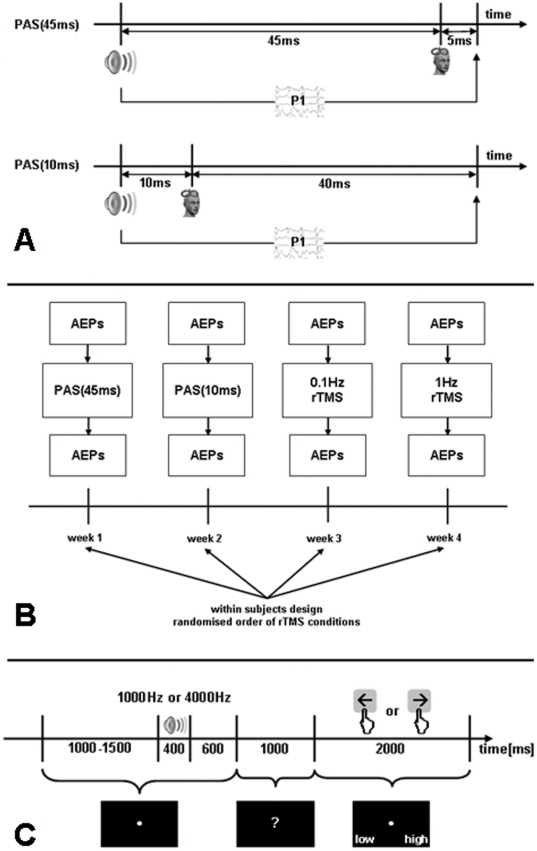
Acoustic stimuli (4 kHz) were paired with TMS of the auditory cortex with intervals of either 45 ms (PAS(45 ms)) or 10 ms (PAS(10 ms)). Two-hundred paired stimuli were applied at 0.1 Hz and effects were compared with low frequency repetitive TMS (rTMS) at 0.1 Hz (200 stimuli) and 1 Hz (1000 stimuli) in eleven healthy students. Auditory cortex excitability was measured before and after the interventions by long latency auditory evoked potentials (AEPs) for the tone (4 kHz) used in the pairing, and a control tone (1 kHz) in a within subjects design.
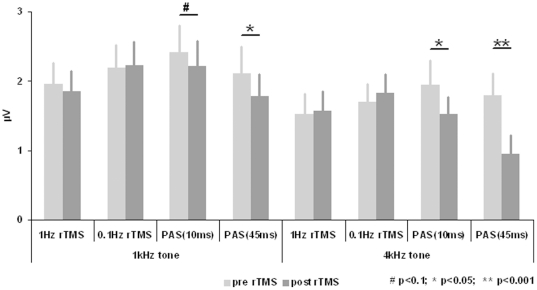
Amplitudes of the N1-P2 complex were reduced for the 4 kHz tone after both PAS(45 ms) and PAS(10 ms), but not after the 0.1 Hz and 1 Hz rTMS protocols with more pronounced effects for PAS(45 ms). Similar, but less pronounced effects were observed for the 1 kHz control tone.
These findings indicate that paired associative stimulation may induce tonotopically specific and also tone unspecific human auditory cortex plasticity.
重复应用经颅磁刺激(TMS)脉冲和伴随的外感受性刺激的成对关联刺激(PAS)已被证明可在运动和躯体感觉系统中诱导神经可塑性效应。目的是研究听觉系统是否可以通过 PAS 进行调节。
用声音刺激(4 kHz)与听觉皮层的 TMS 配对,间隔 45 毫秒(PAS(45 ms))或 10 毫秒(PAS(10 ms))。以 0.1 Hz 的频率应用 200 对刺激,与低频重复 TMS(0.1 Hz 时 200 次刺激,1 Hz 时 1000 次刺激)进行比较。在 11 名健康学生中,在干预前后通过用于配对的音调(4 kHz)和控制音调(1 kHz)的长潜伏期听觉诱发电位(AEPs)测量听觉皮层兴奋性,采用自身对照设计。
在应用 PAS(45 ms)和 PAS(10 ms)后,4 kHz 音调的 N1-P2 复合波幅度降低,但在 0.1 Hz 和 1 Hz rTMS 方案中则没有,PAS(45 ms)的效果更为明显。类似但效果较弱的观察结果也见于 1 kHz 控制音调。
这些发现表明,成对关联刺激可能会诱导特定音调和非特定音调的人类听觉皮层可塑性。