Center for Human Genetics, Duke University Medical Center, Durham, North Carolina, United States of America.
PLoS One. 2011;6(11):e27134. doi: 10.1371/journal.pone.0027134. Epub 2011 Nov 4.
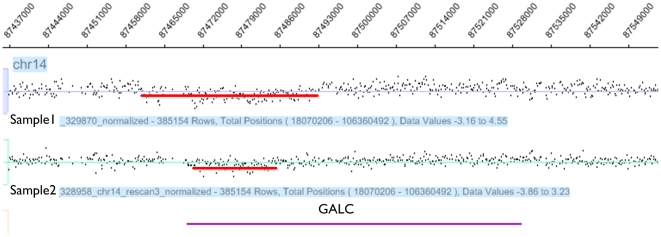
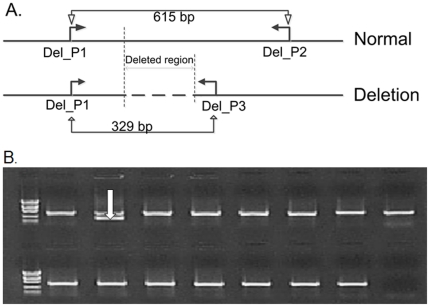
DNA copy number variants (CNVs) have been reported in many human diseases including autism and schizophrenia. Primary Open Angle Glaucoma (POAG) is a complex adult-onset disorder characterized by progressive optic neuropathy and vision loss. Previous studies have identified rare CNVs in POAG; however, their low frequencies prevented formal association testing. We present here the association between POAG risk and a heterozygous deletion in the galactosylceramidase gene (GALC). This CNV was initially identified in a dataset containing 71 Caucasian POAG cases and 478 ethnically matched controls obtained from dbGAP (study accession phs000126.v1.p1.) (p = 0.017, fisher's exact test). It was validated with array comparative genomic hybridization (arrayCGH) and realtime PCR, and replicated in an independent POAG dataset containing 959 cases and 1852 controls (p = 0.021, OR (odds ratio) = 3.5, 95% CI -1.1-12.0). Evidence for association was strengthened when the discovery and replication datasets were combined (p = 0.002; OR = 5.0, 95% CI 1.6-16.4). Several deletions with different endpoints were identified by array CGH of POAG patients. Homozygous deletions that eliminate GALC enzymatic activity cause Krabbe disease, a recessive Mendelian disorder of childhood displaying bilateral optic neuropathy and vision loss. Our findings suggest that heterozygous deletions that reduce GALC activity are a novel mechanism increasing risk of POAG. This is the first report of a statistically-significant association of a CNV with POAG risk, contributing to a growing body of evidence that CNVs play an important role in complex, inherited disorders. Our findings suggest an attractive biomarker and potential therapeutic target for patients with this form of POAG.
DNA 拷贝数变异 (CNV) 已在许多人类疾病中得到报道,包括自闭症和精神分裂症。原发性开角型青光眼 (POAG) 是一种复杂的成人发病的疾病,其特征是进行性视神经病变和视力丧失。先前的研究已经在 POAG 中发现了罕见的 CNV;然而,它们的低频率阻止了正式的关联测试。我们在这里提出 POAG 风险与半乳糖脑苷脂酶基因 (GALC) 的杂合性缺失之间的关联。该 CNV 最初是在一个包含 71 例白种人 POAG 病例和 478 例种族匹配对照的数据集 (来自 dbGAP [研究注册号 phs000126.v1.p1]) 中发现的。它通过微阵列比较基因组杂交 (arrayCGH) 和实时 PCR 进行验证,并在一个包含 959 例病例和 1852 例对照的独立 POAG 数据集得到复制 (p = 0.021,OR(比值比)= 3.5,95%CI -1.1-12.0)。当发现和复制数据集合并时,关联证据得到了加强 (p = 0.002;OR = 5.0,95%CI 1.6-16.4)。通过对 POAG 患者的 arrayCGH 进行分析,确定了具有不同终点的几种缺失。消除 GALC 酶活性的纯合缺失会导致克雅氏病,这是一种儿童隐性孟德尔疾病,表现为双侧视神经病变和视力丧失。我们的研究结果表明,降低 GALC 活性的杂合缺失是增加 POAG 风险的一种新机制。这是首次报道 CNV 与 POAG 风险存在统计学显著关联,这为越来越多的证据表明 CNV 在复杂的遗传性疾病中发挥重要作用做出了贡献。我们的研究结果为这种形式的 POAG 患者提供了有吸引力的生物标志物和潜在的治疗靶点。