Micheal Shazia, Ayub Humaira, Islam Farrah, Siddiqui Sorath Noorani, Khan Wajid Ali, Akhtar Farah, Qamar Raheel, Khan Muhammad Imran, den Hollander Anneke I
Department of Ophthalmology, Radboud University Nijmegen Medical Centre, Nijmegen, the Netherlands.
Department of Biosciences, COMSATS Institute of Information Technology, Islamabad, Pakistan.
PLoS One. 2015 Dec 29;10(12):e0145005. doi: 10.1371/journal.pone.0145005. eCollection 2015.
Recently nonsynonymous coding variants in the ankyrin repeats and suppressor of cytokine signaling box-containing protein 10 (ASB10) gene were found to be associated with primary open angle glaucoma (POAG) in cohorts from Oregon and Germany, but this finding was not confirmed in an independent cohort from Iowa. The aim of the current study was to assess the role of ASB10 gene variants in Pakistani glaucoma patients.
Sanger sequencing of the coding exons and splice junctions of the ASB10 gene was performed in 30 probands of multiplex POAG families, 208 sporadic POAG patients and 151 healthy controls from Pakistan. Genotypic associations of individual variants with POAG were analyzed with the Fisher's exact or Chi-square test.
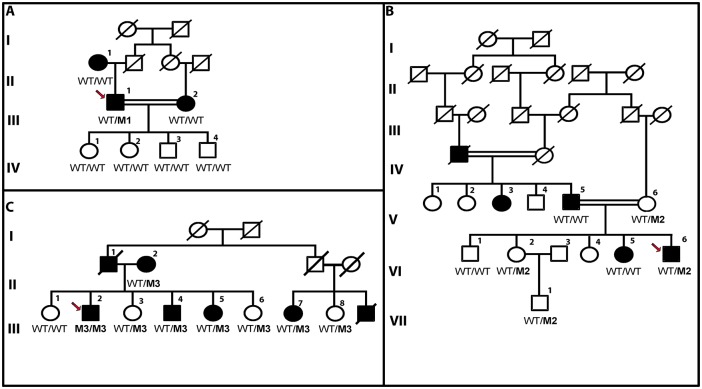
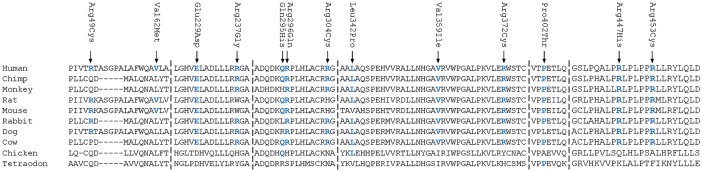
In total 24 variants were identified in POAG probands and sporadic patients, including 11 novel variants and 13 known variants. 13 of the variants were nonsynonymous, 6 were synonymous, and 5 were intronic. Three nonsynonymous variants (p.Arg49Cys, p.Arg237Gly, p.Arg453Cys) identified in the probands were not segregating in the respective families. This is not surprising since glaucoma is a multifactorial disease, and multiple factors are likely to be involved in the disease manifestation in these families. However a nonsynonymous variant, p.Arg453Cys (rs3800791), was found in 6 sporadic POAG patients but not in controls, suggesting that it infers increased risk for the disease. In addition, one synonymous variant was found to be associated with sporadic POAG: p.Ala290Ala and the association of the variant with POAG remained significant after correction for multiple testing (uncorrected p-value 0.002, corrected p-value 0.047). The cumulative burden of rare, nonsynonymous variants was significantly higher in sporadic POAG patients compared to control individuals (p-value 0.000006).
Variants in ASB10 were found to be significantly associated with sporadic POAG in the Pakistani population. This supports previous findings that sequence variants in the ASB10 gene may act as a risk factor for glaucoma.
最近发现,在来自俄勒冈州和德国的队列研究中,锚蛋白重复序列和细胞因子信号转导抑制因子盒包含蛋白10(ASB10)基因中的非同义编码变异与原发性开角型青光眼(POAG)相关,但这一发现未在来自爱荷华州的独立队列中得到证实。本研究的目的是评估ASB10基因变异在巴基斯坦青光眼患者中的作用。
对来自巴基斯坦的30个多重POAG家系的先证者、208例散发性POAG患者和151名健康对照进行ASB10基因编码外显子和剪接连接点的桑格测序。采用Fisher精确检验或卡方检验分析个体变异与POAG的基因型关联。
在POAG先证者和散发性患者中总共鉴定出24个变异,包括11个新变异和13个已知变异。其中13个变异为非同义变异,6个为同义变异,5个为内含子变异。在先证者中鉴定出的3个非同义变异(p.Arg49Cys、p.Arg237Gly、p.Arg453Cys)在各自家族中未分离。这并不奇怪,因为青光眼是一种多因素疾病,这些家族中的疾病表现可能涉及多个因素。然而,在6例散发性POAG患者中发现了一个非同义变异p.Arg453Cys(rs3800791),而在对照组中未发现,这表明该变异会增加患病风险。此外,发现一个同义变异与散发性POAG相关:p.Ala290Ala,在进行多重检验校正后,该变异与POAG的关联仍然显著(未校正p值为0.002,校正p值为0.047)。与对照个体相比,散发性POAG患者中罕见的非同义变异的累积负担显著更高(p值为0.000006)。
发现ASB10基因变异与巴基斯坦人群中的散发性POAG显著相关。这支持了先前的研究结果,即ASB10基因中的序列变异可能是青光眼的一个风险因素。