Group Biomedical Sciences, Department of Biomedical Kinesiology, Research Centre for Motor Control and Neuroplasticity, KULeuven, Heverlee, Belgium.
PLoS One. 2011;6(11):e27292. doi: 10.1371/journal.pone.0027292. Epub 2011 Nov 3.
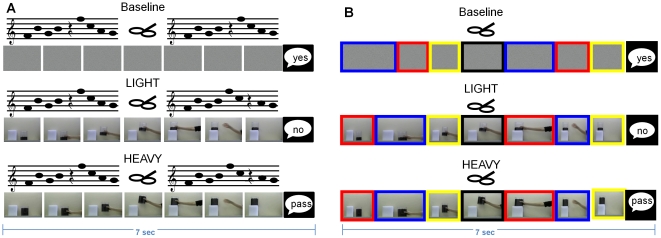
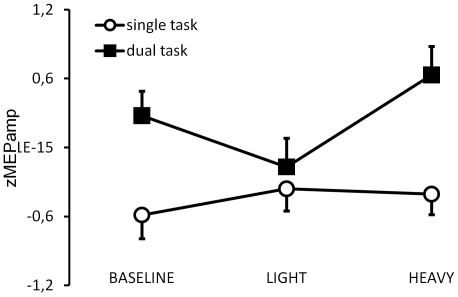
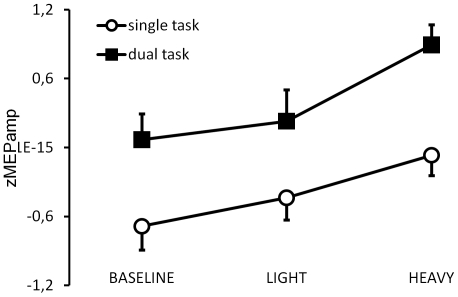
Movement observation (MO) has been shown to activate the motor cortex of the observer as indicated by an increase of corticomotor excitability for muscles involved in the observed actions. Moreover, behavioral work has strongly suggested that this process occurs in a near-automatic manner. Here we further tested this proposal by applying transcranial magnetic stimulation (TMS) when subjects observed how an actor lifted objects of different weights as a single or a dual task. The secondary task was either an auditory discrimination task (experiment 1) or a visual discrimination task (experiment 2). In experiment 1, we found that corticomotor excitability reflected the force requirements indicated in the observed movies (i.e. higher responses when the actor had to apply higher forces). Interestingly, this effect was found irrespective of whether MO was performed as a single or a dual task. By contrast, no such systematic modulations of corticomotor excitability were observed in experiment 2 when visual distracters were present. We conclude that interference effects might arise when MO is performed while competing visual stimuli are present. However, when a secondary task is situated in a different modality, neural responses are in line with the notion that the observers motor system responds in a near-automatic manner. This suggests that MO is a task with very low cognitive demands which might be a valuable supplement for rehabilitation training, particularly, in the acute phase after the incident or in patients suffering from attention deficits. However, it is important to keep in mind that visual distracters might interfere with the neural response in M1.
运动观察(MO)已被证明可以激活观察者的运动皮层,这表现为与观察到的动作相关的肌肉的皮质运动兴奋性增加。此外,行为研究强烈表明,这个过程是自动发生的。在这里,我们通过在受试者观察演员如何单手或双手举起不同重量的物体时应用经颅磁刺激(TMS)进一步测试了这个假设。次要任务是听觉辨别任务(实验 1)或视觉辨别任务(实验 2)。在实验 1 中,我们发现皮质运动兴奋性反映了观察到的电影中所指示的力的要求(即演员需要施加更大的力时,反应更大)。有趣的是,无论 MO 是作为单一任务还是双重任务进行,都可以观察到这种效果。相比之下,当存在视觉干扰物时,在实验 2 中,我们没有观察到皮质运动兴奋性的这种系统调节。我们得出结论,当 MO 在存在竞争视觉刺激的情况下进行时,可能会出现干扰效应。然而,当次要任务位于不同的模态中时,神经反应与观察者的运动系统以近乎自动的方式做出反应的观点是一致的。这表明 MO 是一项认知需求极低的任务,这可能是康复训练的一个有价值的补充,特别是在事件发生后的急性期或注意力缺陷的患者中。然而,需要记住的是,视觉干扰物可能会干扰 M1 中的神经反应。