Department of Neurology, Universidade Metropolitana de Santos, Santos, SP, Brazil.
Brain Struct Funct. 2012 Apr;217(2):473-83. doi: 10.1007/s00429-011-0359-0. Epub 2011 Nov 11.
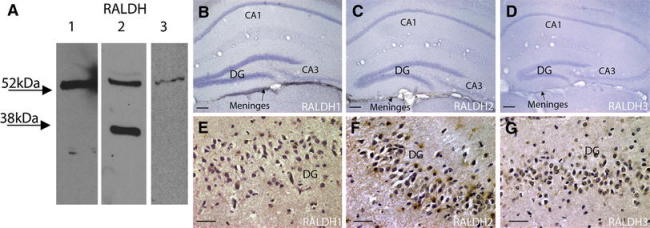
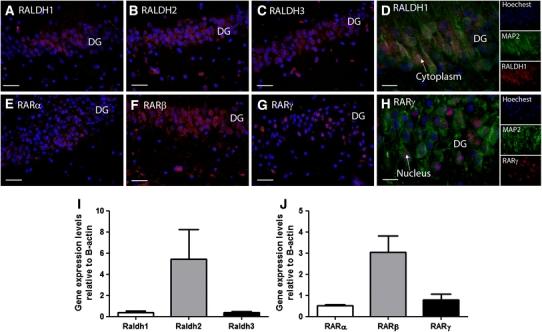
Retinoic acid, the active form of the nutrient vitamin A, regulates several facets of neuronal plasticity in the hippocampus, including neurogenesis and synaptic strength, acting via specific retinoic acid receptors (RARs). Essential for conversion of vitamin A to retinoic acid is the enzyme retinaldehyde dehydrogenase (RALDH) and in the rodent hippocampus this is only present in the adjacent meninges where it must act as a locally released paracrine hormone. Little is known though about the expression of RALDHs and RARs in the human hippocampus. This study confirms that RALDH levels are very low in mouse neurons but, surprisingly, strong expression of RALDH protein is detected by immunohistochemistry in hippocampal neurons. The receptors RARα, β and γ were also detected, each receptor exhibiting differing subcellular locations implying their potential regulation of both transcription and non-genomic actions. These results imply an essential function of retinoic acid in the human hippocampus likely to include regulation of neuronal plasticity.
视黄酸是营养维生素 A 的活性形式,通过特定的视黄酸受体 (RAR) 调节海马体中的几个神经元可塑性方面,包括神经发生和突触强度。将维生素 A 转化为视黄酸所必需的是视黄醛脱氢酶 (RALDH),而在啮齿动物的海马体中,这种酶仅存在于相邻的脑膜中,它必须作为局部释放的旁分泌激素发挥作用。然而,关于 RALDH 和 RAR 在人海马体中的表达知之甚少。这项研究证实,RALDH 水平在小鼠神经元中非常低,但令人惊讶的是,免疫组织化学检测到海马体神经元中 RALDH 蛋白的强烈表达。还检测到受体 RARα、β 和 γ,每个受体都表现出不同的亚细胞位置,这意味着它们可能调节转录和非基因组作用。这些结果表明视黄酸在人海马体中具有重要功能,可能包括调节神经元可塑性。