Department of Pediatrics, University of Minnesota Medical School, Minneapolis, Minnesota, USA.
Obesity (Silver Spring). 2012 Feb;20(2):364-70. doi: 10.1038/oby.2011.337. Epub 2011 Nov 10.
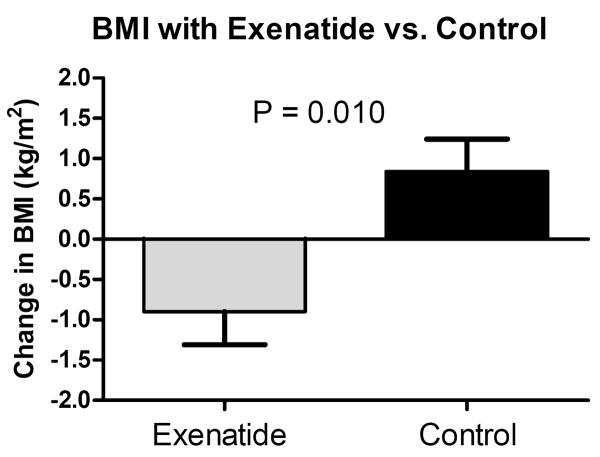
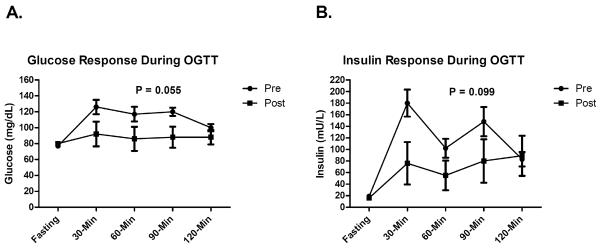
The objective of this pilot study was to evaluate the effects of exenatide on BMI (primary endpoint) and cardiometabolic risk factors in nondiabetic youth with extreme obesity. Twelve children and adolescents (age 9-16 years old) with extreme obesity (BMI ≥1.2 times the 95th percentile or BMI ≥35 kg/m(2)) were enrolled in a 6-month, randomized, open-label, crossover, clinical trial consisting of two, 3-month phases: (i) a control phase of lifestyle modification and (ii) a drug phase of lifestyle modification plus exenatide. Participants were equally randomized to phase-order (i.e., starting with control or drug therapy) then crossed-over to the other treatment. BMI, body fat percentage, blood pressure, lipids, oral glucose tolerance tests (OGTT), adipokines, plasma biomarkers of endothelial activation, and endothelial function were assessed at baseline, 3-, and 6-months. The mean change over each 3-month phase was compared between treatments. Compared to control, exenatide significantly reduced BMI (-1.7 kg/m(2), 95% confidence interval (CI) (-3.0, -0.4), P = 0.01), body weight (-3.9 kg, 95% CI (-7.11, -0.69), P = 0.02), and fasting insulin (-7.5 mU/l, 95% CI (-13.71, -1.37), P = 0.02). Significant improvements were observed for OGTT-derived insulin sensitivity (P = 0.02) and β-cell function (P = 0.03). Compliance with the injection regimen was excellent (≥94%) and exenatide was generally well-tolerated (the most common adverse event was mild nausea in 36%). These preliminary data suggest that exenatide should be evaluated in larger, well-controlled trials for its ability to reduce BMI and improve cardiometabolic risk factors in youth with extreme obesity.
本初步研究的目的是评估艾塞那肽对非糖尿病肥胖青少年的体重指数(主要终点)和心血管代谢危险因素的影响。12 名肥胖青少年(年龄 9-16 岁,体重指数≥1.2 倍第 95 百分位数或 BMI≥35kg/m(2))参与了一项为期 6 个月、随机、开放标签、交叉临床试验,包括两个 3 个月的阶段:(i)生活方式改变的对照阶段,(ii)生活方式改变加用艾塞那肽的药物阶段。参与者按照随机顺序(即,开始接受对照或药物治疗)分为两组,然后交叉至另一治疗组。在基线、3 个月和 6 个月时评估体重指数、体脂百分比、血压、血脂、口服葡萄糖耐量试验(OGTT)、脂肪因子、血浆内皮激活标志物和内皮功能。比较两种治疗方法在每个 3 个月阶段的平均变化。与对照相比,艾塞那肽显著降低了体重指数(-1.7kg/m(2),95%置信区间(CI)(-3.0,-0.4),P=0.01)、体重(-3.9kg,95%CI(-7.11,-0.69),P=0.02)和空腹胰岛素(-7.5mU/l,95%CI(-13.71,-1.37),P=0.02)。OGTT 衍生的胰岛素敏感性(P=0.02)和β细胞功能(P=0.03)也有显著改善。注射方案的依从性极好(≥94%),艾塞那肽通常耐受性良好(最常见的不良反应是 36%的轻度恶心)。这些初步数据表明,艾塞那肽应在更大的、对照良好的试验中评估其降低肥胖青少年体重指数和改善心血管代谢危险因素的能力。